



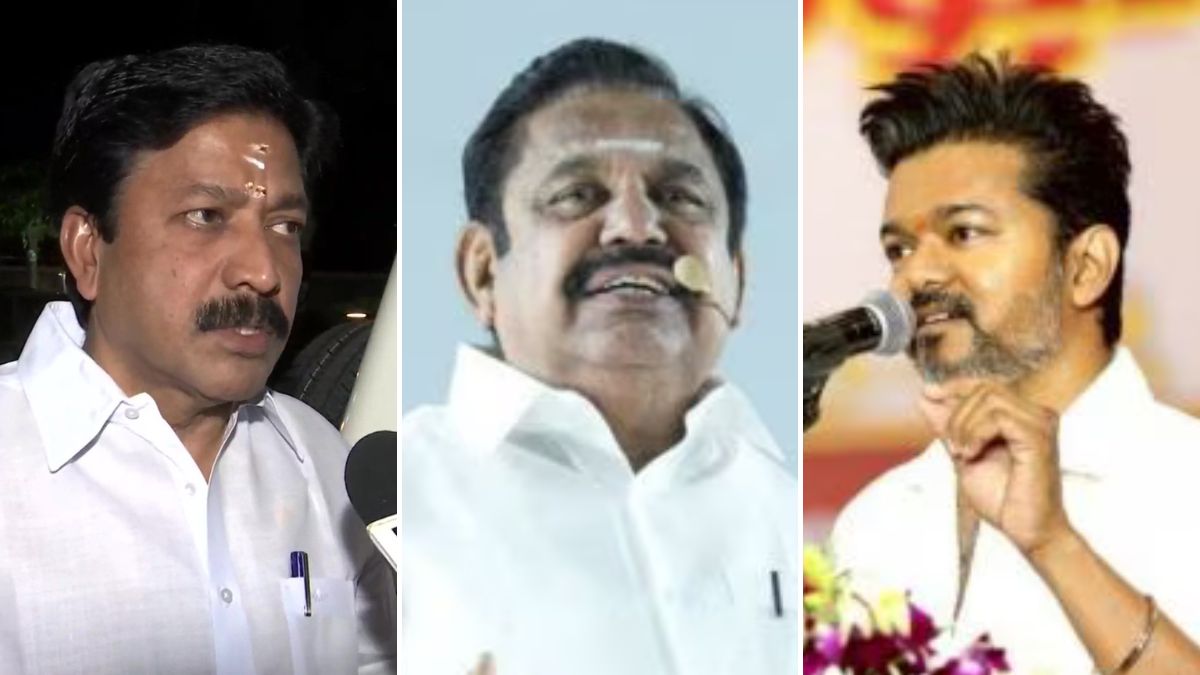
Days after the idea of a possible post-poll tie up, the AIADMK-DMK collapsed and Chief Minister C. Joseph Vijay’s Tamilaga Vettri Kazhagam (TVK) emerged with a majority as the internal rift within the 55-year old Dravidian major, founded by matinee idol M.G. Ramachandran and helmed by J. Jayalalithaa, has hit a new high.
The AIADMK’s failure to secure more than 47 seats has not only hollowed out its institutional authority but has also served as the definitive catalyst for more than two-thirds of the MLAs pushing for a realignment toward the TVK.
In this post-April 2026 landscape, the state is witnessing the collapse of a traditional duopoly in favour of a new order, where the TVK exerts a dominant gravitational pull on the remnants of the old guard.
The current crisis is defined by a fundamental rupture between Edappadi K. Palaniswami (EPS) and a rapidly consolidating rebel bloc, an instability that suggests the AIADMK’s high-command model is no longer functional.
The party which ruled the state for more than 30 years since its formation seems to be heading for a historic split. A group of MLAs headed by former minister C.Ve. Shanmugam are openly challenging EPS and his authority.
In the AIADMK, leadership stability has historically served as the primary currency of institutional survival. Under the centralised command structures of its predecessors, the party operated through rigid patronage networks.
But after the 2026 elections, the erosion of this command and control mechanism threatens the AIADMK’s very existence.
EPS remains the general secretary on paper, but his operational reality suggests a leader presiding over a hollowed-out institution. The deterioration of his standing is punctuated by a stark divergence between official protocol and political fact—the many scenes that unfolded in the past one week, such as the AIADMK's resort politics, the majority of the power centres and the financial heavyweights in the party abandoning the high command.
The resort politics and the differences within the MLAs underscores a desperate and fragile attempt to maintain physical control over the party which has already witnessed an ideological and strategical drift, post Jayalalithaa.
This internal rift within the party reached a point of public visibility during the oath-taking ceremony for the 17th legislative Assembly, where the AIADMK legislators broke the decades-old tradition where members entered as a monolithic entity.
The members of the AIADMK instead appeared as two fractured groups: one following EPS, and another led by former ministers S.P. Velumani, Dr. C. Vijayabaskar, and C.Ve. Shanmugam.
The deliberate absence of veterans like Velumani and C. Ve. Shanmugham from the EPS group confirms the fragmentation. The rebel faction has now moved from quiet dissent to an overt demand.
Reportedly, the rebel group is pressurising EPS to voluntarily step down and restructure the party. This leadership vacuum is a direct consequence of EPS’s inability to deliver either electoral victory or a viable power-sharing arrangement with external actors.
“This failure was the final proof of EPS’s strategic obsolescence. By prioritising his personal title over a collective survival strategy, he effectively signalled the end of the AIADMK's relevance in this election. He did not listen to any of our pre-poll advice,” a former minister who is part of the rebel bloc told THE WEEK.
For AIADMK legislators that are a part of the rebel bloc, an alignment with the new government is viewed as practical for political survival rather than ideological continuity.
The shift represents an attempt to preserve local patronage networks by plugging into the new state power structure.
Out of the 47 AIADMK MLAs, between 30 and 36 have aligned with the rebels.
Despite their shared goal of ousting EPS, the rebel camp faces its own internal succession crisis. The lack of consensus between Velumani and Shanmugham suggests that this mutiny may be less about institutional renewal and more about a desperate rearrangement for ministerial access.
The BJP factor and the changing caste arithmetic in the party
Sources say the AIADMK’s fragmentation is accelerated by a Delhi-led attrition strategy and the stubborn realities of local social hierarchies. In fact, Delhi’s long-standing desire for a fractured post-Jayalalithaa AIADMK seems to be coming true with the current isolation of EPS.
The relationship between the BJP and EPS has reached a nadir, with the rebel camp citing two primary grievances—insults by EPS towards the senior BJP leadership during the 2024 Lok Sabha negotiations, and allocating 27 unwinnable seats to the BJP in the 2026 Assembly polls. These two are looked at as a deliberate move to minimise the national party’s footprint at the expense of the alliance’s health.
The AIADMK currently faces a binary choice—total institutional decay after five years in Opposition, or a compromise that facilitates participation in the TVK-led government.
This internal rift after the party’s failure in its 11th consecutive election since the demise of Jayalalithaa in 2016 is likely the endgame for the AIADMK in its traditional form.
The churn of 2026 signals that the era of the Dravidian duopoly has concluded, replaced by a TVK hegemony that has successfully co-opted the machinery of its predecessors. For the AIADMK, the choice is no longer between power and opposition, but between a controlled dissolution into the TVK order or total political irrelevance.
