



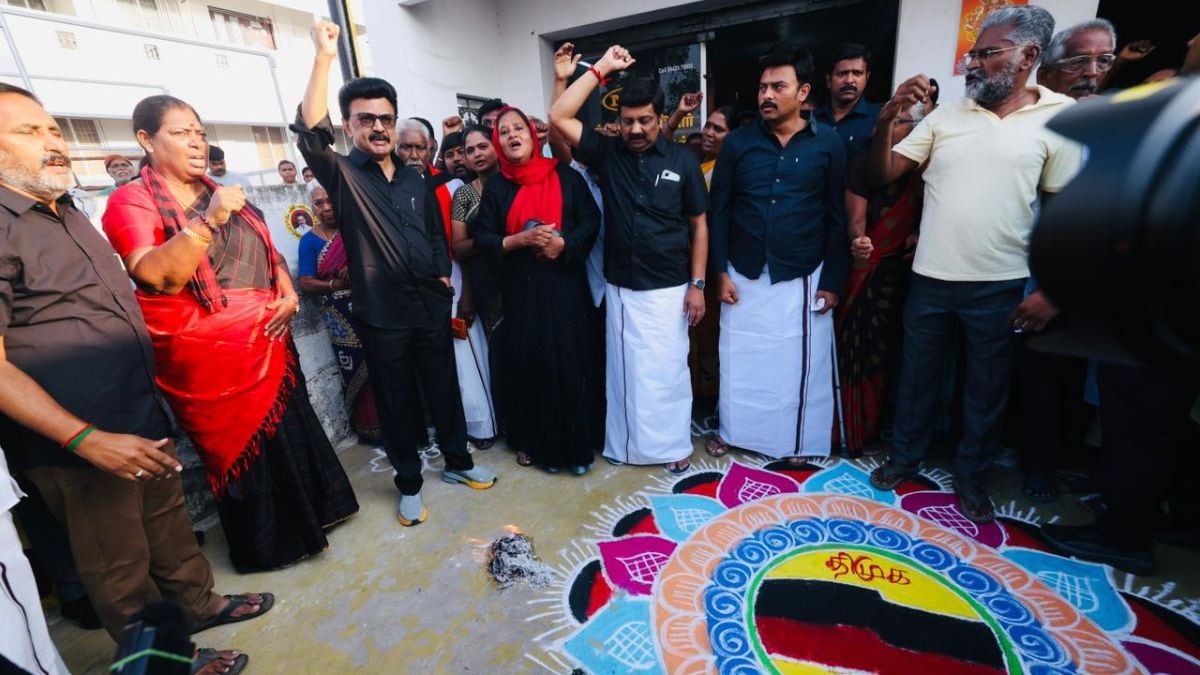
“Delimitation: Let the fire spread all over Tamil Nadu! Let the hubris of the BJP be defeated. The flames of anti-Hindi imposition had then burnt Delhi. It subsided only after Delhi’s capitulation,” Chief Minister M.K. Stalin wrote in a social media post on Thursday as he hosted a black flag in protest against the delimitation bill being tabled in the Parliament on Thursday.
Burning a copy of the draft, while being in an election campaign at Namakkal, Stalin described the Delimitation bill as a legislative move aimed at turning the Tamil people into refugees in their own country. Stalin said he is lighting yet another fire in protest.
“I am lighting yet another fire by burning the copy of the bill, which will turn the Tamil refugees in their own country. This fire will spread all over the Dravidian land and tame the arrogance of the BJP,” Stalin said. Soon, black flags were hoisted all across the state, in the DMK party offices and the houses of the leaders of the INDIA bloc.
This is not the first time Stalin has come out to protest against the Delimitation bill or the BJP-led central government’s idea of census exercise, delimitation and the women’s reservation, which has been linked to it. Stalin’s message, immediately after the BJP announced the convening of a special session of the parliament to debate and discuss the delimitation bill, quickly intensified the political temperature in the state.
While he has consistently framed the Tamil Nadu elections as a battle between the state and the Centre—or 'Tamil Nadu versus Delhi'—the proposed Delimitation Bill has provided a timely political tool for the DMK and its allies to challenge the BJP. On Wednesday, after convening an emergency meeting of DMK MPs and district secretaries, Stalin said the proposed delimitation exercise was a “grave danger” and likened it to a looming threat which had materialised now.
What is delimitation, and why is Stalin opposing it?
The Union BJP-led government proposed the Delimitation exercise in 2024, soon after Narendra Modi was sworn in as the prime minister for the third time in a row. Delimitation is the process of redrawing the boundaries of electoral constituencies across the country, by which the existing 543 Lok Sabha seats will be increased to 850 seats. Though the constitution allows only up to 550 seats, by this new proposition, the boundaries of the existing Lok Sabha constituencies will be redrawn, and the number of Lok Sabha seats will be increased to 850 - 815 for states and 35 for union territories. Though this exercise can be carried out only after every Census under Article 82 of the Constitution, it is argued that the demography of the country has changed with migration, urbanisation and even population growth.
While the BJP argues that the increase in numbers is done proportionally and it is based on the population growth, DMK argues that the exercise cannot be carried out now, as the census enumeration is still hanging in balance. In fact, Stalin had emerged as one of the strongest critics of delimitation, saying that it punishes the states which sincerely followed the centre’s population control measures.
Calling it a “bias” against the south Indian states, Stalin has been vociferous against the centre. He argues that the population-based seat redistribution will reduce the political weight of southern states like Tamil Nadu and increase the representation of the northern states which witnessed higher population growth in the past. He has also raised concerns that the shift and the increase in number could “disproportionately tilt power in the parliament” towards the northern states and widen the north-south divide.
Stalin says that the move “effectively punishes” the states that performed well on development indices. “Delimitation is an historic injustice to the people of the South,” Stalin argues. He strongly feels that delimitation at this juncture will only distort India’s federal structure. While positioning himself against the move and the BJP, Stalin had already rallied all the non-BJP ruled states and called for a united front. He had also warned of protests and political consequences if the centre goes ahead without consensus. He had also warned of protests and mass agitations, reminding of the days of the 1950s and 1960s against the centre, over state rights.
Being vociferous against the Centre, Stalin has positioned himself beyond party politics, making the developments mark a rapid escalation from rhetorical opposition to organised political mobilisation on the ground. And with elections round the corner, organising district secretaries' meeting, MPs meeting and the black flag protests and outreach within hours had only positioned him as the face of opposition against the BJP.
