



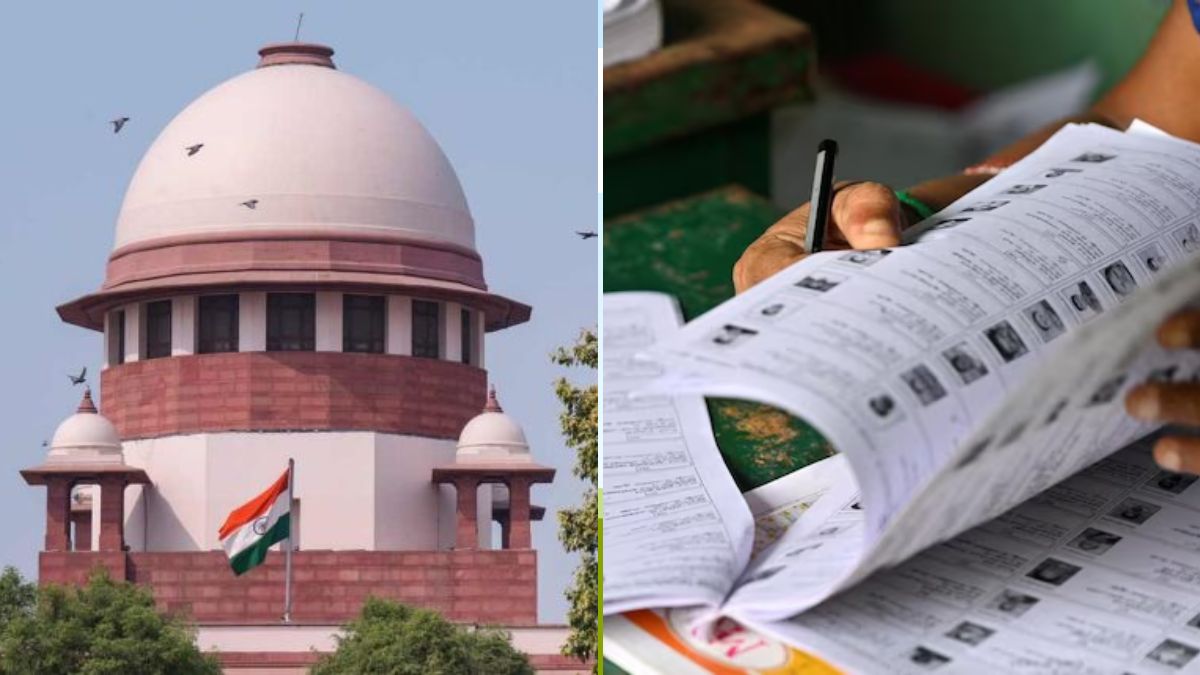
Giving huge relief to people of West Bengal, the Supreme Court stepped in to ensure clarity and fairness in the Special Intensive Revision (SIR) of electoral rolls, invoking its extraordinary powers under Article 142 of the Constitution to bring the process to a close before the upcoming Assembly elections.
In a significant direction, the court asked the Election Commission of India (ECI) to implement all appellate orders by April 21 or April 27, 2026, through a supplementary revised electoral roll.
This means that individuals who were initially excluded from the draft rolls but later cleared on appeal will now be able to vote in the elections.
The order, passed on April 13 but uploaded today, passed a slew of directions for the poll panel.
The order reads:
"We, therefore, invoke our powers under Article 142 of the Constitution of India and direct the ECI that, wherever the Appellate Tribunals are able to decide the appeals by 21.04.2026 or 27.04.2026, as the case may be, such appellate orders shall be given effect to by issuing a supplementary revised electoral roll, and all necessary consequences with respect to the right to vote shall follow. However, it goes without saying that the mere pendency of appeals preferred by excluded persons before the Appellate Tribunals shall not entitle them to exercise their right to vote."
"If such a scenario were to be permitted to subsist, the consequence would be that objectors may likewise seek denial of the right to vote to those individuals whose names appear in the revised electoral roll, but against whom such objectors have preferred appeals. The resultant situation would effectively recreate the very state of affairs that existed prior to the entrustment of the verification exercise to the Judicial Officers. This, in our considered view, cannot be permitted, particularly when Judicial Officers from the State of West Bengal, duly assisted by Judicial Officers from the States of Jharkhand and Odisha, have completed what can only be described as a truly herculean task within a remarkably short span of time," the order reads.
At the same time, the court drew a clear line on pending cases.
It clarified that those whose appeals are still undecided would not regain their voting rights for this election.
The judges pointed out that allowing such claims at this stage would disrupt the election process and create uncertainty.
The bench also issued a strong warning against attempts to reopen the entire exercise indirectly. It noted that once the appellate stage is over, fresh objections should not be entertained in a way that delays or derails the finalisation of the voter list.
The aim—the court stressed—is to ensure that the election process moves forward in a stable and predictable manner.
More importantly, the court acknowledged the scale and difficulty of the verification process.
It described the work carried out by judicial officers as a truly herculean task, noting that thousands of claims and objections had to be examined within a very short period.
The judges recognised that such an exercise required both speed and care, given that it directly affects a citizen’s right to vote.
The SIR exercise in West Bengal has been under scrutiny for weeks, with concerns raised about wrongful exclusions and the possibility of eligible voters being left out.
Petitioners had approached the Supreme Court seeking relief for those affected, and questioning the fairness of the process.
By invoking Article 142, the court effectively used its constitutional authority to render complete justice to the matter.
With the deadline now set, all eyes will be on the ECI to quickly publish the supplementary rolls and ensure that those cleared through appeals are included.
For many voters who were at risk of being excluded, the court’s intervention offers a final window to participate in the democratic process.
At the same time, the ruling makes it clear that the process cannot remain open-ended.
Elections—the court indicated—require certainty as much as they require fairness, and both must be protected together.
