



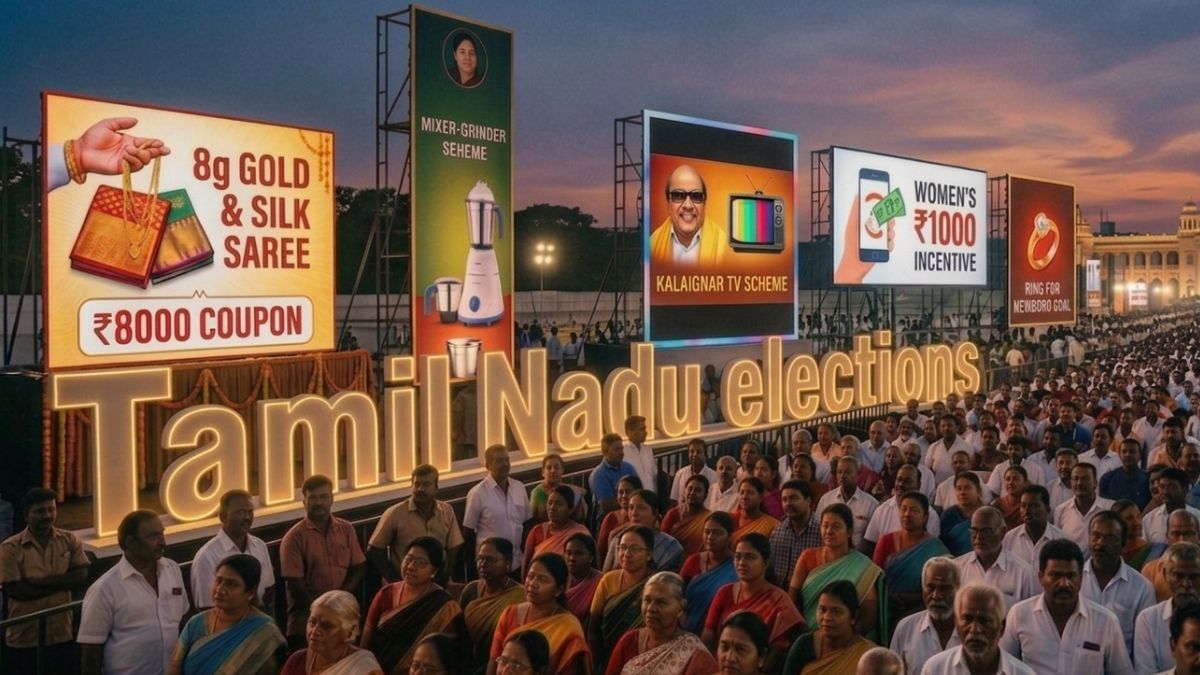
If mixies and wet grinders churned the Tamil Nadu politics of sops until a decade and a half ago, refrigerators, coupons worth Rs 8,000 to buy any household appliance, 8g of gold with a silk saree for women at the time of marriage, and a gold ring for newborn girls are parts of a long list of promises made by political parties in Tamil Nadu.
With just ten more days to go until voting, the Dravidian political landscape is witnessing a high-decibel campaign.
All the political parties—the two Dravidian majors AIADMK and the DMK, actor Vijay’s fledgling new party TVK, and Seeman’s NTK—are trying to lure voters with new promises and sops.
Except for Seeman and his Naam Tamilar Katchi (NTK), every other political party in the state has promised continuous cash transfers and welfare schemes if they come to power.
The ideological pivot: From principles to rice
In the early years, Tamil Nadu’s politics always mirrored the rest of the country. The 1952 elections were fought on the dry terrain of economic models and Nehruvian principles. However, the rules of the game began to shift with the rise of the DMK. By 1957, Tamil affinity became the new currency, but identity alone wasn't enough to sustain a movement.
The real tectonic shift occurred between 1962 and 1967. This was the moment the ballot box became inextricably linked to the cooking pot.
A severe scarcity of rice turned food security into the ultimate electoral weapon. The Congress party, once invincible, lost in 1967 largely because it could not guarantee a meal for common folk.
The scarcity of rice became an issue. Survival became the first brick in the welfare foundation, and no politician has been able to ignore it since.
This is when the rice scarcity fundamentally transformed Tamil Nadu's elections by shifting the focus from ideological debates to material welfare and food security.
This rice scarcity, combined with the rising sentiment of Tamil affinity introduced by the DMK, became a decisive electoral issue that felled the Congress party in the 1967 elections.
These rice politics of the 1960s laid the groundwork for the state's extensive welfare system. It established the expectation that the state must play an active role in the everyday life of its citizens by ensuring access to basic necessities.
By the 1970s and 80s, welfare began to move beyond the plate. In 1971, chief minister M. Karunanidhi introduced a remarkably personal form of intervention: free spectacles and cataract surgeries for the poor. It was a signal that the state was watching over the physical well-being of its citizens.
Following this era, successive leaders utilised food security to gain political legitimacy.
For instance, after former Tamil Nadu chief minister MGR took over in the late 1970s, he subsidised rice through the Public Distribution System (PDS) which was significantly widened and framed as a foundational state responsibility, rather than a discretionary benefit.
In his next term, he institutionalised this as a tool of political legitimacy. He expanded the Nutritious Meal Scheme in 1982, providing cooked mid-day meals to millions of children.
Critics called it a waste,but instead, it became a global case study in boosting school enrollment and child nutrition. MGR’s tenure saw the state provide free saris, dhotis, footwear for the those without it, and even free tooth powder.
Crucially, this era also introduced direct cash support.
The state moved to care for the unproductive members of society—a 30-rupee monthly dole for the destitute and a 50 to 100-rupee stipend for unemployed graduates.
These weren't just handouts; they were the beginnings of a cradle-to-grave infrastructure that shifted the perception of welfare from discretionary charity to a foundational state responsibility.
If rice politics set the tone for welfare in the 1960s, the promise of free colour television sets in 2006 by the DMK fundamentally altered electoral strategies by ushering in an era of consumerism and shifting the focus of political competition from ideology to tangible household goods.
“Before 2006, elections were fought among others on basic staples like rice. The 2006 election promise marked a point where the trend completely changed, moving welfare beyond basic needs into the realm of consumer items,” says R. Kannan, author and biographer of Dravidian leaders C.N. Annadurai and M.G. Ramachandran.
If the colour TV sets were a masterstroke of cultural engineering, it saw the the nature of welfare undergoing a sophisticated, consumerist mutation in 2011, as Jayalalithaa churned the state with her mixer-grinder-table fan offer. With this package, she did not just outbid her rival DMK, but also effectively targeted women engaged in domestic labour.
However, more than making women feel comfortable in grinding grains to make the idli or dosa batter, this offer aimed to reduce the time they spent in the kitchen.
Apart from that, the electoral promises and the subsidised two-wheelers she promised ensured that her party secured the unwavering loyalty of the women voters at the booth.
Later in 2021, the DMK turned this in their favour, by promising a direct cash transfer—a Rs 1000 monthly cash dole for women—in addition to a free bus ride.
The direct cash transfer tactic has now spread across the country under various names.
Indeed, from Delhi and Bihar to Karnataka and Maharashtra, every state now has a direct cash benefit scheme for women.
Now, with the state to head to the polls on April 23, tensions between the parties in the fray for the 2026 election have reached fever pitch, as they try outbidding each other.
The DMK has proposed Rs 8,000 household coupons and an expansion of breakfast schemes for older students. The AIADMK has responded with refrigerators and fuel support.
Among the promises, the most fascinating development is the dilemma of the disruptors. New political entrants like Vijay’s TVK have attempted to pivot toward a rhetoric.
At a time when Tamil Nadu’s total debt will touch an unusual high of Rs 10.71 lakh crore in 2027, implementing welfare schemes promised by the DMK in their manifesto could cost Rs 57,084 to the exchequer, while implementing the AIADMK’s promises could cost Rs 83,092 crore.
However, the biggest impact on the exchequer would be from the implementation of the promises made by Vijay's TVK: Rs 1,10,304 crore.
Vijay had promised one sovereign of gold for every girl getting married in the state. The state witnesses close to six lakh weddings in a year, on an average. TVK's promise of one sovereign of gold per wedding would itself set the exchequer back by about Rs 7,200 crores per year.
In Tamil Nadu, if political parties aren't promising to improve the voter's life in a tangible, material way, they may not be really in the race.
However, the promises have to ensure growth and the quality of life of the people, in order to translate into votes.
