



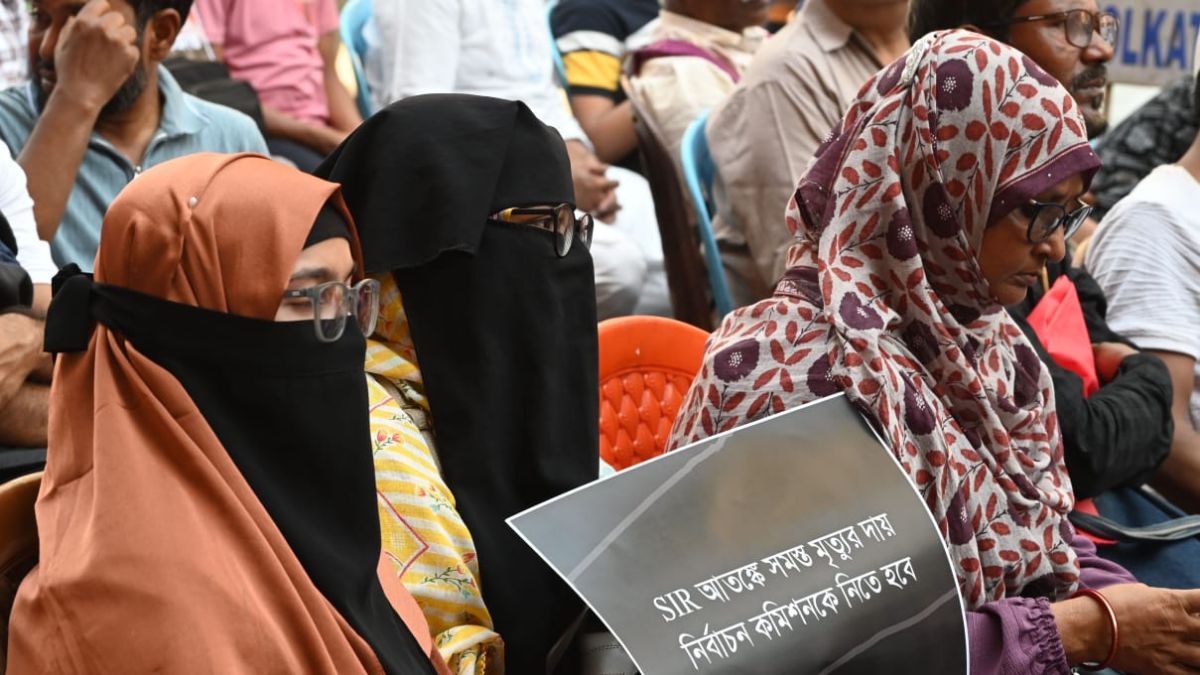
West Bengal’s Special Intensive Revision(SIR) exercise has raised a question on the fate of 27 lakh voters whose names have been cleared after being in the 'under adjudication' category.
The remaining 32 lakh odd names of the 60 lakh have been cleared. The electorate has slipped down further from 7.66 crore before the SIR to 7.04 after the final SIR list was released, to now 6.75 crore after the results of the under-adjudication cases came to light. This is a 12 per cent decline in the electorate.
Data analysis
A private research organisation found that since the start of the SIR, which is out of the 90 lakh odd deletions, there are more deletions from the Hindu Matua-dominated community that find their origins in Bangladesh.
North 24 Parganas district (Total – 1,71,448): Bagda - (50,230), Gaighata - (3,031), Bongaon North - (42,165), Bongaon South - (36,022)
Nadia district (Total – 71,273): Krishnaganj - (30,825), Ranaghat Dakshin –(40,448)
Total deletions from Matua dominated districts– 2,42,721
Deletions from Hindu minority community – 2,25,741
Deletions from Muslim minority community – 16,050
A breakup of the data across the state for 90 lakh deletions from the start of SIR suggests there are more Hindu deletions.
The data is as follows:
Absent, Shifted, Duplicate, Dead or ASDD – 58,20,896 (Approx 58 lakhs)
Hindu – 43,81,378 (approx 43 lakhs)
Muslim – 13,31,325 (approx 13 thousand)
Final SIR list (Feb 28) – 5,46,053 (approx 5 lakhs)
Hindu – 5,28,820 (approx 5 lakhs)
Muslim – 13,363 (approx 13 thousand)
Under Adjudication – 26,95,266 (approx 27 lakh)
Hindu – 8,37,116 (approx 8 lakhs)
Muslim – 17,65,475 (approx 17 lakhs)
Total deletions till date – 90,62,188 (approx 90 lakhs)
Percentage of deletion from Muslim community -34.32 per cent
Percentage of deletion from Hindu Community – 63.42 per cent
ECI Data
However, when the 'under adjudication' data was considered as per the data released by the Election Commission of India(ECI), the maximum deletions are from the minority dominated districts.
Murshidabad - (4,45,137)
North 24 Parganas - (3,25,666)
Malda - (2,39,975)
South 24 Parganas - (2,22,929)
Sabar Institute research data
Another private organisation, Sabar Institute, which looks at particularly minority representation in West Bengal, considering two key constituencies of Nandigram in East Midnapore district and Bhabanipur in Kolkata, data suggests maximum deletions are from the minority community: Nandigram with 94.5 per cent and Bhabanipur with 40.1 per cent. Hence, there are more deletions of the non-Muslim community from Bhabanipur. BJP leader Suvendu Adhikari is contesting from both seats, while Mamata is contesting only from Bhabanipur, which is her winning seat.
Nandigram (18 supplementary lists)
Total inclusions - 7,141 (Form 6, New voters)
Total deletions - 3,461
Net change - +3,680
Number of Muslim voters deleted - 3,270 or 94.5 per cent
Number of Non-Muslim voters deleted – 191 or 5.5 per cent
Bhabanipur (15 supplementary lists)
Total inclusions - 10,238 (Form 6, new voters)
Total deletions - 3,875
Net change - +6,363
Number of Muslim voters deleted - 1,554 or 40.1 per cent
Number of Non-Muslim voters deleted – 2,321 or 59.9 per cent
Muslim Population (census estimate) - 20 per cent of the total assembly population.
Sabar Institute believes that the Muslim minority community had better progeny mapping to the 2002 SIR list, when looking at the Muslim minority dominant districts. They were also found to be proportionately deleted in the Absent Shifted Dead Deleted(ASDD) list. But Logical Discrepancy(LD) was more arbitrary on a case-by-case basis, which included small anomalies.
“The Muslim population in Bhabanipur is 20 per cent and 22 per cent of ASDD were Muslims. It is close to that proportion. There is no bias or over-representation of any community. Muslims and non-Muslims are proportionately deleted. But in LD, which is very arbitrary, Muslims are massively overrepresented. 22 per cent were deleted in the ASDD list in Bhabanipur, and almost 52 per cent were Muslims in the LD list. What this trend shows is that Muslims have better mapping with all documents. They are not dead, shifted, or absent when the BLO(Booth Level Officer) came. They have submitted all documents to EC," says Ashin Chakraborty, an associate researcher at Sabar Institute.
LD was implemented only in the West Bengal SIR, which drastically overrepresented Muslims, unlike in the Bihar SIR, where no LD was implemented. “It is a drastic over-representation of Muslims despite them being in India for generations and having all documents. The data, hence, shows bias," added Chakraborty. The research team suggests misrepresentation of the Muslim community.
“Prima facie, it shows that Muslim’s names are disproportionately put under scrutiny, adjudicated and deleted. That is clear from the data," said Sabar Ahamed, the lead researcher at Sabar Institute.
“This raises serious concerns about how it was implemented, how AI was programmed so they(EC) can identify Muslim names," added Ahamed.
Reality Of SIR
Overall, concerns are raised about several deletions from the Muslim community. However, deletions from the non-Muslim communities also raise questions about the reasons behind these exclusions and the veracity of the overall SIR exercise conducted.
The fact remains that deleted voters are approaching the tribunal to include their names in the future voter list, even if they are not permitted to vote in the upcoming assembly elections in West Bengal, which is scheduled to be conducted on April 23 and 29.
The outcome of SIR will be a deciding factor for political parties that are targeting votes from both communities and constituency-wise demography, which are their respective strongholds.
