



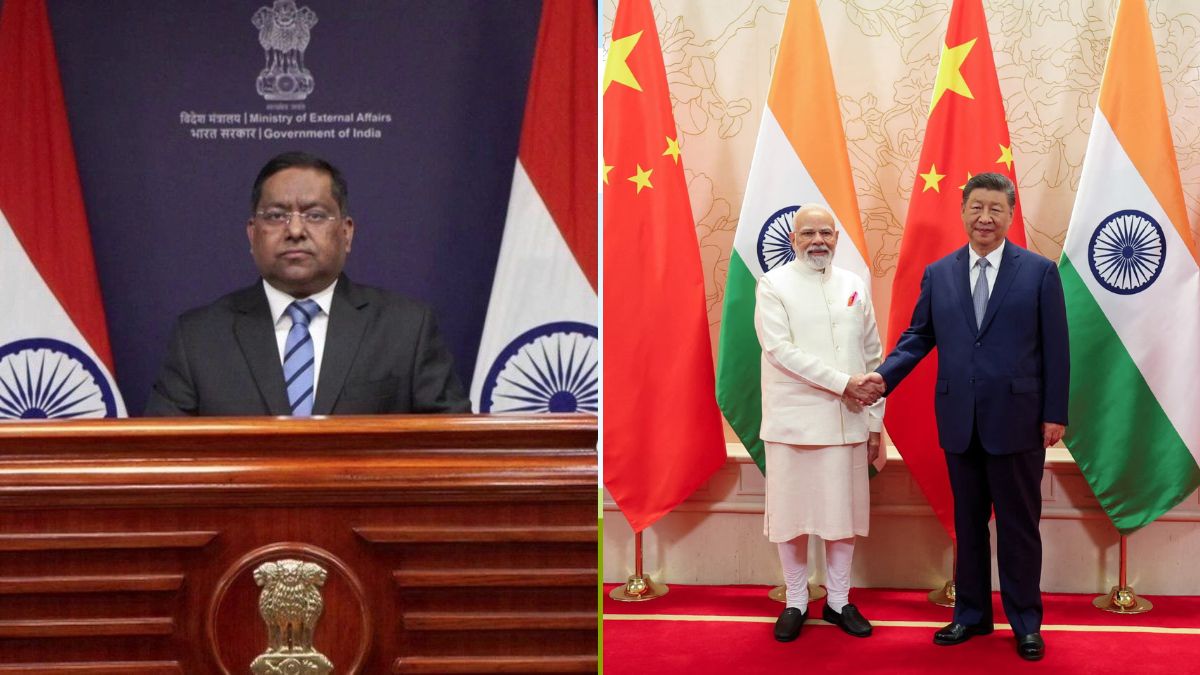
The Ministry of External Affairs (MEA) on Sunday rejected what it called China's attempts to rename Indian places with "fictitious" ones, marking the latest development in Beijing's administrative actions along shared borders.
"Such attempts by China at introducing false claims and manufacturing baseless narratives cannot alter the undeniable reality that these places and territories, including Arunachal Pradesh, were, are, and will always remain an integral and inalienable part of India," an MEA statement read.
It added that such disputes over nomenclature strained "ongoing efforts to stabilise and normalise India-China bilateral ties".
This comes hours after China set up a new county, named Cenling, in its volatile Xinjiang province near Pakistan-occupied Kashmir (PoK) and the the Afghanistan border.
Located near the Karakoram mountain range, the March 26 announcement about Cenling—followed by the April 12 establishment of the county—reportedly aims to beef up security along the narrow Wakhan Corridor, in order to stop Uyghur separatist militants from infiltrating China, as per a PTI report.
Cenling will be administered by the Kashgar prefecture, which is the starting point of the disputed $60 billion China-Pakistan Economic Corridor (CPEC), which passes through Pakistan-occupied-Kashmir (PoK), and has been opposed by India.
China's administrative move is seen as an emphasis on increasing its strategic influence and boosting its border security in the sensitive region.
Cenling is the third such county to be established by China in the volatile province of Xinjiang—primarily comprising Muslim Uyghurs—in just over a year.
This comes after China established the Hean and Hekang counties in the Hotan prefecture of the Xinjiang province, which India had protested last year.
Parts of Hean and Hekang overlap with parts of the Aksai Chin plateau, which have been under Chinese administration since the war in 1962, but remain a historically disputed area that India has always claimed belongs to Ladakh.
While proper administrative limits and borders for Cenling remain unknown, the alleged administrative encroachment remains a thorn in the side of thawing India-China relations, which had recently faced strain over the case of UK-based Indian Prema Wangjom Thongdok.
The woman had alleged mistreatment by Chinese officials during a November 21 transit flight at the Shanghai Pudong Airport.
Officials had reportedly declared her Indian passport “invalid” as it had mentioned Arunachal Pradesh as her birthplace—a place that it calls 'Zangnan', that it asserts is a part of China. She was later released after diplomatic intervention.
