



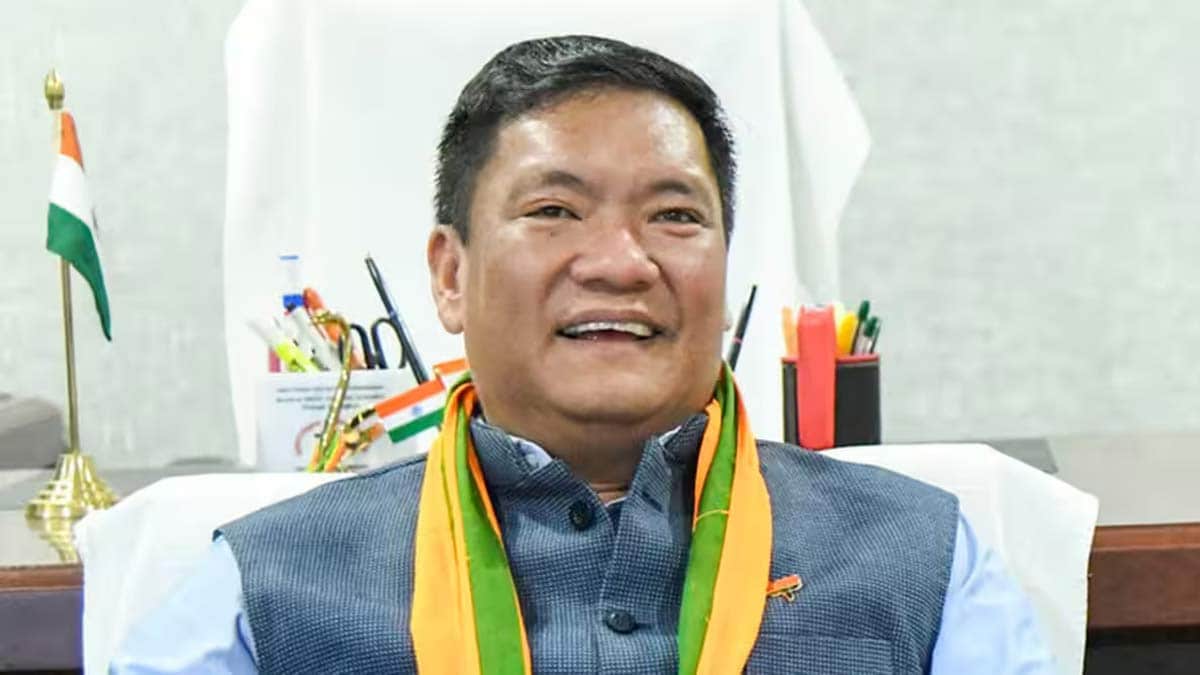
In a development with major political ramifications in the Northeast, the Supreme Court on Monday directed the Central Bureau of Investigation (CBI) to conduct a preliminary inquiry within 16 weeks into the awarding of public works contracts in Arunachal Pradesh to firms allegedly linked to Chief Minister Pema Khandu and his family.
The court’s order comes after hearing a public interest litigation by Save Mon Region Federation and Voluntary Arunachal Senaa on the large-scale irregularities and conflict of interest in the awarding of government contracts.
The case relates to allegations that government contracts worth around Rs 1,270 crore were awarded over the past decade to four firms linked to Khandu or his family members, including his wife, mother and brother from November 2015 to 2025.
The petitioner alleged that the contracts were awarded in violation of the norms and raised concerns about cartelisation and a lack of transparency in the tendering process.
A bench headed by Justice Vikram Nath, after hearing arguments and examining affidavits filed by the Arunachal Pradesh government, directed the CBI to register a preliminary inquiry to examine whether there were irregularities or corruption in the awarding of contracts.
The court had earlier sought a comprehensive affidavit from the state government detailing all public works contracts awarded to firms linked to the chief minister’s relatives across districts between 2015 and 2025, indicating the seriousness with which it was examining the allegations.
During earlier hearings, the court had also commented on what it described as a remarkable coincidence in the tender process, noting that the difference between competing bids in several cases appeared to be minimal, which raised suspicions of cartelisation.
The allegations were brought before the court by a civil society organisation, which claimed that lucrative public works contracts were repeatedly awarded to firms linked to the chief minister’s family, raising questions about conflict of interest and misuse of office. The petition also alleged that auditing and oversight mechanisms had failed to properly examine the contracts.
Political implications
The Supreme Court’s order is politically significant for multiple reasons. Arunachal Pradesh has been a politically sensitive border state where the Bharatiya Janata Party (BJP), led by Chief Minister Pema Khandu, has maintained a strong political hold. Any corruption probe involving the chief minister’s family could have implications for the BJP’s image in the Northeast, a region where the party has expanded rapidly over the past decade.
At the same time, the Supreme Court ordered only a preliminary inquiry, and not a full-fledged FIR or investigation yet, indicating that the court wants the CBI to first determine whether a cognisable offence is made out.
Legally, a preliminary inquiry is conducted to assess whether there is sufficient material to register a formal case. If the preliminary inquiry finds evidence of wrongdoing and leads to a formal CBI investigation, it could become a major political controversy not only in the state but also at the national level.
The case is also significant because it involves questions of conflict of interest in public procurement, an issue that has increasingly come under judicial scrutiny in recent years.
The CBI is now expected to conduct the preliminary inquiry and submit its findings, after which further legal and political developments will depend on whether the agency finds material to proceed with a formal investigation.
