



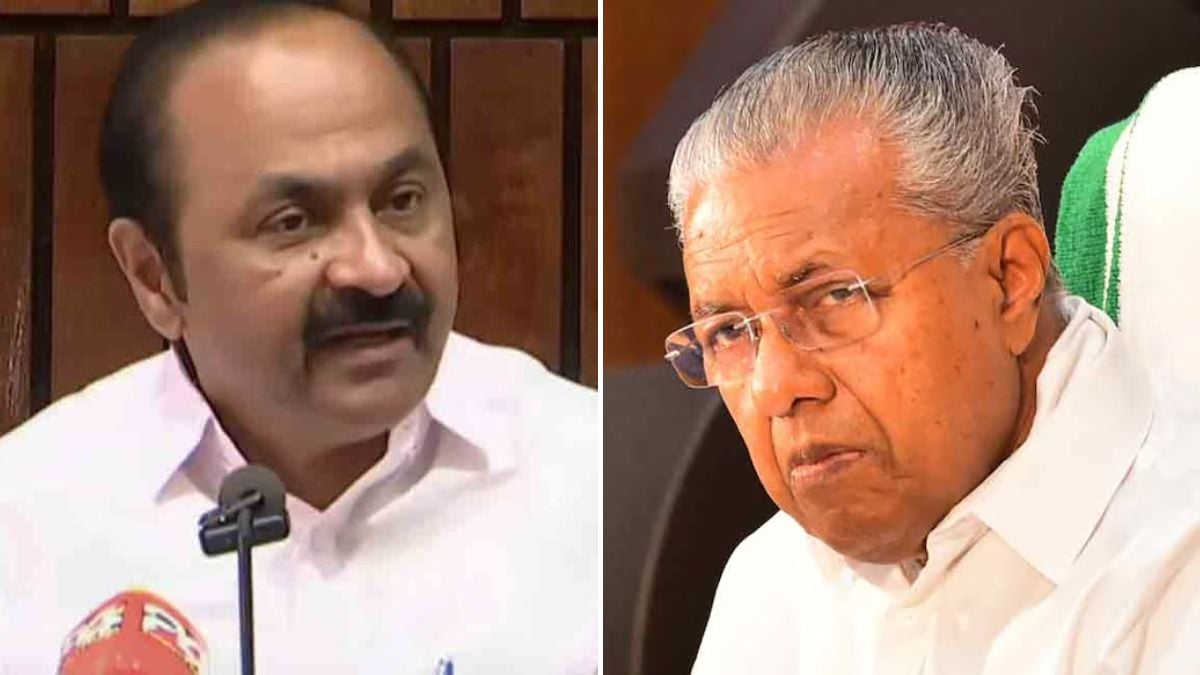
With just two weeks left for polling, allegations of a “secret deal” between the ruling LDF and the BJP have emerged as a major political flashpoint in Kerala. The Palakkad Assembly constituency—where the contest is primarily between the BJP and the UDF—has become the epicentre of a narrative pushed by the UDF.
Opposition Leader and UDF chairman V. D. Satheesan reignited the controversy, alleging “adjustment politics” between the BJP and the CPI(M) following candidate announcements by all three fronts. His primary charge was that the LDF had fielded a candidate in Palakkad to split the UDF vote and indirectly aid the BJP. The Congress leadership subsequently expanded the claim, alleging that in several constituencies the NDA, too, was engaging in “adjustment politics” by fielding weak candidates to benefit the LDF.
As the narrative gained traction, Chief Minister Pinarayi Vijayan responded on March 24, dismissing the allegation and countering that it was the Congress that had no qualms about an understanding with the RSS.
“The Leader of the Opposition says there is a ‘deal’ in every constituency… In Palakkad, the LDF candidate is a Muslim. Is that why they are calling it a deal? In 1996, the LDF had won the Palakkad constituency. Who was the candidate then? Noushad. He too was a Muslim,” Vijayan said.
In this context, THE WEEK analyses the UDF’s allegations and what the constituency dynamics suggest.
Strategic seating?
The BJP has emerged as the runner-up in the last three Assembly elections, including the 2024 bypoll, in the Palakkad constituency. The constituency’s demographic composition has played a pivotal role in this performance. The urban belt has a Hindu-majority population, with communities such as the Moothan, Nair, Tamil Brahmins and Chettiyars forming a significant portion of the electorate. The Moothan community—traders with roots in Tamil Nadu’s Kongu belt—has also been a reliable BJP vote bank.
The BJP has, in fact, won the Palakkad municipality three consecutive times, most recently in 2024. However, its power weakens outside the municipality, where both the UDF and the LDF try to keep control—especially in areas like Pirayiri, which has a large minority population.
With Palakkad remaining a tightly contested seat, the Congress now alleges that the LDF’s decision to field N.M. Razak, a businessman, is aimed at splitting minority votes and thereby aiding the BJP.
The UDF now alleges a similar pattern in the NDA’s candidate selection, claiming it indirectly benefits the LDF.
Generosity redefined?
In 2021, the BJP contested 115 seats but failed to win any. In 2026, it is contesting only 97 seats. Notably, the party has allotted 19 seats to its new ally, the Twenty20 Party (TTP)—a corporate-backed outfit with primary influence in Ernakulam district. Meanwhile, the BDJS, formed in 2015 with the backing of the SNDP Yogam leadership representing the Ezhava community and the second-largest NDA constituent in Kerala, has been given 23 seats, along with one seat for an independent candidate.
The BDJS, which contested 21 seats in 2021, had reportedly sought 40 seats this time. Despite having a presence across the state, it secured only a marginal increase, while the TTP—whose influence is largely confined to pockets in Ernakulam—was allotted a significant share. The UDF cites this distribution to argue that the seat-sharing arrangement reflects a “shady deal.”
Notably, in 2021, as many as 50 constituencies recorded victory margins of less than 10,000 votes. The BJP finished second in nine constituencies, including Manjeshwar, Kasaragod, Palakkad, Chathannur, Nemom and Kazhakootam. These are among the A-class constituencies where the party is pinning strong hopes of victory this time.
There were 11 constituencies where the victory margin was less than 10,000 but BJP’s vote was over 20,000.
Nevertheless, the BJP has ceded some key and symbolically important constituencies among them to the TTP. For instance, in Thripunithura, the BJP polled 29,843 votes in 2016, when the CPI(M) won the seat with a narrow margin of just over 4,000 votes over the Congress. In 2021, the BJP secured 23,756 votes, and the Congress won by a margin of just 1,992 votes. The constituency remains a key bipolar contest between the CPI(M) and the Congress, but the BJP has handed it over to the TTP this time, raising questions about possible vote transfer.
Konni is another key seat where the UDF alleges an “adjustment.” The BJP polled over 30,000 votes in both the 2019 by-election and the 2021 Assembly election, when senior leader K. Surendran was the candidate. In 2021, the CPI(M) won the seat with a margin of 8,508 votes. This time, however, the seat has been allotted to the BDJS. Meanwhile, in Ranni—which includes the Sabarimala pilgrim centre—the NDA candidate from the TTP stated that the Sabarimala gold controversy would not be an election issue, a remark the Congress interprets as indirectly benefiting the CPI(M)-led LDF.
In Ettumanoor, where Devaswom Minister V.N. Vasavan of the CPI(M) is seeking re-election, the seat has been allotted to the TTP, which struggled to field a candidate after its initial nominee was not there in voters list. The constituency’s Ezhava vote dynamics could be crucial this time, as both Vasavan and the Congress candidate, Nattakom Suresh, belong to the community. In 2016, the BDJS—drawing primarily from the Ezhava base—contested here and secured 27,540 votes. In 2021, the BJP took over the seat, but its vote share dropped by around 10 percentage points. This time, however, the seat has not been given to the BDJS again but to the TTP, which the UDF suspects as a move to avoid further splitting Ezhava and other Hindu votes and help the LDF.
Benefit plan
There are 51 seats where the LDF has remained undefeated since 2011—the first election after delimitation. The UDF is banking on a wave and consolidation of minority votes in its favour to overcome this historical trend and win the election. The narrative of a tacit understanding between the BJP and the CPI(M), is apparently a move to fuel this potential consolidation.
So far, the UDF has been effective in turning this into a central talking point, while also putting both the CPI(M) and the BJP on the defensive. Nevertheless, in the coming days, one can expect countermeasures—particularly from the CPI(M)—to project that no such deal exists and to reinforce its projection as the principal anti-BJP force in Kerala and beyond.
