



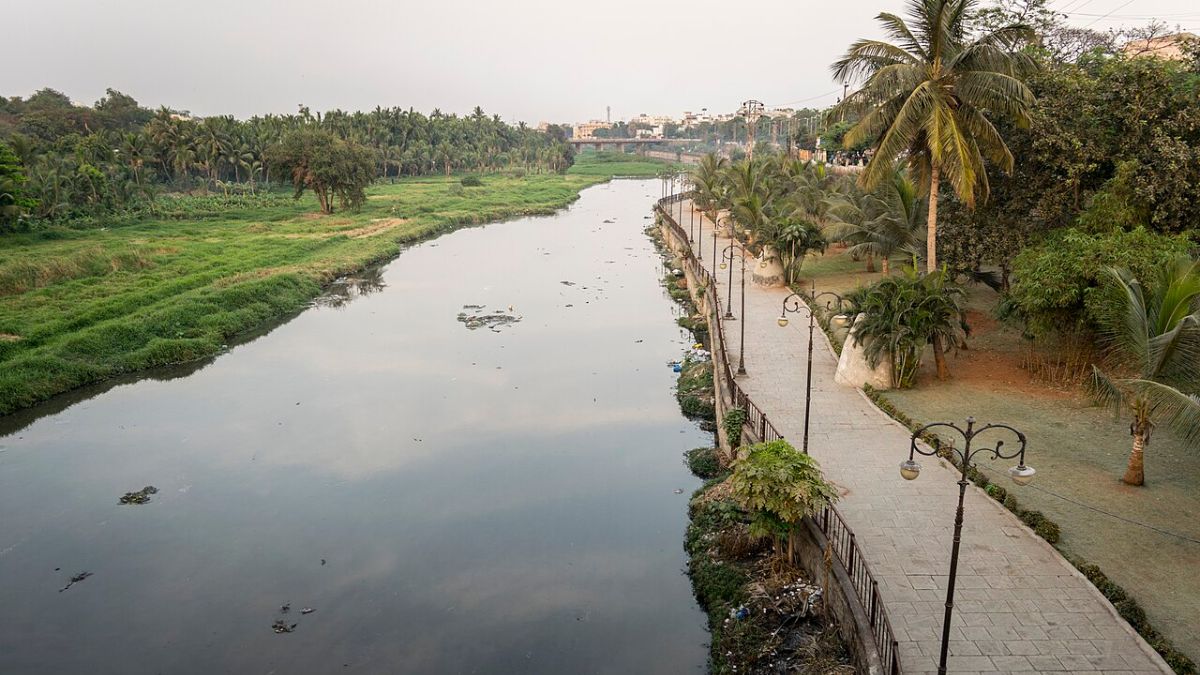
Stunning his friends and foes alike, Telangana Chief Minister A. Revanth Reddy has announced the details of the Musi River embankment and beautification project on March 13 in a gathering of city public representatives, officials, leaders of construction companies, and dozens of journalists at the 'Musi Invites' event in Hyderabad. In his passionate one-hour speech, the CM touched upon different aspects, mostly the disputes, of the project and explained how this project could change the face of Hyderabad and serve as a tourism and investment magnet.
Musi is a river formed after the merger of Musa and Esa streams at Langar Houz in Hyderabad. Musa originates in Ananthagiri Hills and Esa in Parigi Hills. They fill the Osman Sagar and Himayat Sagar lakes developed by Mir Osman Ali Khan, Nizam the seventh, before merging and forming the Musi River. Then Musi cuts the Greater Hyderabad region into two parts. The current issues the river is facing is severe pollution and lack of deep-enough flow path and supporting embankment. Due to these issues, the river causes floods and has also become a cesspool.
Going by the publicly available data, this could become the longest urban river embankment project in the world once completed. The full project targets the entire 55 km stretch of the Musi River flowing through Hyderabad (from upstream reservoirs like Osman Sagar/Gandipet and Himayat Sagar to downstream areas near the Outer Ring Road junction). Presently, the Ravi River embankment project (46 km) in Lahore, Pakistan, stands as the world’s longest. The Sabarmati Riverfront project is being extended from present 11 km to 38 km. CM Revanth Reddy has visited the iconic Thames in London, the Singapore River project in Singapore, the Sumida River embankment in Tokyo and Cheonggyecheon Stream in Seoul and sent official teams to study the granular details of their infrastructure.
The CM has spoken about the historical necessity to embank the river that often causes severe flooding and turn it into a clear flowing water body from its current state of an unrecognisable cesspool. “In 1908, the Musi floods killed more than 15,000 people. The then ruler Mir Osman Ali Khan, Nizam the seventh, built the Osman Sagar and Himayat Sagar to contain water flowing from Musa and Esa streams. When a king could think about Musi more than a century ago, why can’t we do it today? It’s high time we act and save the river for our own sake,” he appealed.
Revanth Reddy made it clear that no family would be left uncompensated. He informed that all the 10,000 families were enumerated, houses were being allocated, and all the compensation that they should get would be given. “We are working on their livelihood opportunities. Why can’t the opposition parties suggest to us what should be done for these families?” he questioned. Without naming the parties, he blasted the Bharat Rashtra Samiti and the BJP for “blindly opposing the project.”
He stated that the developed Musi riverfront would change the face of Hyderabad city, attract daily visitors and tourists and transform the city into an investment magnet. He questioned the BRS and the BJP to spell out their reasons for the opposition to the project. “We have studied similar projects across the world. Called the global tenders to select top-class consultants to advise on construction and financial models. We are working on relocation and rehabilitation of the families living in subhuman conditions. Your ideas are most welcome, tell me what should be done,” he explained.
Revanth Reddy challenged the opposition leaders to live on the Musi banks if they think poor families should live there. I will provide container houses with all the facilities. I dare these leaders to live with their family members for three months, he said, adding that these families have been suffering from health issues and the lack of basic infrastructure.
Before the chief minister’s speech, Musi Riverfront Development Corporation Managing Director E.V. Narsimha Reddy made an elaborate presentation for about 90 minutes, touching upon hydrology of the river, global benchmarks of urban embankment, flood management and east-west mobility corridor, among other topics.
Narsimha Reddy showed the flood simulations how the proposed embankment could stabilise the flow. “We are 100 per cent preparing the banks to face the highest flood possibilities. The height of the banks is designed for one in 10 years,” he said. To ensure the year-long flow, the MRDC is going to revive 1,000 lakes in the city and link them to the Musi River. As the lakes overflow, they release water to the lake next in the chain and finally they join the Musi, he shared.
The embankment would have only public spaces and roads, as per the recommendations of the Central Water Commission. The 55-km banks would have a six-lane road on one side and a service road on the other side. This road decreases between the upstream and downstream sections based on terrain and urban needs. The project is being implemented in five phases, with Phase 1 focusing on a 21-km stretch (approximately 9.5-11.8 km from Osman Sagar/Gandipet to Bapu Ghat and 9.2-11.5 km from Himayat Sagar to Gandhi Sarovar, converging at Bapu Ghat, where Mahatma Gandhi's ashes were placed in 1948, along with another 10 cities.
This phase includes key components like river cleaning (sewage interception and no inflows), silt and debris removal, hydrology-based riverbed profiling, flood mitigation walls/embankments, slope stabilisation, public promenades, parks, recreational spaces, heritage tourism, 24x7 economic zones, mobility enhancements (east-west corridor), sustainable urban integration and a proposed 123-ft Mahatma Gandhi statue.
The tentative cost for Phase 1 is estimated at Rs 6,500–7,000 crore (excluding land acquisition and Transferable Development Rights costs; Gandhi Sarovar component worth Rs 200–250 crore and statue worth Rs 70–75 crore, which is less than 2 per cent of total). Funding includes in-principle approval from the Asian Development Bank for around Rs 4,100 crore (final approval pending), with implementation via public-private partnership mode and global tenders. Land acquisition has begun in key areas, tenders have been invited for rejuvenation works. The overall vision positions Musi as a model for global urban riverfronts.
