



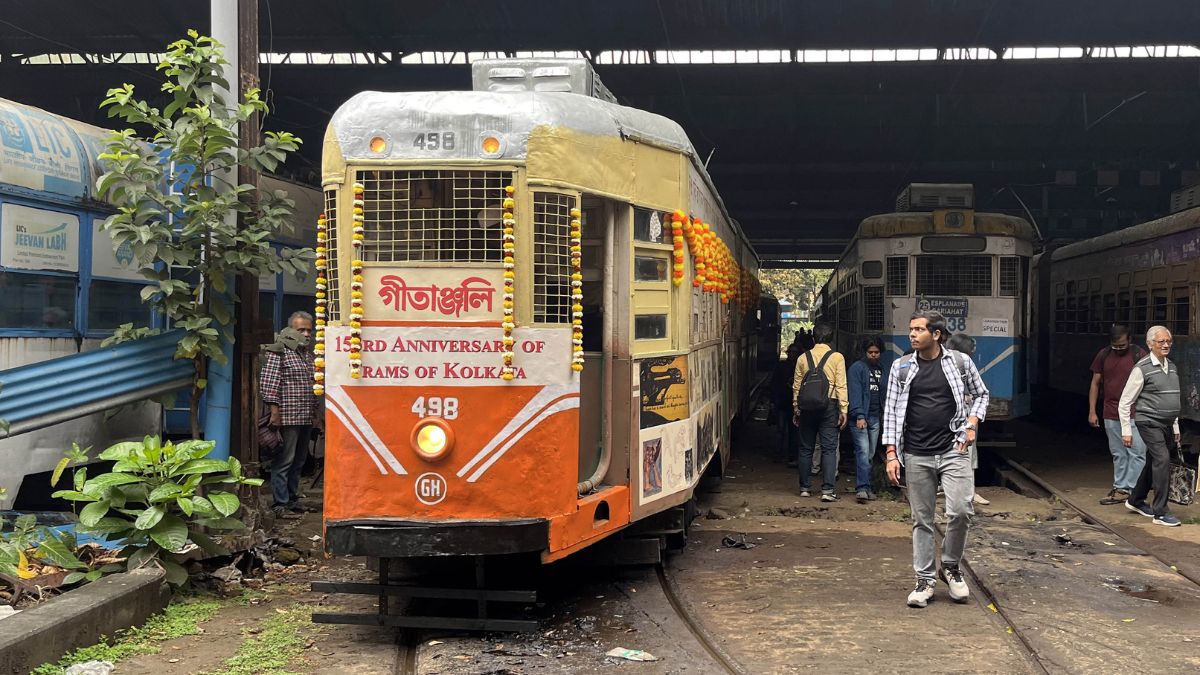
February 24 marks the anniversary of the first tramcar introduced in Kolkata in 1873. To celebrate the occasion, a decorated World War-II era wooden-bodied tram rolled out on Tuesday morning from the Gariahat tram depot to Shyambazar via Esplanade, making passersby at once curious and nostalgic.

Much more than a mode of transport, the tram is a moving symbol of the city’s layered history and a witness to many landmark events. Its criss-cross of steel tracks and overhead wires once connected large parts of the metropolis. Today, only a handful of routes are operational and the tramcars are few and far between. If one wanted to take a ride, one would have to Google the time and location in order to know how to catch it.
The tram has been critiqued for being slow, adding to traffic congestion, and causing bike accidents by skidding wheels on iron tracks. Threats of closure have beleaguered it as a result. However, the birthday celebration augurs well for the tram.
A heritage tram named “Gitanjali”, built during World War II at the Nonapukur workshop, was at the centre of the celebration. According to Sagnik Gupta, Joint Secretary of the Calcutta Tram Users Association, trams were once manufactured under difficult circumstances during the war. The Japanese air raids on Kolkata led to blackouts which meant that work at the depot had to be done by candlelight.
“Gitanjali” stopped its commercial passenger service in the 1980s. It later functioned as a staff tram connecting depots such as Khidirpur and Tollygunge. There were nearly 7,000 employees who worked within the system back then. Of the two such staff cars, one has been preserved as a souvenir, while the other restored one was declared a heritage tram in 2014 and is available for hire.
Tram lovers contend that since the infrastructure still exists across the city, why the city doesn’t reclaim this environment-friendly mode of transport. At a time when metropolises across the world are reintroducing the electric tram to flight pollution, they question the apathy of the authorities to in reinstating it.
