



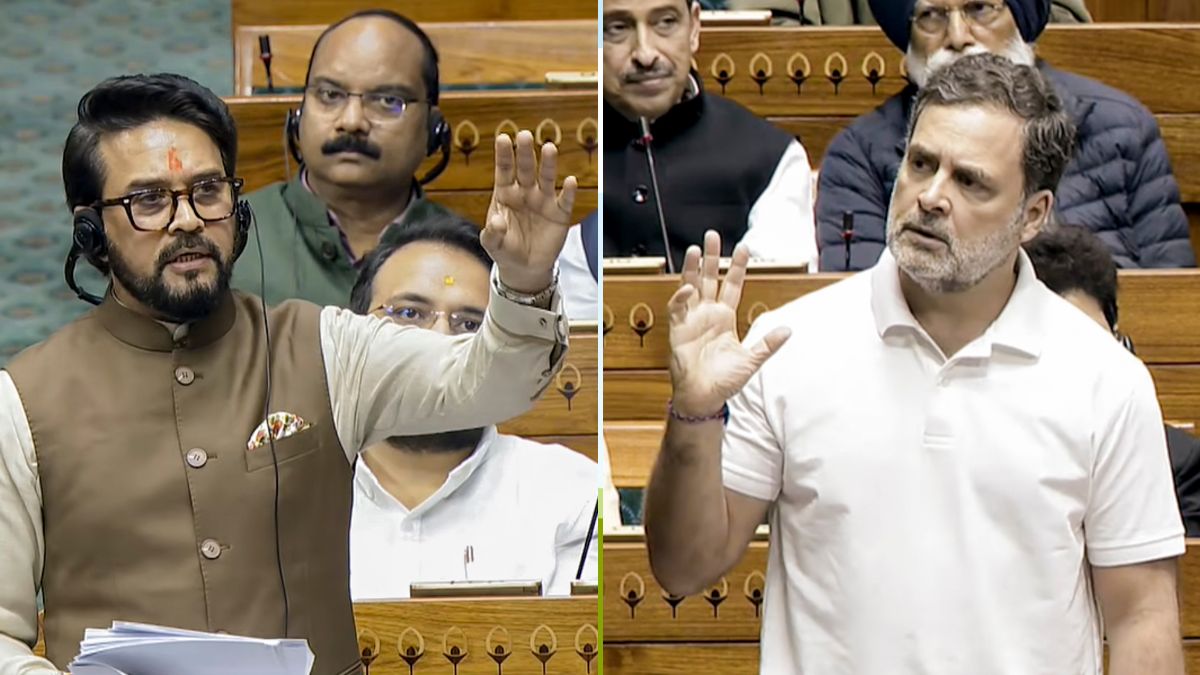
The Lok Sabha witnessed sharp exchanges during the discussion on the Union Budget, with Leader of the Opposition Rahul Gandhi launching a scathing attack of the government’s economic and geopolitical approach, especially on the issue of budgetary provisions and the India US trade deal. He accused the government of selling out.
During the discussion, when BJP MP Anurag Thakur rose to respond, Congress staged a walkout, setting the stage for a combative government defence.
Parliamentary Affairs Minister Kiren Rijiju also intervened during the debate, asserting that Prime Minister Narendra Modi remains the “strongest Prime Minister of this country”, while rejecting the Opposition’s allegations.
Rahul Gandhi’s arguments
Rahul Gandhi framed his argument through a martial-arts metaphor.
“In martial arts, everything begins with a grip. Without a grip, nothing happens. Grip leads to choke, and choke leads to surrender,” he said, adding that while such moves are visible in sport, “in politics the grip and choke are hidden".
Drawing on the Economic Survey, Gandhi argued that the world was entering a period marked by “intensifying geopolitical conflict” and the “weaponisation of energy and finance”, signalling a transition from "a world of stability to a world of instability”.
Referring to wars in Ukraine and West Asia, he said that global developments contradicted earlier claims that the era of wars had ended, asserting instead that “we are moving into the era of war”.
He warned that artificial intelligence could significantly disrupt India’s employment landscape, stating that “the idea of becoming a software engineer ... is going to be challenged” and that many software professionals could be replaced.
Gandhi identified India’s fundamental strengths as “our people ... our data ... our food supply ... and our energy system”, but argued that despite acknowledging global instability, “there is absolutely nothing in the Budget” addressing geopolitical risk, energy vulnerability or financial weaponisation.
A central focus of his speech was the India-US interim trade understanding.
Gandhi alleged India had “given up control over digital trade rules”, removed “the need for data localisation”, enabled “free data flow to the United States”, limited digital taxation, and granted long tax concessions to major firms.
He linked these developments to broader domestic consequences, warning that tariff structures could damage sectors such as textiles and agriculture, claiming farmers now face intense competition from US imports and that the domestic textile industry has been severely hit.
Escalating his criticism, Gandhi alleged the arrangement compromised India’s strategic autonomy, suggesting the United States could determine “whom we buy oil from”.
He described the outcome as a “wholesale surrender” and accused the government of having “sold India” and “sold our mother, Bharat Mata”. He added that an INDIA bloc government would have insisted on equal treatment in negotiations with Washington.
During the speech, treasury bench members repeatedly objected to what they termed unsubstantiated allegations, when Gandhi repeatedly referred to Epstein files. The Chair expunged those remarks. Gandhi said he possessed documentary evidence and was prepared to authenticate his claims.
Government’s counterattack
Responding after the Opposition walkout, Anurag Thakur mounted a forceful defence of the government and Prime Minister Modi. Taking a direct swipe at Gandhi, he said the Congress leader earlier left the House midway through speeches but had now “started leaving even before the speech begins”, adding that “those who are used to speaking lies cannot stand for long”.
Thakur said Gandhi had “not woken up for a long time” to India’s transformation and urged members to compare “the helpless India of the past with the strong India of today”.
Rejecting the martial-arts analogy, he argued the Opposition had instead exposed its own weakness and accused previous Congress-led governments of crippling the economy through corruption, while asserting that under Modi, India had emerged as the world’s fourth-largest economy.
Praising Finance Minister Nirmala Sitharaman’s Budget as historic, he said it had given “140 crore Indians a reason to smile” and described Indian women as “born economists with rare foresight and natural accountants by instinct".
He characterised the Budget as “a continuation of a 12-year reform journey” that moved India from “policy paralysis to policy performance”, “leakage to delivery”, and “corruption to confidence”, contrasting earlier governments that ran schemes with a present administration that builds systems and shifts governance from file movement to fund movement.
Listing achievements since 2014, Thakur cited transparent allocation processes, higher public capital expenditure, increased agricultural spending, rising per-capita income, declining poverty and expanding women’s workforce participation, asserting that 25 crore people had been lifted out of poverty.
He also criticised the Congress on women’s representation, alleging leadership remained confined to one family while women MPs were pushed to the forefront of protests.
