



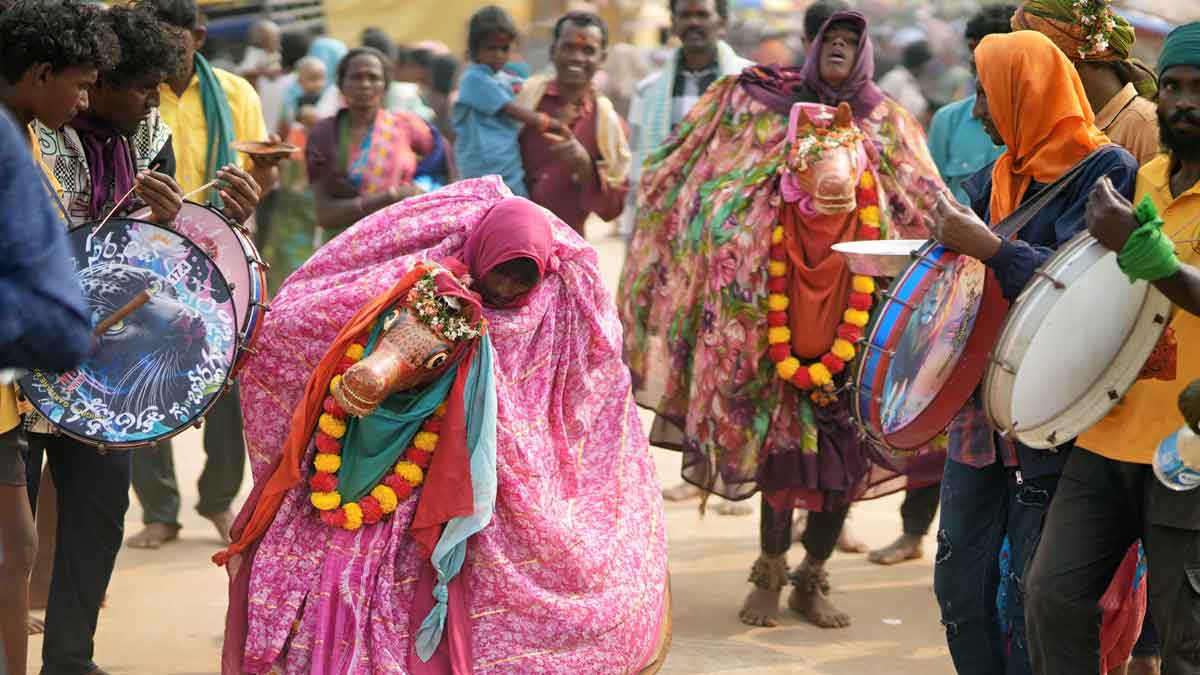
The four-day festival, popularly known as Medaram Maha Jatara, is being held from January 28 to 31 in Telangana and is expected to draw more than three crore pilgrims.
The Jatara commemorates the valour and sacrifice of Sammakka and Saralamma, the mother–daughter duo revered as Vana Devatalu or forest goddesses, along with their family members, Pagididda Raju, Govinda Raju and Jampanna.
Though Koya oral traditions trace the festival’s origins back several centuries, organised celebrations are believed to have begun around the 1950s. At the time, the gathering reportedly drew barely 2,000 pilgrims, of whom nearly 1,500 belonged to the Koya tribe. The turning point came in 1996, when the then-united Andhra Pradesh government declared it a state festival. Increased patronage and large-scale infrastructure development since then have transformed Medaram into what is today considered the largest tribal congregation in the world.
According to the Telangana government, more than three crore devotees are expected during the four days. Pilgrims have arrived from Telangana, Andhra Pradesh, Chhattisgarh, Odisha, Karnataka, Maharashtra, Kerala, Tamil Nadu and Pondicherry. To ensure smooth conduct, the state has deployed more than 5,000 police personnel and thousands of officials from various departments.
Medaram lies within the Mulugu Reserve Forest, an area that was once under strong Maoist influence. Reflecting the dramatic change in ground realities, a massive Maoist memorial column located at Kannepalli has now been painted green. Now, about 80 per cent of it is in green and the remaining in red with a sickle and hammer above it. A local scribe doubted that it could be painted red again in another 30 days. Time will have to tell.
The Jatara is rooted in a popular legend. According to it, around the 13th century, a tribal chief discovered a newborn girl glowing with divine light while playing fearlessly among wild animals. She was adopted and named Sammakka. She later married Pagididda Raju, a tribal chieftain serving under the Kakatiya rulers of Warangal, and the couple had three children — Sarakka, Nagulamma and Jampanna.
Legend says a prolonged drought later devastated the region, drying up the Godavari River and preventing the payment of tribute to King Pratapa Rudra. The Kakatiya army was dispatched to enforce collection, triggering a fierce battle on the banks of Sampenga Vaagu, a tributary of the Godavari. Despite valiant resistance, the tribal forces were defeated, and several members of Sammakka’s family lost their lives.
Sammakka is believed to have entered the battlefield herself, rejecting peace offers and fighting with extraordinary courage. Gravely wounded, she assured her people that she would protect them as long as they remembered her before disappearing into the forest at Chilakalagutta. Unable to bear the loss of his family, her son Jampanna is believed to have sacrificed his life in Sampenga Vaagu, which later came to be known as Jampanna Vaagu in his memory.
Despite evolving into a massive Hindu religious gathering, the rituals and traditions of the Jatara remain firmly under the control of the Koya community, which does not believe in idol worship. Sammakka and other deities are represented only through Gaddelu — small earthen mounds. Devotees offer jaggery, called gold in local parlance, coconuts and prayers at these sacred platforms, believing the divine presence manifests there temporarily during the festival. The Gaddelu symbolise the intimate bond between the goddess, the earth and forest life.

The festival remains strikingly autonomous in practice. Animal sacrifice takes place openly, and alcohol is sold alongside cold drinks in local shops. There are no restrictions on the consumption of non-vegetarian food or liquor.
Speaking to the media on the first day, Telangana rural development minister and Mulugu MLA D. Anasuya Seethakka said the Medaram tradition has remained intact despite large-scale development. This year, the state government spent about ₹250 crore on infrastructure works and deployed thousands of staff across departments.
The Jatara unfolds through a series of sacred rituals. It begins with ceremonies performed by tribal priests in the forest, followed by the ceremonial arrival of Saralamma from Kannepalli and Sammakka from Chilakalagutta to Medaram. Devotees gather in vast numbers to offer jaggery, coconuts and prayers at the Gaddelu. The central days mark the symbolic reunion of the mother and daughter and the peak of worship. Pagididda Raju and Govinda Raju are believed to arrive from Kondai, a nearby forest hamlet traditionally associated with their worship.
It concludes on Magha Pournami. On this day, after the final rituals, the symbolic representations of Sammakka and Saralamma are ceremonially sent back to the forest — Sammakka to Chilakalagutta and Saralamma to Kannepalli. This ritual, known as Vanapravesam, marks the end of the festival and the return of the deities to their sacred forest abodes.
A striking feature is the large number of transgender people who could be seen at the festival. They consider themselves manifestations of Siva and Sakti and are colloquially known as Sivasattulu.
Sravani, a transgender devotee from Warangal, said they believe Sakti enters their bodies and summons them to the Gaddelu. She added that she avoids entering Jampanna Vaagu or going near the Sammakka shrine, fearing possession. They visit the Gaddelu in small groups whenever they feel called by the goddess.
Despite crores of people believing in the legend circulated through the media and books, the Koya people do not subscribe to it, and they have their own version. Chanda Gopal Rao, a priest at the Sammakka shrine, said the mainstream narrative was not acceptable to the community as it was constructed for mass consumption by non-tribal writers.
According to Koya songs, Sammakka was neither a queen nor did she fight the Kakatiyas. She opposed exploitation by unnamed rulers or doralu. Govinda Raju, he said, was not Saralamma’s husband but a relative. Though the Koyas do not oppose the legend and the festival’s growth, they wish to preserve their own version of the tradition.
In whichever direction one approaches the festival, it continues to hold its intrigue and mystic aura. The ocean of humanity and temporary pilgrim city that appears for four days in the middle of a reserve forest leave people in a forever amazement. Either due to devote nature or sheer curiosity in the people and nature, Sammakka-Sarakka Jatara could only grow on us and engulf us before we even realise. One can only get flooded and lost in the festival, which is nothing but an ocean of humanity.
