



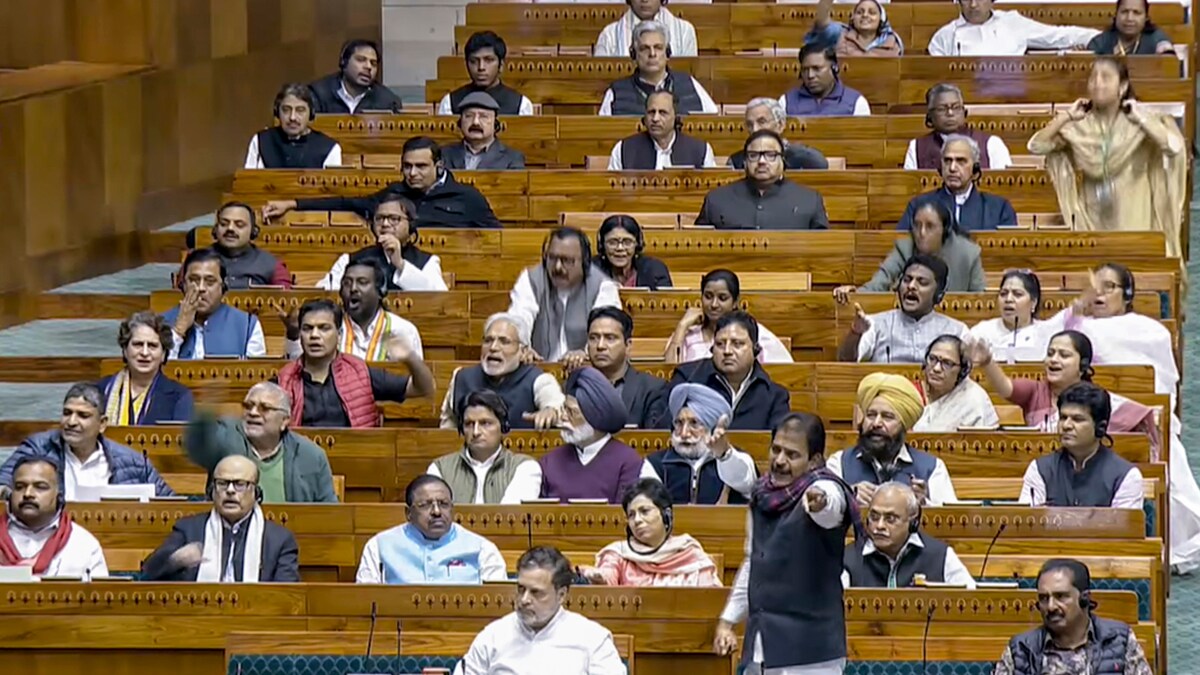
A discussion on electoral reforms in Lok Sabha turned into a political flashpoint on Tuesday when Rahul Gandhi declared the Election Commission captured and accused the Bharatiya Janata Party-led Union government of colluding in vote theft. The Opposition slammed the legality of the ongoing Special Intensive Revision (SIR) of electoral rolls, flagged large-scale voter deletions, and demanded structural reforms, warning that democracy itself is at risk if the poll body continues functioning without independence.
Rahul Gandhi set the tone with a sweeping indictment of the government and the institutions he claimed had come under its influence. Wearing khadi, an intentional political symbol, Gandhi argued that India's democracy derives its moral force from its people, and no government has the right to tamper with their mandate. In a broadside against the RSS, he alleged that the organisation had captured educational institutions, investigative agencies, and now, the Election Commission. “The Election Commission of India is also captured,” he declared. “The government is using the EC to destroy democracy.”
Gandhi’s attack sharpened when he turned to the removal of the Chief Justice of India from the selection panel for Election Commissioners, a provision brought in through the new Chief Election Commissioner and Other Election Commissioners Act. “Why was the CJI removed from the panel? Why is the prime minister so keen on choosing the same people he wants as Election Commissioners?” he asked, calling the decision a deliberate dilution of institutional independence.
The Congress leader also questioned the legality of destroying CCTV footage of strong rooms after 45 days and demanded unrestricted access to Electronic Voting Machines (EVMs) in the context of alleged irregularities in the Haryana elections. “It is not just about data,” he said. “It is about stealing the data. 'Vote chori' is an anti-national act.”
BJP MP Nishikant Dubey accused the Congress and Samajwadi Party of misleading millions about mass voter deletions. “If SIR is illegal, why did Congress governments conduct it for years? Why did states ruled by Congress and Trinamool Congress submit their SIR data this year without objection?” he asked.
Other Congress leaders reinforced this narrative. MP Manish Tewari argued that the Election Commission was meant to work in an unbiased manner, but it doesn’t look like these days, a paradoxical remark that he used to question the poll body’s neutrality. He insisted that the ECI had no legal backing to conduct the SIR under Section 21 of the Representation of the People Act. Calling the exercise a grey zone operation, he asserted that the country has a right to know how it is being conducted.
The Congress reiterated three core demands: reform of the EC selection process to include the Leader of Opposition and the CJI, an immediate halt to the SIR, and a bar on pre-poll direct benefit transfers, which Tewari described as against democracy.
Echoing the Congress, Samajwadi Party chief Akhilesh Yadav compared the SIR in Uttar Pradesh to National Register of Citizens (NRC)-style operation. “They are doing NRC-like work,” he alleged, warning that disenfranchisement through voter deletions would be the biggest blow to electoral trust. He advocated a return to paper ballots or, at a minimum, a stronger VVPAT-based verification regime.
Trinamool Congress MP Kalyan Banerjee sharpened the critique further, claiming that Booth Level Officers were under extreme pressure, leading to stress and even suicides. Questioning whether the Election Commission could take away voting rights through mass deletions, he warned that now the government decides who will be their voters.
From Maharashtra, Nationalist Congress Party (SP) leader Supriya Sule pointed to selective inaction by the state election authorities. “People are caught red-handed with cash, but no action is taken,” she said, noting that 25 candidates had won unopposed in local polls without any scrutiny from the Commission.
The government has so far rejected the Opposition’s allegations, insisting that the SIR is a routine annual exercise and that the EC functions independently. But the cumulative force of the Opposition’s arguments, especially Gandhi’s framing of electoral integrity as a national-security issue, ensured that the debate resonated far beyond the Lok Sabha chamber.
Rahul Gandhi’s charge of vote chori may have been the headline, but the broader message from the Opposition was equally pointed: electoral reforms must begin with restoring the autonomy and credibility of the Election Commission itself.
