



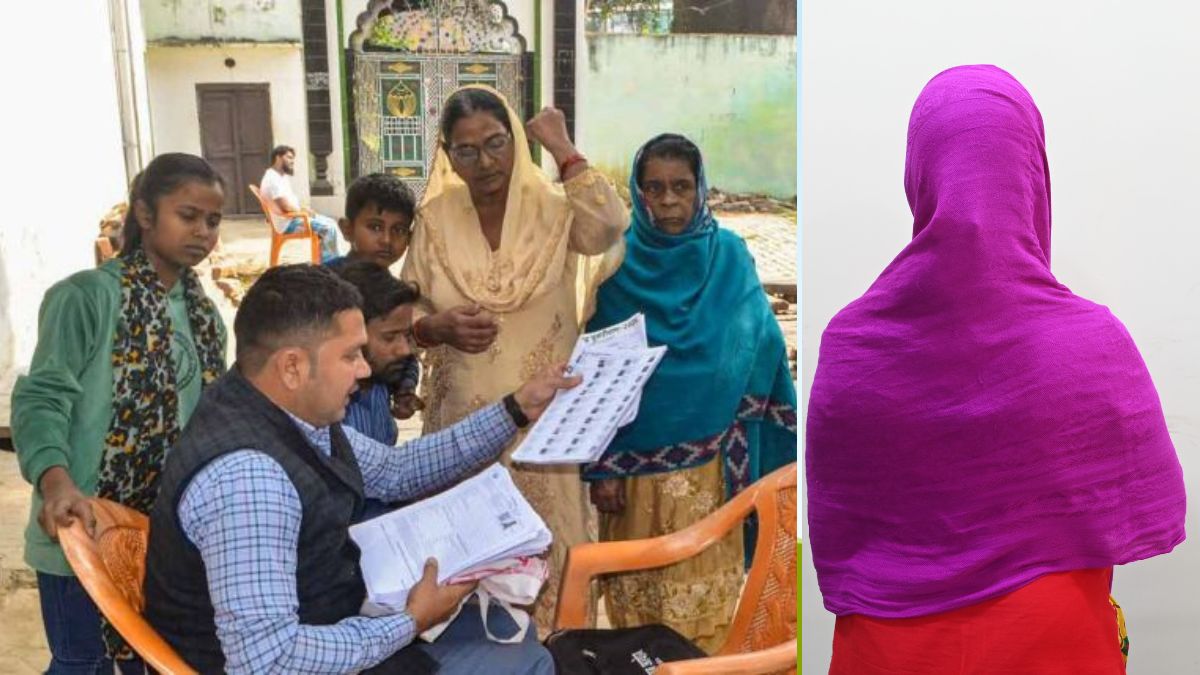
“I wonder where to get the documents to establish connection with my family in the 2002 SIR (Special Intensive Revision) list as I am not on good terms with them. The documents are with me as I am voting from Kolkata. I am looking for a solution, as I’m not in touch with them, and they won’t give me documents. And what will happen to those sex workers are illiterate?” remarked Bina Mondol, a sex worker in Sonagachi, a red light area in Kolkata.
From running around for documents to establishing a connection with family members for the SIR that is underway in West Bengal, sex workers and their children already feel marginalised, with the electoral process leaving many worried and traumatised.
Many like Bina have lost touch with their family members, while some have been ostracised in their villages.
Organisations point out that the problem in Sonagachi—which houses about 10,000 sex workers—is structural, not political: many of them came from rural Bengal or neighbouring states before 2002.
Several of them left home without papers, and in some cases, families still don't know the women's current profession.
"I have my documents, but my name does not feature in the 2002 list, and I am worried as I have not been in touch with my family members for the last 22 years," said Sabita Das, who has lived in Sonagachi for over two decades.

“I am wondering how to get in touch with them. I am tensed about what will happen and many others like me also worried as we have to show one document as proof," she added.
“We have spoken to the BLO (Booth Level Officer) and Election Commission and they said that they are looking into the matter. They do not need to fear. We are explaining to sex workers that they do not need to fear anything. We have told them they do not need to run away from here,” noted Bharati Dey, a Mentor at the Durbar Mahila Samanwaya Committee, a welfare organisation working for women and their children in Sonagachi.
Amid sex workers rushing to their villages to find family members and establish a connection with the 2002 SIR list, those who are from Bangladesh have disappeared from Sonagachi, which houses 7,000 workers.
“Many sex workers who are in good terms with their families are going back to their villages to collect documents and some who are from Bangladesh are going back. Many have gone without informing us. The ones who do not come back, we assume from Bangladesh.” Dey added.
The children of sex workers face yet another battle against ostracisation in society and for the right to be educated and to be integrated into mainstream society.
In the case of Suraj Sahu, who is studying Masters in Social Work and rarely reaches out to his father—who is married with a family—reconnecting with his father for voter details was psychologically stressful.
“I had to contact my father who is an affluent person and married. I had to call him and ask him where he voted and then I got out the 2002 SIR list. I have been in touch with my father sometimes, but did not build up a special bond. This has been a traumatic experience for me. SIR is meant to harass people. I was wondering whether to contact my father and whether I will be insulted. But he gave me the details, which helped me find my name in the 2002 list," explains Sahu, whose mother hails from Nepal and was sold three decades ago. His mother’s name does not feature in the 2002 SIR list.
“There are many like me, who do not have a birth certificate. The Supreme Court has said that sex workers are working in this profession out of their free will and should face no harassment. Their documents should be made. We also wrote to the Election Commission to look at us as a different category and not in the same light as everyone else.” pointed out Ratan Dolui, whose mother hails from Birbhum district and was ostracised from her village after her brother, a police officer, sold her off in Sonagachi as they hailed from a poor family.
34-year-old Dolui works with Amra Padatik, a welfare organisation working for children of sex workers, and which aids in them getting birth certificates and other valid identity documents.
For the sex workers and their children, survival is a battle, and documentation is the least of their concerns.
Apart from gaining formal education, the SIR has also made many realise the importance of having valid ID documents.
While the Election Commission (EC) has assured the sex workers that they would not be removed from the voter list, there is still no clarity on the road ahead for this marginalised section of society.
