



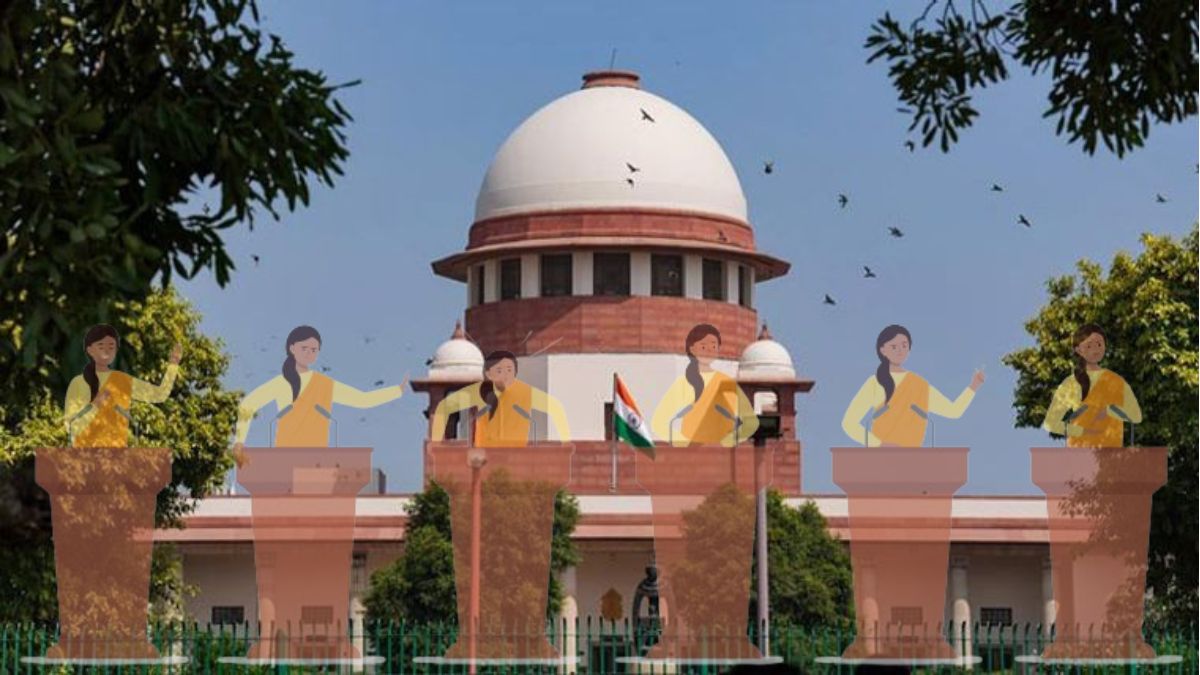
In a country where women make up nearly half the population, but occupy barely a fraction of seats in Parliament, even the promise of equality seems to come with a waiting period.
On Monday, the Supreme Court began hearing a petition that strikes at the heart of this paradox challenging delays in the implementation of the Women’s Reservation Act, which promises 33 per cent representation for women in legislatures, but only after a future census and delimitation exercise, whose timelines remain uncertain.
A Bench of Justice B.V. Nagarathna and Justice R. Mahadevan issued a notice to the Union government, seeking its response on why the implementation of the long-awaited reservation for women has been linked to a future exercise whose timeline remains uncertain.
"Preamble says all citizens are entitled to political and social equality. Who is the largest minority in this country? It is the woman, almost 48 per cent. This is about the political equality of the woman," Justice Nagarathna orally observed.
Why wait for an uncertain future?
Appearing for the petitioner, the counsel questioned the government’s decision to tie the enforcement of the constitutional amendment to two future exercises: the national census and delimitation—neither of which has begun.
Senior Advocate Shobha Gupta said:
"After 75 years of India's independence from British colonial rule, it is unfortunate that we have to move court for the representation. They have to reserve only one third of total seats. They have decided to grant the reservation based on some data."
“Why make it contingent on a future event? No exercise has even commenced. There is no rational nexus. The Act nowhere mentions when the census will begin or when the delimitation process will be completed,” she stressed.
“Women have already waited decades for political representation, now they are being told to wait for an undefined process.”
Enforcement is executive’s domain
Justice Nagarathna, known for her thoughtful interventions on gender and equality issues, observed that while the court can examine the logic of the condition, the implementation of a law falls within the executive’s domain.
“The enforcement of a law is in the domain of the executive,” she remarked. “At best, we can ask when they are proposing to carry out these exercises.”
When the petitioner’s counsel pressed that the very contingency clause was unconstitutional for making women’s political rights dependent on a delayed bureaucratic process, Justice Nagarathna responded, “Maybe they want to do it based on scientific data.”
The bench then issued notice to the Centre, seeking its response.
Passed by Parliament in September 2023 with much fanfare, the Constitution (106th Amendment) Act, 2023, guarantees one-third reservation for women in the Lok Sabha and State Assemblies. Yet, the fine print shows that it will come into effect only after the next delimitation effectively postpones its implementation for years.
Despite forming nearly half of India’s population, women remain grossly underrepresented in political institutions. In the 17th Lok Sabha, only 78 of 543 members (about 14 per cent) are women. The figure is even lower in several state assemblies.
The plea by Congress leader Dr Jaya Thakur calls for implementing the Women's Reservation Bill without waiting for the conduct of a fresh delimitation exercise.
For now, the promise of women’s political empowerment hangs suspended between constitutional intent and administrative delay.
The Women's Reservation Bill was passed by the Lok Sabha on September 20, 2023, and by the Rajya Sabha on September 21 that year, before it received the President's assent on September 28, 2023.
The Bill added Article 334A to the Constitution of India.
This new Article states that reservations for women in the Lok Sabha and State legislative assemblies will come into effect only after a delimitation exercise is carried out.
This process will take place after the results of the first census conducted after the amendment are made public.
