



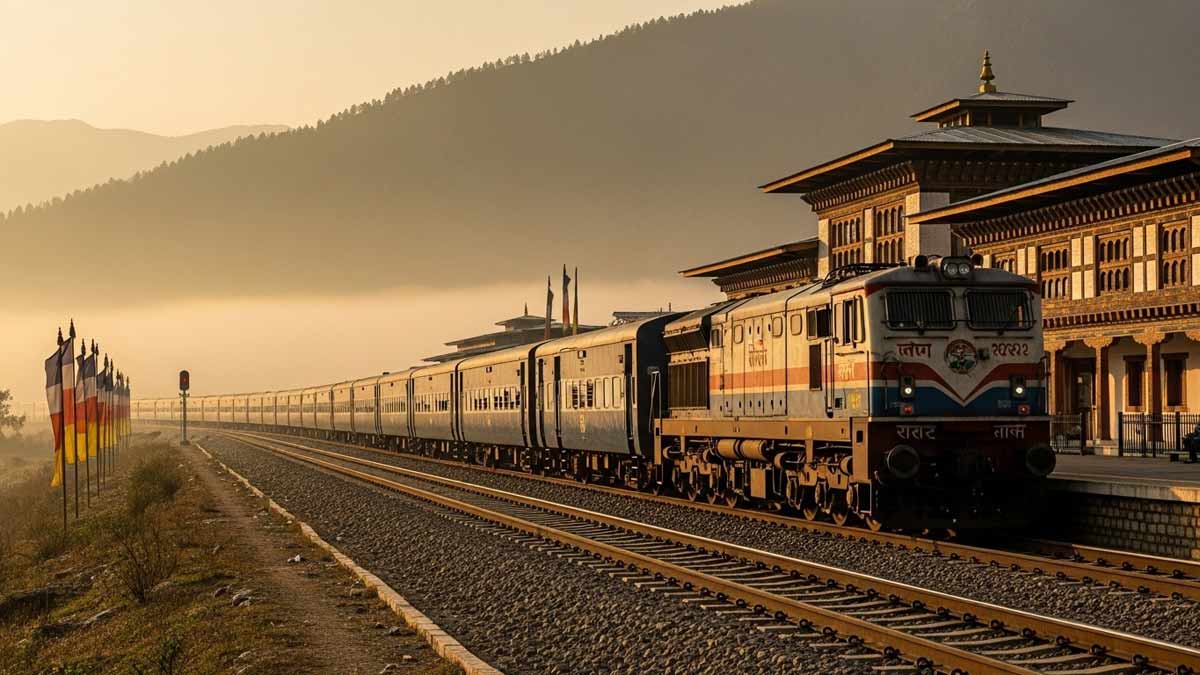
More than a decade of efforts to bolster India’s neighbourhood first policy is reaping benefits today, as Bhutanese citizens are upbeat about cross border movements not just becoming easier but also opening up economic lifelines to the land locked country. With India clearing the project to build the first-ever rail links-Assam’s Kokrajhar to Gelephu and West Bengal’s Banarhat to Samtse-Bhutan’s Gelephu Mindfulness City (GMC) has also got a boost. The GMC is being developed as the first of its kind Special Administered Region based on a “two systems, one country” policy.
The Banarhat-Samtse line linking the industrial towns and the Kokrajhar-Gelephu line connecting Assam to the planned GMC together promise a drastic reduction in logistics costs and transit time.
Currently, trade is heavily reliant on road transport, which is expensive and often slow due to limited road infrastructure at the borders connecting Bhutan and India. Locals recall that during the early 1970s to the late 1980s, there were no gates at the international borders, with the exception of a pull down barrier utilised by the forestry and trade departments for the entry and exit of trucks and other vehicles largely transporting timber and timber related products. The two countries have come a long way since. A major reason why the rail connectivity is being seen as an economic lifeline is because it will facilitate seamless, bulk movement of raw materials for the Bhutanese industries and transport finished goods for export.
“India is already our largest trading partner, and these links will provide Bhutan with unhindered access to Indian ports for third-country trade, effectively resolving our landlocked status for EXIM (Export-Import) cargo,” says Dawa Penjor, general secretary of the Bhutan-India Friendship Association. “We expect a significant boost to the export of our products- agricultural produce, and minerals, which will, in turn, help address our trade deficit. This improved movement of goods and people is also expected to significantly strengthen the economies of the bordering regions in both India and Bhutan.”
Bhutan may be a late participant in the global race for development and modernisation but its vision of the GMC is to tie together urban progress with peace and well-being of citizens, keeping in line with its Gross Happiness Index that continues to define the country’s progress beyond economic growth.
Once again beyond economics, Penjor says the projects embody the "exceptional trust, mutual respect, and understanding" that defines the Indo-Bhutan relationship. “They are a tangible demonstration of India’s Neighbourhood First policy and our shared commitment to regional development and security interests.”
Notably, Gelephu, a town strategically situated on the border of Assam, offers convenient access to other districts within the neighbouring country. It has long served as an important trading post and transit point for monks and traders moving between the Indian plains and Bhutanese highlands. Today, making Gelephu a more accessible and investment friendly destination is critical to the success of the GMC project which is sitting at the heart of Bhutan’s efforts to catapult itself from a lower middle-income category by enhancing its overall economic efficiency.
India’s relations with its neighbours Bangladesh, China, and Pakistan have been fraught with different challenges over last few months, but Bhutan has been a stable ally.
After facing criticism over losing allies in its neighbourhood, foreign policy experts say India is looking at a win-win situation with Bhutan where it not only gets a first mover advantage over China with the GMC - without disturbing the Bhutan-China equation - but also ties Bhutan and India’s strategic interests together by giving the former passage through the northeast, thereby keeping New Delhi’s border irritants with Beijing at bay. Already, Bhutan’s border talks with China have kept Indian interests in mind, and according to sources shared economic interests will only strengthen efforts to support national security strategies.
