



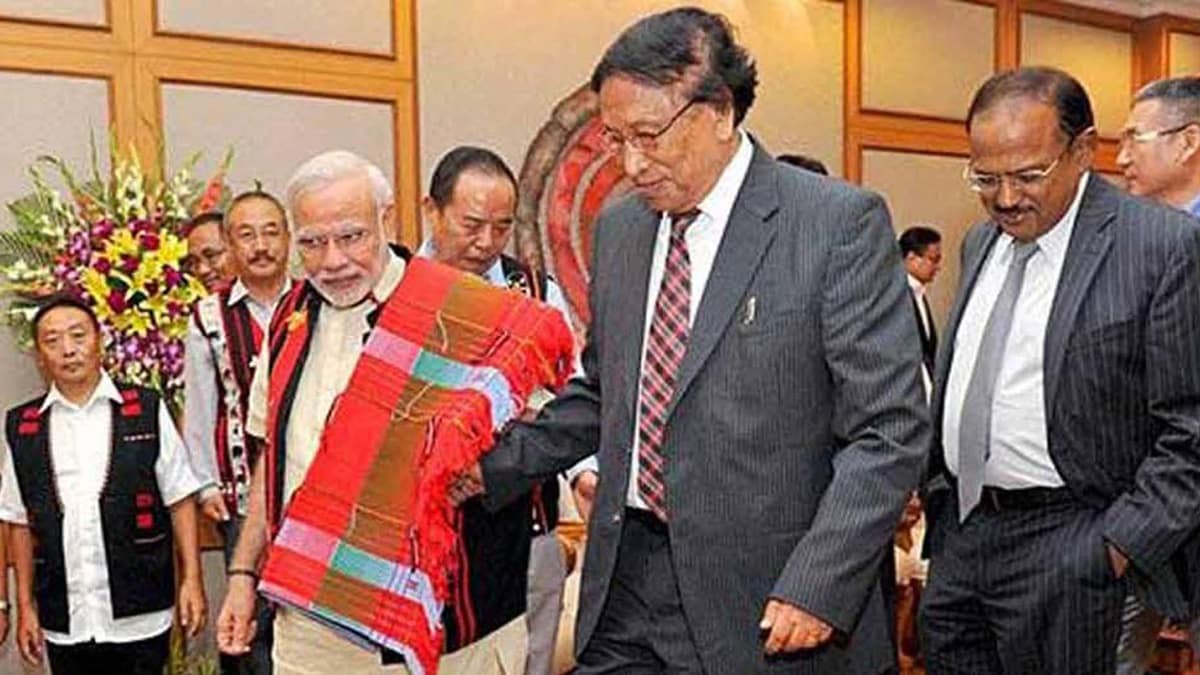
The much-hyped framework agreement between the government and the largest Naga insurgent group, the National Socialist Council of Nagalim (IM), has completed 10 years, but, the larger promise of a Naga accord for lasting peace to the decades-long insurgency is still a distant dream.
Importantly, the framework agreement signed on August 3, 2015, was the culmination of several rounds of discussions to set the stage for political talks and an acceptable solution for both sides. For the government, the basic premise of the talks is finding a lasting solution under the framework of the Indian Constitution. For the NSCN(IM), it has clearly been the protection of the distinct identity and unique history of the Nagas, and the dream of integration of the Naga people territorially and politically, which has been a long-standing demand.
It may be recalled that a historic breakthrough was made in July 2002, at Amsterdam, where the government, represented by K. Padmanabhaiah, met the NSCN leadership and formally recognised the unique history and situation of the Naga people. A joint communique issued after the meeting said that the talks should continue in an accommodative and forward-looking manner so that a lasting and honourable solution can be arrived at. Th Muivah, general secretary of the NSCN called it the first “realistic step ever taken towards working out an honourable solution to the long-drawn-out Indo-Naga issue", and praised the Indian leadership, under then Prime Minister Atal Bihari Vajpayee, “for the right step taken”.
After more than 10 years of negotiation, in 2015, the Naga group claimed that the framework agreement signed during the first term of the Modi government acknowledged that the sovereignty of the Nagas lies with the Naga people and that sovereignty would be defined in the final accord.
Interestingly, while the framework agreement was signed between the government and the NSCN(IM), what also followed was several rounds of discussions between the government and another distinct group called the Naga National Political Groups (NNPGs), a conglomerate of at least seven Naga outfits, after the two signed an agreed position in 2017. The NNPGs have also been discussing the contours of a final agreement that can show the way forward. But the NSCN(IM) views it as an attempt to dilute the Naga people’s struggle and weaken the authority of the NSCN(IM).
The NNPGs, on their part, do not insist on holding talks outside the framework of the Indian Constitution, nor are they insisting on a distinct territorial or political identity for the Naga people. On the other hand, the NSCN(IM) demands a separate flag and has not completely given up its idea of a Greater Nagalim, to be formed by adding contiguous Naga-inhabited regions of Manipur, Arunachal Pradesh, and Assam with Nagaland.
While the government is open to the idea of more autonomy for the Naga-inhabited regions, government officials have clearly said that a separate flag or constitution, or the idea of Greater Nagalim, is neither feasible nor appropriate, given the supremacy of the Indian Constitution.
With a significant drop in insurgency-related incidents in Nagaland and people's demand for lasting peace, all eyes are once again on how quickly the NSCN(IM) and the government are able to show the way forward. “We have seen a decline in insurgency-related incidents in Nagaland over the last few years. This demonstrates that there has been a visible shift in people’s minds who are rejecting violence and looking forward to peace and development," says D.K. Pathak, former chairman of the Ceasefire Monitoring Group, created in 2001 to oversee the ceasefire with the Naga militants. But Pathak says the ceasefire must be implemented on the ground for peace dividends to continue.
In the last two years, the spiraling tensions in Manipur following ethnic violence between communities in the hill and valley districts have created concerns for security agencies, who witnessed some activities of the NSCN(IM) in the hill districts, home to the Naga people, keeping them on their toes to prevent any insurgent groups from taking advantage of the situation. The NSCN(IM) is also said to be active in the troubled areas in Myanmar, across the border with Manipur, where it has set up bases and continues smuggling arms and extortion activities, according to intelligence agencies.
Given all the concerns and the evolving security situation in the Northeast, it will be a tightrope walk for the government. Security officials say the focus must be on continuing the ceasefire in letter and spirit with the Naga insurgent groups to ensure the dividends of peace are visible on the ground, while rolling out peace talks and initiatives that can have a lasting impact, not just in Nagaland, but in Manipur, Assam, Arunachal Pradesh, and beyond.
