



In December 2022, while delivering a special address at the 81st Indian History Congress, Tamil Nadu Chief Minister M.K. Stalin said that it would be apt to rewrite the Indian subcontinent’s history from the Tamil landscape.
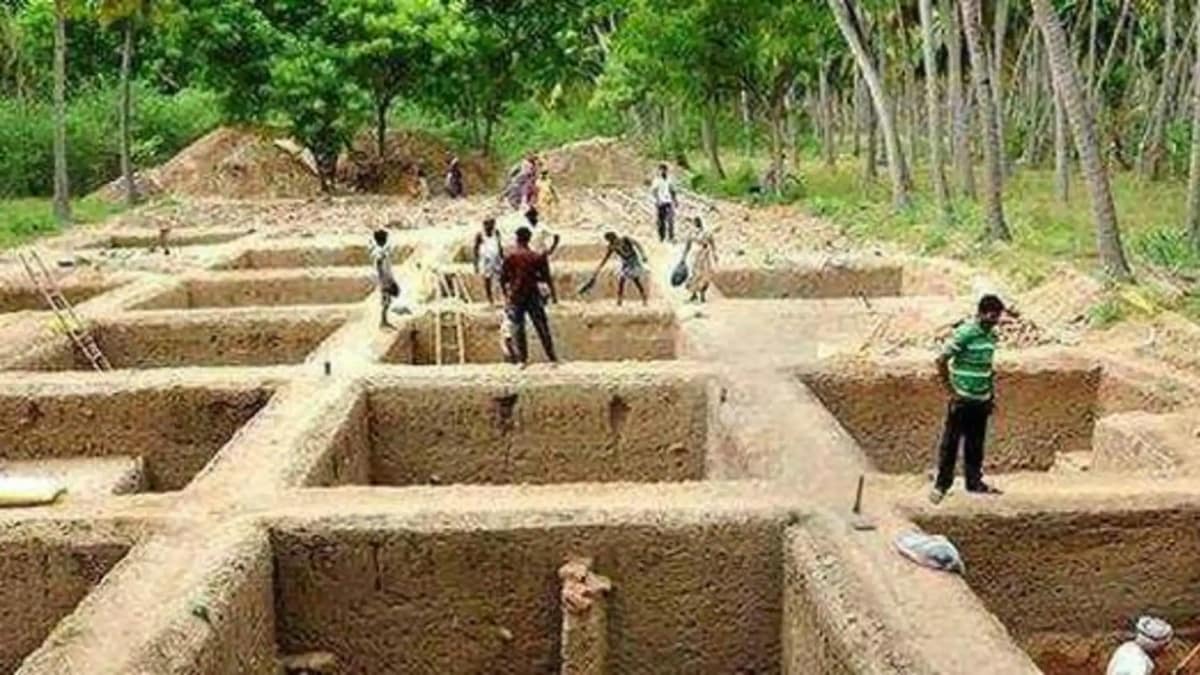
Stalin’s statement came in the backdrop of the excavations in Keeladi which had fuelled the Tamil pride and a sense of national identity. The carbon dating of the artefacts unearthed from Keeladi, the tiny hamlet located on the banks of the Vaigai river, near Madurai in South Tamil Nadu, has proved that urban civilisation existed in the ancient Tamil landscape. The carbon samples were dated back to 585 BCE (2,600 years ago). Paddy husks from a burial urn in Sivagalai, 150 kms from Madurai were found to be 3200 years old reaffirming the need for widespread archaeological excavations across Tamil Nadu.
K. Amarnath Ramakrishna, the then Superintending Archaeologist of the Archeological Survey of India (ASI), was the man behind the beginning of these excavations. Amarnath who was very vocal about his discovery of Keeladi and called it a Sangam-era site and made it clear that an urban industrialised settlement might have existed in the region. But this prompted his transfer far away to Assam in 2017. His successor P.S. Sriraman, who was tasked with the third phase of archaeological excavations at Keeladi, contended that “there were no significant findings.” Subsequently, a pause button was pressed and the excavations came to a temporary halt. This raised doubts that Ramakrishna was transferred intentionally.
Later, hearing a PIL, the Madurai bench of the Madras High Court asked the state’s archeology department to take over the excavations. Since then the Tamil Nadu State Department of Archeology (TNSDA) has conducted seven rounds of excavations and is ready to step into the eighth phase in June this year. In all these phases about 20,000 artefacts have been found from Keeladi since Ramakrishna discovered the site in 2014.
After the regime change, in Tamil Nadu, Ramakrishna was posted back in Chennai in September 2021. This time he was posted in the temple survey department of the ASI following which he began working on the voluminous report. In 14 months he penned a 982-page report, on the 5000-year Tamil civilisation with scientific evidence, plenty of pictures and diagrams and submitted it to the ASI.
The report gave details on the artefacts which were discovered during the seven phases of excavations. Heaps of pottery which were unearthed from Keeladi portrayed how a pottery-making industry was flourishing in the Tamil landscape several 1000 years before. Hundreds of potsherds containing Tamil Brahmi inscriptions, spindle whorls, copper needles, terracotta seals, hanging stones of the yarn, terracotta spheres and earthen vessels to hold liquid found in the later phases suggested that various stages of a weaving industry existed. Also, the gold ornaments, copper articles, semi-precious stones, shell bangles, ivory bangles and combs unearthed during the excavation revealed the artistic, culturally prosperous lifestyle of the people who lived in the ancient age in Keeladi.
But, two and a half years after he submitted his report the ASI has now asked Ramakrishna to resubmit his report after making necessary corrections for taking further action. A letter from the ASI said that two experts suggested corrections in his report. The letter asked him to rewrite the report and to make it “more authentic.” In its letter dated May 21, 2025, the ASI said the report submitted by him in January 2023, lacked adequate scientific rigour in certain areas and required corrections. ASI also cited extensive technical deficiencies in his report and questioned his classification of three historical periods - 8th to 5th century BCE, 5th century BCE to 1st century BCE and 1st century BCE to 3rd century CE.
Ramakrishna, two days after receiving the letter, shot back to ASI saying that the chronological sequence of the excavation has been clearly explained in his report. He reportedly wrote back to Hemasagar A. Naik, Director of the Exploration and Excavation Department at the ASI, stating that the period of the Keeladi excavation was determined using standard archaeological procedures, including stratigraphic sequencing, cultural deposits, material culture, and AMS dating.
However, ASI’s letter to Ramakrishna and his transfer earlier, makes it apparent that it is politically motivated after his preliminary findings suggested the presence of an urban civilisation in Tamil Nadu that could rival the civilisation in the Gangetic plains. It is said that the whole idea of moving Ramakrishna out of Tamil Nadu was only to say that South India did not have an urban civilisation and the only urban civilisation was the Harappan civilisation.
The ASI which apparently should have released the report and made it public for everyone to witness the artefacts excavated from has only asked two experts to vet Ramakrishna’s report which is based on his factual finding of the artefacts. This has stirred a row in the state which celebrates language and cultural pride.
