



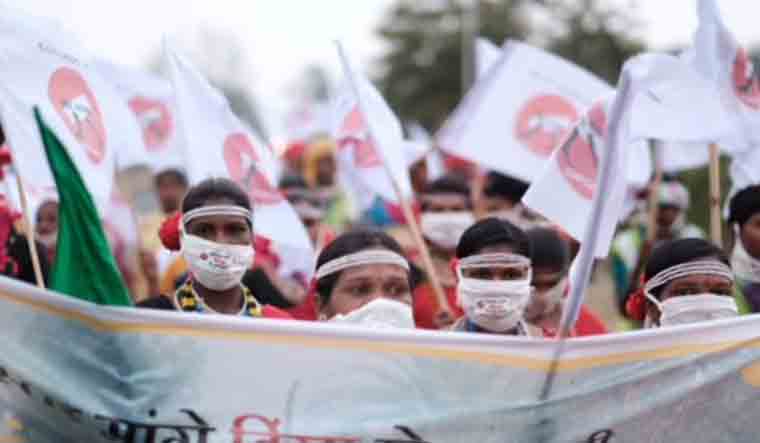
In March, a peace march was conducted from Abujhmad, the so-called capital of Maoists in Chhattisgarh, to the state capital Raipur, urging both sides to begin a dialogue for ending the half a century-old conflict between the state and the so-called Left-wing extremists. While the march was in progress, the Maoists sent a press note saying they are ready for dialogue if three of their demands are met. Reacting to it, the state government said they are also ready for talks but it needs to be without any conditions.
This is a welcome development. Though both sides have certain issues on which they say there can be no compromise, it is after a long time when one side offered to talk and the other has replied positively. Though his party's election manifesto had promised to make serious efforts to resolve the issue through talks, Chief Minister Bhupesh Baghel has been saying he will not talk to Maoists before they dilute their stand.
The Maoists too had been proving difficult. Their first demand has been the release of some of their leaders from jail. Secondly, they want the ban on their organisation lifted. And lastly, they want withdrawal of the paramilitary and police forces from operations, something which no government can agree to. The government's insistence on disarming of Naxals is also a demand that the Maoists cannot agree to.
Against this background of certain rigid preconditions being raised by both sides, the recent development is a step forward. Now, the question is: if talks start, what will they be about? The government has been saying that the talks will only be under the purview of the Constitution. Interestingly, the Maoists too have, of late, been invoking—or at least referring to—provisions of the Constitution. If one examines their recent press notes, one would notice frequent references to two terms—mediator and constitution. For instance, their press note refuting the government claim on drone attack said, “If you don’t trust our words, send a mediator”. Those who have been interlocuting with the Maoists say, by mediator they probably mean 'mediaperson'! Indeed, one has to read a lot between the lines when dealing with them.
The other term—Constitution—is more interesting. Most of the press notes allege that the government is not adhering to the Constitution. The foot march press note also said in its headline that “It is not time for talks but movement”. Yet, later they put forward three conditions, including the release of certain leaders from prison. What one has to read between the lines is this—conditions are put forward only when the party is willing to talk. Even the Nepal Maoists, who were swearing by revolution, finally conceded during the talks that bringing democracy to Nepal had been a big victory for them.
Revolution is about big change. If talks can lead to implementation of the constitution and its provisions in the Adivasi areas of central India, that itself would constitute their revolution, and that would be a welcome change for both the state and the Maoists.
Indeed, most of the time, I hear Maoists leaders expressing fond hopes such as: “capitalism will collapse under its own weight in 50 years”, and “the revolution will start from base areas like Bastar”. But the less romantic among them tell me “if we can ensure implementation of pro-Adivasi laws of Indian Constitution, that will be a big victory for the current phase of our movement”.
The Adivasis are the hosts to the Maoist revolutionaries, and the Adivasi voice is now heard largely through the Maoists. The fact is that though several pro-Adivasi laws have been enacted under our Constitution, none of them has been implemented honestly in the last 75 years. The Maoists have also been fighting the Adivasis' battles against businessmen who give low rates for forest produce, and also against government functionaries who harass the Adivasis.
Like several of the Maoist leaders, the state too has been daydreaming. Its functionaries often talk of eliminating the Maoists completely in a few years. More than 12,000 people, including 2,700 policemen and several more caught in the middle, have been killed in the last 20 years, and yet the problem has refused to go away.
It is time for both sides to realise that their ultimate goals are not going to be achieved. This is a suitable time for talks for two reasons. For one, now majority of forest-dwelling Adivasis want peace which was not the case even five years ago. And secondly, the Maoist leadership has become old; they have not been able to create a second-rung political Adivasi leadership though they have created many fighters.
Why talks now, one may ask. As one who has been working among the Adivasis, I fear that once the present generation of Maoists leaders—mostly non-Adivasis—are dead, the Adivasi Maoist cadre will get divided into many factions. The police are eagerly waiting for that day when they will fund one faction to finish the other. Imagine the fate of the poor folk among the Adivasis who will get caught in the fratricide. It is in their interest that peace activists like this writer are asking both sides to start talking. Will they listen?
Choudhary is a peace activist in Chhattisgarh and convener of www.thenewpeaceprocess.org
The opinions expressed in this article are those of the author's and do not purport to reflect the opinions or views of THE WEEK.
