



After asking Amarnath yatris and tourists to curtail their visit to Kashmir, the government last night issued ordered the suspension of class work in National Institute of Technology (NIT) in Srinagar where students across India are enrolled in different engineering courses.
“This is to inform all the students of the institute that the class work for all courses stand suspended till further orders,’’ a order issued by NIT registrare said. “ The above notice stands issued in accordance with the instructions received from district administration Srinagar.’’
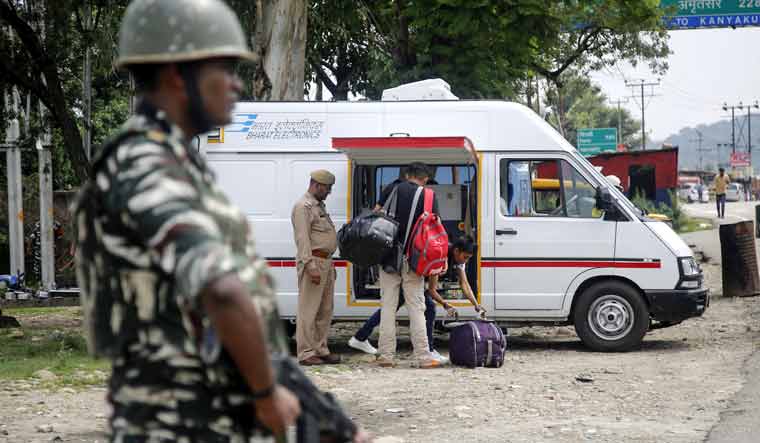
This morning, students from different states were seen boarding buses of State Road Transport Corporation (SRTC) to leave the valley.
The latest order came hours after J&K government Friday asked Tourists and Amarnath yatris to curtail their visit in the Valley and go back immediately.
“Keeping in view the latest intelligence inputs of terror threats with specific targeting of the Amarnath Yatra, and given the prevailing security situation in the Kashmir Valley, in the interest of safety and security of the tourists and Amarnath Yatris, it is advised that they may curtail their stay in the Valley immediately and take necessary measures to return as soon as possible," Principal Secretary, Home Department, Shaleen Kabra said in a statement.
The order comes in the wake of halting of Amarnath Yatra on Friday which, the 15 Corps Commander Lt Gen K.J.S. Dhillon in a press conference said, was due to militant threat to the yatra and blockade of Srinagar-Jammu highway following bad weather.
But not many in Kashmir, including officials, are convinced by the reason cited by Dhillon.
Rumours of scrapping article 35A rife
The suspension of classes in NIT is seen as another indication of Centre planning something big on Kashmir before August 15.
Rumours about scrapping of Article 35 A of the Constitution that bars outsiders from settling in Jammu and Kashmir have gained currency after the Union home ministry inducted 100 companies (10,000) additional Central Armed Police Force (CAPF) personnel into the state on July 27 “to strengthen the counter-insurgency grid as well as for maintaining the law and order situation in J&K”.
The validity of Article 370 and Article 35A had been challenged by several petitioners in the Supreme Court on the contention that it violated the fundamental rights of Indian citizens from settling in Jammu and Kashmir. The petitioners—that included a right wing-backed NGO and West Pakistan refugees living in Jammu—argued that Article 35A was discriminatory and should be struck down as it was a Presidential Order and not an Act of Parliament.
A slew of government orders asking the state police to stock food, water and riot-control weapons for three to four months have also reignited fears that the J&K special status might be scrapped by the BJP-led Union government. The zonal superintendents of police have also been asked prepare a list of mosques and their managements.
The surge in the deployment of the Central forces has also coincided with a flare-up of the situation on the Line of Control. The clashes on the LoC this week saw an escalation from small arms and mortars to artillery firing for the first time since 2003.
The order asking tourists and pilgrims to leave Kashmir has further brought fear in the Valley with people wondering whether to stock eatables.
In Kashmir, many people believe that the big decision that the BJP government is likely to announce on the state could range from scrapping special status to the bifurcation of the state with statehood to Jammu and Union Territory status to Ladakh.
The chaos that has gripped Kashmir is happening at a time when the BJP has signalled that it is ready for Assembly elections. The party is hopeful of an impressive showing and of forming its own government by riding on the success in Lok Sabha elections and tough steps it has taken on Kashmir.
