



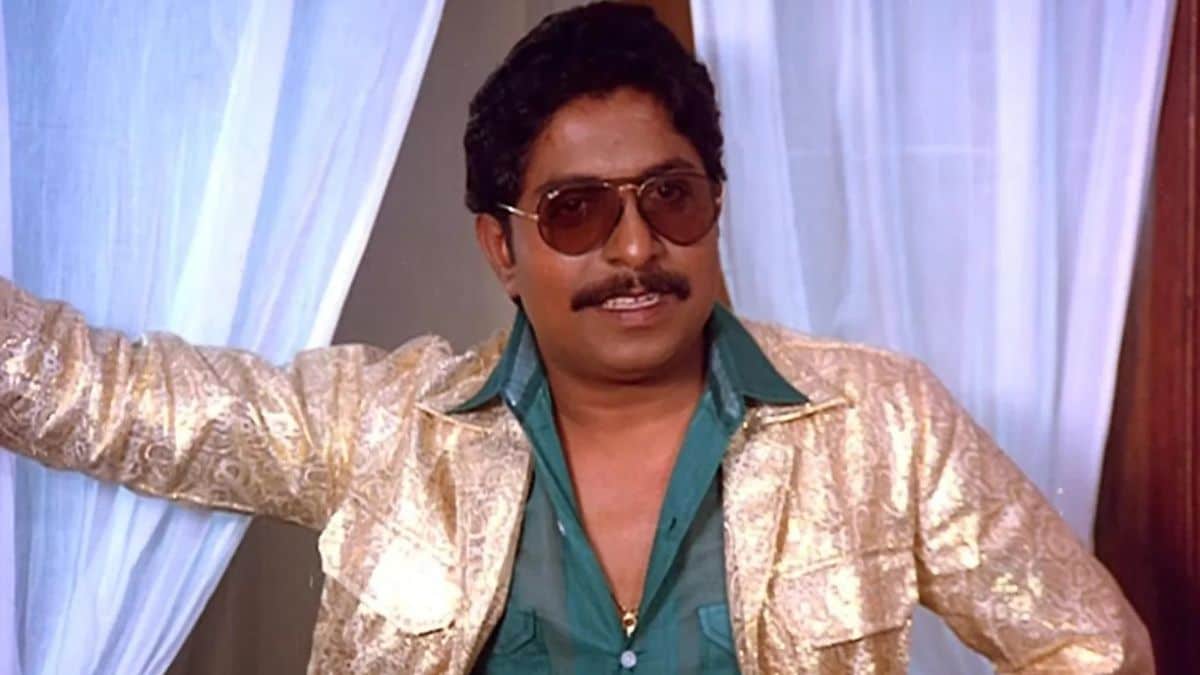
In Mazha Peyyunnu Maddalam Kottunnu, Sreenivasan's character got Mohanlal's character to pretend to be somebody in pursuit of a self-serving endeavour. In Gandhi Nagar 2nd Street, the former gets the latter to pretend to be somebody in an act of benevolence. Two different dynamics, two different stories. Written by one man: Sreenivasan. How many can boast of such an enviable record list of comfort films — both in his work as a scenarist and actor. He envisioned the kind of lighthearted films you can watch with a plate of biryani, with a serene mental state. In my case, and I'm sure for many others, Mazha Peyyunnu Maddalam Kottunnu still remains the ultimate go-to film when life gets a bit too overwhelming for our taste.
I don't know who came up with this tagline on the poster of Mazha Peyyunnu Maddalam Kottunnu, which says, "Even if you didn't laugh, make your wife laugh." Perhaps Sreenivasan himself came up with it. Regardless of the source, this line, I think, sums up the essence of Sreenivasan the man. He wrote flawed male characters with the kind of sincerity, depth, and insight rarely found today. While his contemporaries ventured into darker territories with their flawed characters, Sreenivasan took a predominantly comedic route. His writing, in his best films, was unparalleled, characterized by intellectually stimulating humour. Simply put, his films spoke to the shortcomings of many of us.
One also imagines these stories could've been Sreenivasan's way of dealing with the absurdities of life through his art, which turned out to be therapeutic for everyone consuming them too. He was possibly laughing at some of his own flaws while also embracing them as qualities that one cannot completely eliminate, and are bound to pop up occasionally, depending on the circumstances. Sreenivasan's films showed us that it's just a natural part of being human, that it's okay to be imperfect, as long as you're not causing anyone any harm.
That tagline on the poster must've also been a suggestion to men to ditch their misguided sense of masculine pride, at least for a short time, instead of making it about themselves all the time. Perhaps this was the message: Let another person, regardless of gender, enjoy whatever they wish to see, regardless of what your spouse or others may feel about it.
But the master screenwriter whose scripts many aspiring filmmakers see as textbooks, and who made actors and characters wear all kinds of convincing disguises (or disguises within disguises), Sreenivasan, despite being most celebrated for his humour, was himself adept at navigating a wide range. Three roles of varying — but impactful — screentime had struck me the most.
When growing up, I remember my first introduction to Sreenivasan quite vividly. It had to do with his directorial debut, Vadakkunokkiyanthram, which he also had written. I remember my mother enthusiastically speaking about the follies and quirks of Sreenivasan's character, Thalathil Dineshan — a character that has now become the epitome of the insecure, jealous Malayali. Perhaps my mother understood so well the absurd behaviour that comes with the married man territory. This is a character who, when told by the photographer to look straight at the camera, fumbles multiple times. Even when the final picture is clicked, he cannot stop feeling bothered about his wife: when the photographer (Mamukoya, another comedy legend) finally clicks his picture, Sreenivasan is framed with a hilarious side-eye expression.
I remember being curious about this film back then as a child, but the intention behind the writing made sense to me only after I grew up, while dealing with my own share of insecurities and jealousy-inducing situations, which hit you more in your 20s and 30s than in your 40s; when your 40s begin, you stop caring because you know how silly and insiginficant everything is in the larger scheme of things. Sreenivasan wrote, I imagine, some of his best scripts with this philosophy from very early on. He wrote Vadakkunokkiyanthram in his early 30s, but his writing was coloured by the maturity, perception and wisdom of a 40/50/60-year-old man. The script's impressive strength is such that we wish we had the same degree of level-headedness and also the understanding of not just others but ourselves, too. We wish we had the same ability to not only be brutally honest in our art, but also be unfazed in the face of criticism directed towards us and forge ahead, without letting time and age deter our spirit and sense of humour.
Since Sreenivasan is known mostly for his humour — and I imagine most people preferred him in comedy — his serious characters, the few that he did, often failed to find mention. One such role that still haunts me to this day is the one in G. Aravindan's Chidambaram. As Muniyandi, the troubled husband of Smita Patil's character, he is the stuff that Thalathil Dineshan's nightmares are made of. Written by Aravindan from a story by C.V. Sreeraman, the fact that this character is a quiet presence — the exact opposite of Sreenivasan's loudest, most talkative, and celebrated characters — makes it even more unforgettable. And the fact that he did another insecure husband — a funnier, more haughty version of Dineshan, with multiple wives — in Kilichundan Mampazhan, is worth remembering as an amusing parallel. And let's not forget that before all this, there was Panchavadi Palam, from writer-director K.G. George, where Sreenivasan's character, despite being an "observer", ends up being in the film's most haunting, defining climax — a supreme example of the tragicomedy.
Of all the characters he wrote, it's the ones who create problems of their own making that stand out the most. It's as though Sreenivasan was trying to keep himself grounded in an industry that can sway you into unpleasant realms of temptation, greed and malice. Aside from the fact that nobody writes male camaraderie today the way Sreenivasan wrote them (today's buddy comedies are no match for, say, Odaruthammava Alariyaam, Akkare Ninnoru Maaran, or Nadodikkaatu), what sets his writing apart is the self-assuredness of it. They gave the sense they weren't written for seeking anyone's approval; they came from a genuine place inside a writer who is so in love with the subject he wants to tell, but also is not too serious or attached about it. The best stories, I've always felt, are those that were written without the intention of winning any award or ticking off a certain checkbox (unfortunately the case with many films made today).
It goes without saying: The world is a lesser place today without Sreenivasan.
