



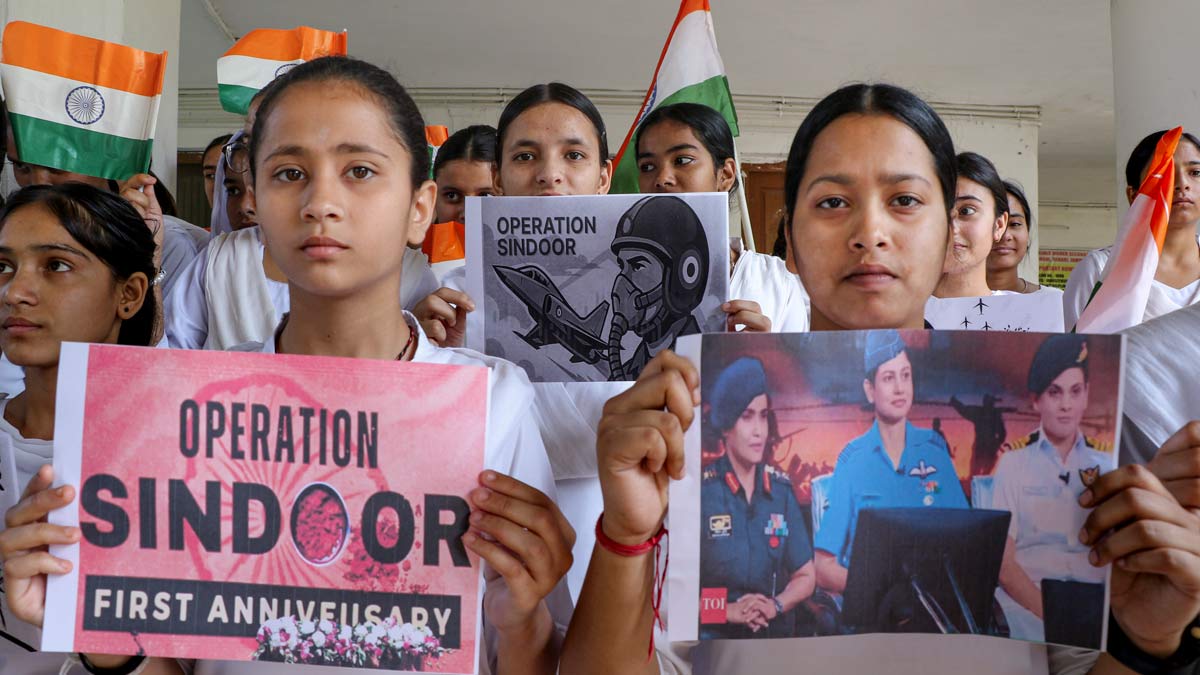
Anniversaries in national security are rarely ceremonial. They are moments of assessment. Operation Sindoor is one such marker. A year later, the significance lies less in the operation itself and more in what it set in motion. The Indian Army did not treat Sindoor as a standalone episode. It used it as a pivot.
The scale of change since then is revealing. Fifty mission-ready units. Four new agile formations. A steady induction of next-generation systems. Eight revised counter-terror frameworks. Seen individually, these could pass as routine updates. Taken together, they point to something more deliberate: a reworking of how the Army prepares for conflict in an environment where time is compressed, and margins are thin.
For years, India’s military posture relied on balance, combining mass, geography and escalation management. That equilibrium is under pressure. The nature of conflict has shifted in ways that are hard to ignore. Precision now outweighs volume. Speed consistently trumps scale. Battlefields are no longer linear, nor do they pause. Sindoor compelled clear institutional recognition of this reality.
The most visible changes are structural and go beyond incremental reform. The Army is moving towards integrated formations built for immediate employment.

The newly raised Rudra all-arms brigades reflect this shift. These are not crisis-assembled formations. They are permanently structured combat groupings that integrate armour, mechanised infantry, artillery, infantry, special forces and unmanned systems under a unified command. Designed for autonomy, they are configured for short, intense engagements across both the Line of Control and the Line of Actual Control.
Alongside them, the Bhairav light commando battalions introduce speed and disruption at the tactical level. Lighter, more mobile, and logistically lean, they are equipped with drones, precision weapons, and real-time surveillance. They sit between conventional infantry and special forces, intended to seize the initiative and unsettle the adversary before the situation stabilises.
Firepower is being reorganised, not merely enhanced. The Divyastra batteries mark a notable shift. By embedding composite artillery elements, including loitering munitions and surveillance drones, directly within infantry units, the Army is narrowing the gap between detection and engagement. Complementing these are Shaktibaan regiments, structured around drone-enabled artillery, counter-UAS capabilities and precision targeting. The emphasis is clear: move from massed fires to distributed, responsive firepower.
Air defence is undergoing parallel evolution. Under Mission Sudarshan Chakra, a layered architecture is taking shape, combining long-range systems with indigenous capabilities. These are integrated via the Akashteer command network to enable faster, coordinated responses. The focus is on depth, redundancy and the ability to counter emerging threats, particularly drones and low-signature systems, while safeguarding critical infrastructure.
These structural changes align with a clearer definition of readiness. The term is no longer rhetorical. Units are being configured with integrated logistics, embedded ISR and pre-designated fire support, enabling them to move from decision to execution without the delays traditionally associated with mobilisation. The objective is straightforward: compress response timelines to reinforce deterrence through immediacy.
Technology is driving this transformation. The effort has not been limited to acquiring platforms in isolation. The emphasis is on integration. Unmanned systems, precision-strike capabilities, and electronic warfare assets are being integrated into a broader operational grid. Data from satellites, UAVs, and ground-based systems is fused into a shared picture, enabling dispersed formations to act in coordination and at speed. AI and autonomy are finding increasing space besides cyber and quantum technology.
This is where the shift becomes more fundamental. The Army is moving towards a kill web construct, where sensors and shooters are linked across domains. In such a system, advantage lies not only in movement but in decision-making. The side that processes information faster and acts first gains the edge.
The revised counter-terror frameworks reflect this approach. The movement is away from reactive patterns towards intelligence-led, technology-enabled operations. Persistent surveillance, predictive targeting and rapid precision engagement are becoming central. The intent is to pre-empt, within defined thresholds, rather than respond after the fact.
Doctrinally, the outlines of a Cold Strike approach are becoming clearer. While not formally articulated, its features are visible. It rests on calibrated, high-speed conventional action delivered with precision and control. It depends on pre-authorised decision chains, integrated intelligence and coordinated strike capabilities. The aim is to impose costs quickly without triggering uncontrolled escalation.
Long-range strike capabilities support this posture. Existing systems provide reach and accuracy, while emerging technologies promise to shorten engagement cycles further. Combined with drones, networked artillery and cyber capabilities, they create a layered strike architecture capable of engaging targets at depth with limited warning.
At the same time, vulnerabilities are expanding. Swarm drones, electronic warfare and low-signature threats require equal attention. Air defence systems, counter-UAS measures and AI-enabled detection are becoming integral to the overall design. Offence and defence now operate together, not in sequence.
Sustaining this shift will depend on the industry. The requirement is no longer limited to induction, but to scale. Drones, loitering munitions, sensors, and precision components must be produced in volume and supported by secure domestic supply chains. Without manufacturing depth, even the most refined doctrine risks remaining aspirational.
In retrospect, Operation Sindoor was less an isolated operation and more a moment of clarity. It demonstrated what alignment between technology, integration and intent can achieve. It also highlighted the cost of delayed adaptation in a faster battlespace.
One year on, the Indian Army is not simply stronger. It is becoming faster in response, tighter in integration and more deliberate in execution. The direction is evident.
Future success will not be measured by territory alone. It will rest on the ability to shape choices, impose costs and manage escalation with precision. By that measure, Sindoor did not conclude a chapter. It opened one.
