



There is nothing like a free lunch. Israel’s thrust to position India as a main pivot of the proposed ‘Hexagon of Alliances’ has New Delhi in a quandary—a reason why New Delhi has been non-committal about the alliance.
While India’s West Asia policy gets a firmer foothold by deepening and enhancing military ties with Israel and the other Mediterranean partners, it will pit India against Iran, with whom there has been traditionally and historically warm ties.
Closer military ties with Israel would mean graduating from the current levels of defence engagement by closely cooperating on intelligence-sharing, drones and other military tech to the next level, which will include cooperation in AI, quantum, and air defence technologies like the ‘Iron Dome’.
India opting for the Alliance membership will also jeopardise New Delhi’s trade and connectivity interests with Iran, with the Chahbahar port in Iran’s south coast being the prime example of what might be affected. The Chahbahar port is looked upon as India’s ‘Gateway to Afghanistan and Central Asia’.
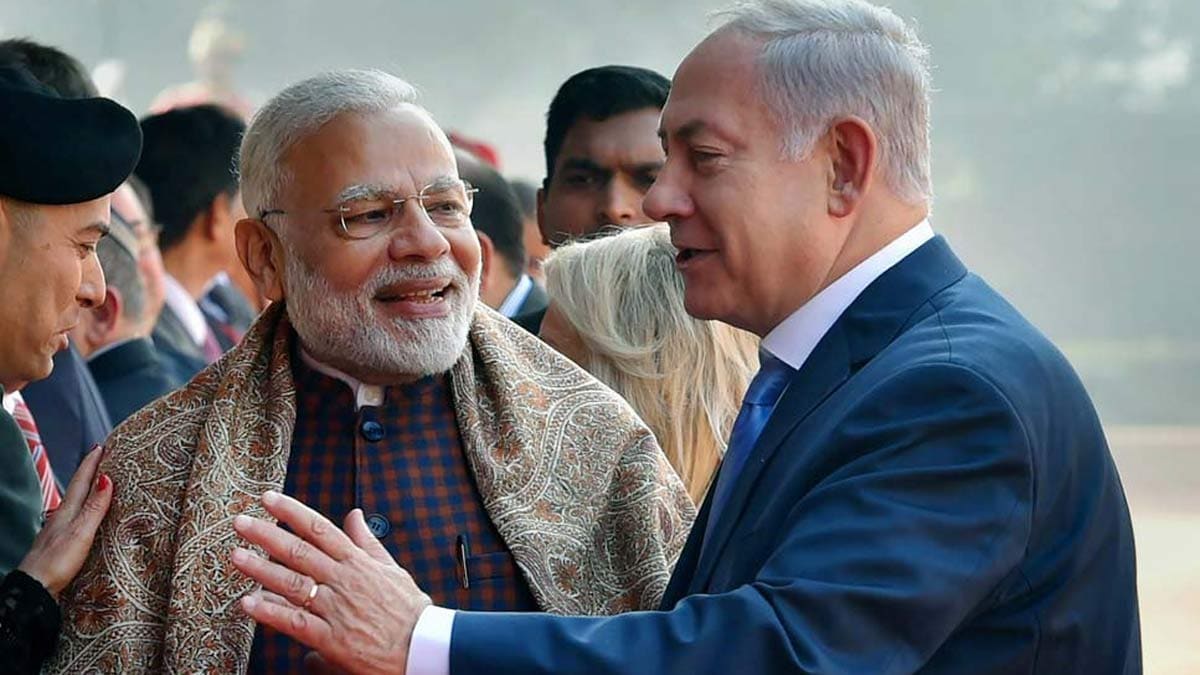
The ‘Hexagon of Alliances’ was first proposed by Israeli PM Benjamin Netanyahu in February, just ahead of Prime Minister Narendra Modi’s visit to Tel Aviv. Netanyahu outlined the mandate of the alliance “to create an axis of countries that see reality, the challenges, and the goals in the same way, in contrast to the radical axes... Both the radical Shia axis, which we have hit very hard, and also the emerging axis—the radical Sunni axis.”
Besides Israel, India, Greece, the Greek Cypriot Administration, and unnamed Arab, African, and Asian countries were listed as members of the proposed alliance. In West Asia, the UAE, Bahrain and Jordan are perceived as being close to Israel.
Notably, the alliance proposal cropped up amid a new strategic alignment between Pakistan, Saudi Arabia, Turkey and Egypt, often being labelled as the “Islamic NATO”. While Pakistan and Saudi Arabia have already inked the Strategic Mutual Defence Agreement (SMDA) in September 2025, Turkey and Egypt have expressed eagerness to be a part of this grouping.
The Israeli PM looked at the ‘Hexagon’ as a counterweight to the Iran and its proxies like the Hamas, Hezbollah, and the Houthis, while he referred to the “emerging radical Sunni axis” as being linked to remnants of the ISIS or Daesh.
A deeper relationship with Israel in the form of the ‘Hexagon of Alliances’, which is seen in many quarters as an ‘anti-Islamic’ grouping, will invite domestic criticism. Already, the proposed alliance has been labelled as an anti-Muslim Ummah bloc. More than 14 per cent of the Indian population is Muslim.
While India has been cautious on aligning itself with any security blocs, membership in the ‘Hexagon’ would undermine the pursuit of strategic autonomy, which is a declared state policy.
India is an important member of several key multilateral groups like the Shanghai Economic Cooperation (SCO) and BRICS, and Iran is a member of both. Iran officially joined the SCO in 2023 and became a full member of BRICS on January 1, 2024. India fronting the ‘Hexagon’ would lead to substantial internal turmoil within these groupings.
