



Codenamed 'Operation Tiranga', the “closed door” deliberations between the Chief of Defence Staff (CDS) and the three service chiefs to establish joint theater commands, had taken the form of a mission mode operation.
And rightly so, because once approved, the plan would lead to a historic transformation of the Indian military that has been in the works for many years.
Now, Operation Tiranga has finally concluded, with a draft proposal likely to be placed before the Defence Minister and the Cabinet Committee on Security for the final go-ahead.
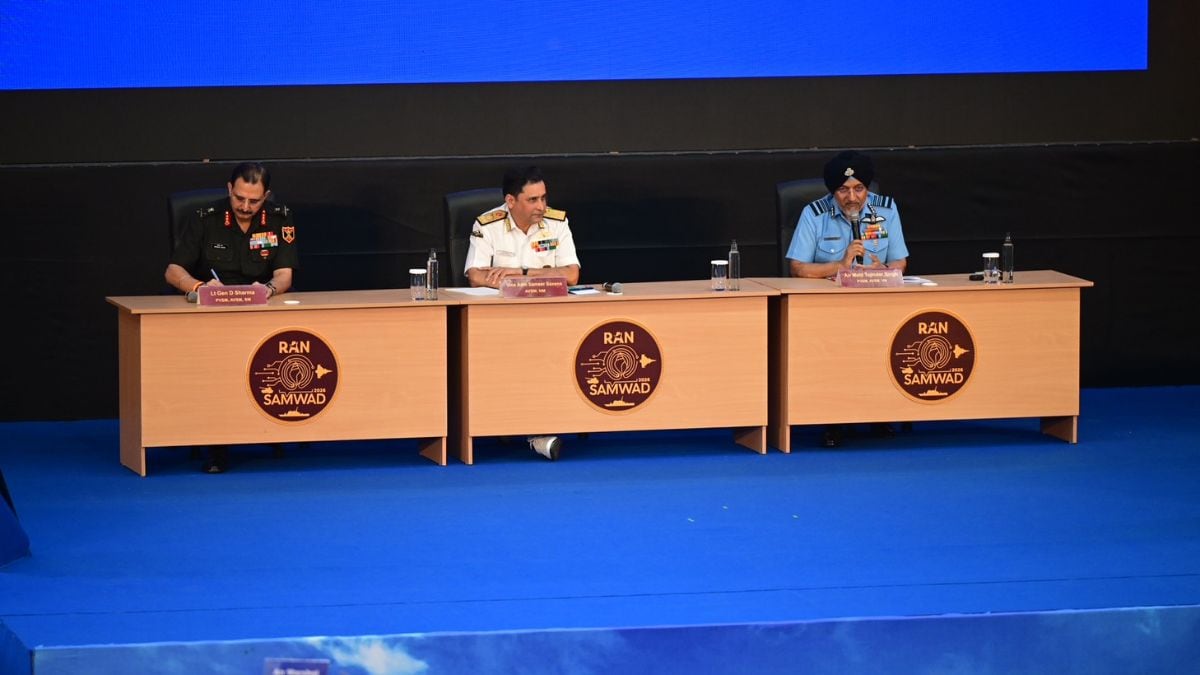
Speaking at a fireside chat during the two-day ‘Ran Samwad’ event being held in Bengaluru, CDS General Anil Chauhan said: “No service chief has any doubt on the concept. It is 100 per cent. No service chief is saying it is not to be done ... But there are some differences in the manifestation or how it is to be done ... But I am sure these differences will get resolved ... so from the services side, this work has been done.”
“Hopefully I should be able to compile my report in another one week.”
The second edition of ‘Ran Samwad’ is themed on the idea of building a roadmap for preparing the Indian military for Multi-Domain Conflict, encompassing land, air, sea, cyber, space and cognitive domains.
The tri-services integration effort in the form of a ‘theaterisation’ plan aims to replace functional commands with theater commands, where a single commander in a designated zone will command all the assets and resources of all services—be it from the Army, the Navy or the Air Force, stationed in that particular zone.
The new structure will do away with the system of the Army, Navy, and the IAF operating separately under their own respective commands, and replace it with one where all the various arms of the military participate in a single cohesive format during wars and conflicts.
Currently, India has 17 single service commands based on operational and geographical needs—six Army commands and one training command, three Navy commands, five IAF operational commands, a Training Command, a Maintenance Command, and then the tri-services command located in the Andaman and Nicobar Islands. This excludes the SFC (Strategic Forces Command).
The idea of the ‘theaterisation’ of India’s military germinated in the aftermath of the Kargil conflict in 1999, when the idea got traction in the Kargil Review Committee (2000). It then took shape in the form of a recommendation in a Group of Ministers (GoM) report in 2001, when a joint command was envisaged at the Andaman Nicobar Command as the "crucible for future joint commands" which was similar to theatre commands.
In 2005, the discussion on theatre commands was started by the Headquarters Integrated Defence Services (HQIDS), when Admiral Arun Prakash was the Chairman of the Chief of Staff Committee (COSC).
In 2006, Admiral Prakash wrote to the defence minister that theatre commands were the "end point of jointness". The discussion continued thereafter, and it was most firmly stated in the Shekatkar Committee report (2016).
