



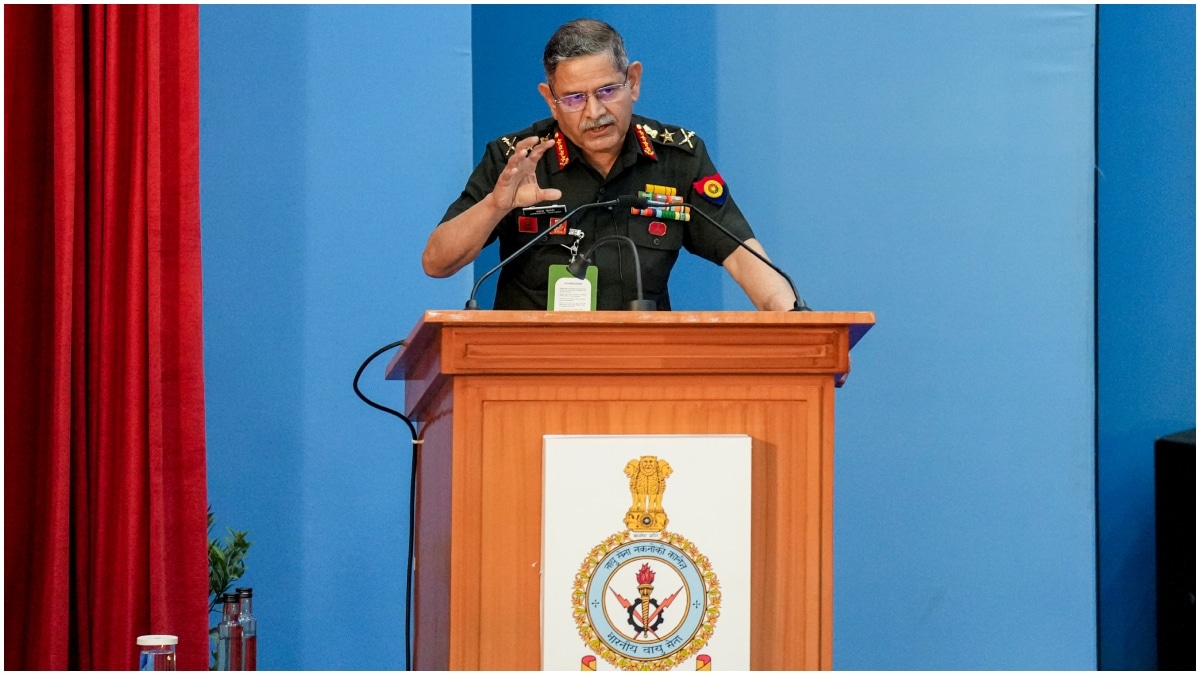
Operation Sindoor was India's most powerful tool of progression towards domain jointness, Indian Army Chief General Upendra Dwivedi said on Thursday.
The Army Chief stressed that modern warfare is no longer confined to geographical boundaries or single-service dominance, but is instead defined by continuous interaction across domains, stakeholders, and levels of conflict.
The offensive against Pakistan was a "defining case study" of the operational significance of integration, General Upendra Dwivedi said. "Operation Sindoor was India's most powerful tool of progression towards domain jointness. But we need to achieve domain integration and fusion," he said.
He was addressing the "Ran Samvad" forum on "Land Forces' Visualisation of Multi-Domain Operations (MDO)" in Bengaluru.
The Chief of the Army Staff said his visualisation of MDO is not of six domains operating in parallel, but all of them "in constant dynamic interaction where the weight shifts and the lead changes".
In May last year, India launched a military response targeting terror launchpads in Pakistan following the April 22 Pahalgam terror attack, which killed 26 Indian tourists.
ALSO READ | What were the turning points in Operation Sindoor? Indian Army chief explains
"We are living through a dispersed, undeclared, multi-theatre, multi-domain war of our times. The question is not whether domains interact; it is how the interface is orchestrated across the battlespace," he was quoted as saying by news agency PTI.
Elaborating on the evolving battlefield, General Dwivedi noted that MDO has transformed warfighting into a layered, three-dimensional construct.
"In MDO, the battlefield is no longer a line on a map. It's 3D — cyber effects shaping the cognitive space, space assets cueing targets, and electronic warfare contesting every frequency simultaneously," he said.
He emphasised that commanders must develop cross-domain situational awareness from the tactical to the strategic level. Highlighting the operational significance of integration, General Dwivedi referred to Operation Sindoor as a "defining case study".
"It was a ground intelligence network coupled with cyber and EW (electronic warfare) inputs that gave the joint Army-Air Force targeting, while the Navy's repositioning shaped the strategic calculus simultaneously. No single domain decided the operation," General Dwivedi added.
General Dwivedi drew a distinction between the land domain and land forces, explaining that while the former refers to the operational space, the latter represents the actors, comprising all six domains — land, air, maritime, cyber, space, and cognitive — operating in a shared environment. He underlined that these domains are no longer siloed but function through dynamic synergy.
