



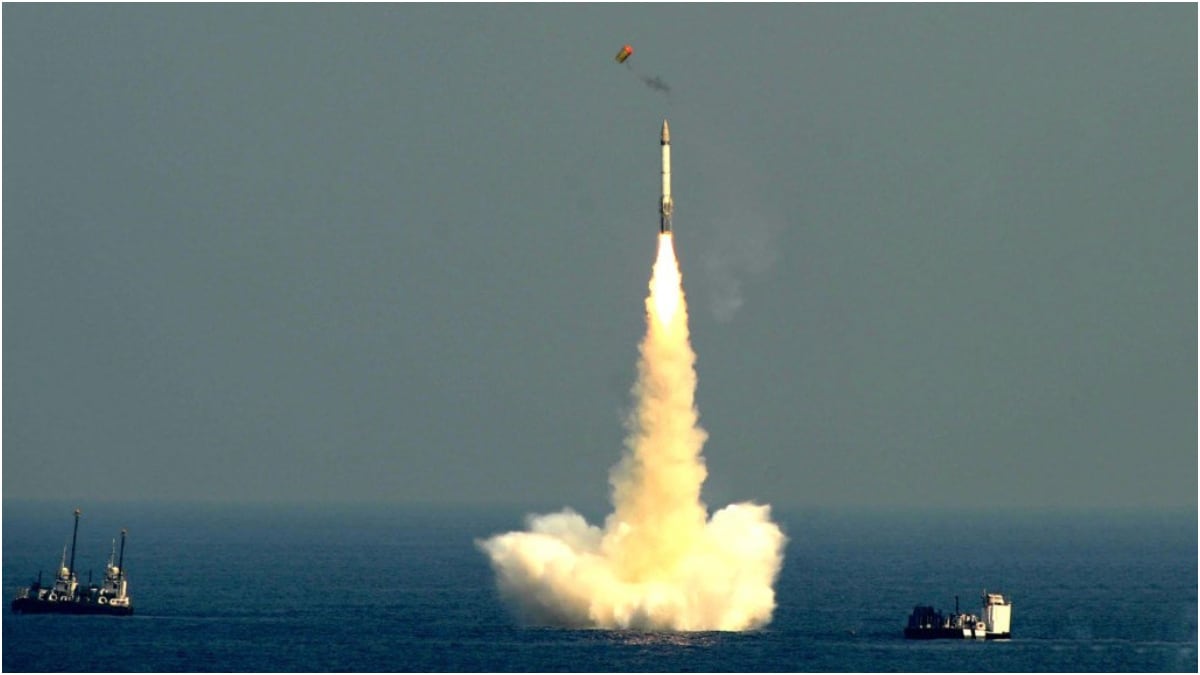
India's K-15 Sagarika missiles are yet again in the news following the formal commissioning of INS Aridhaman—the third Arihant-class Submersible Ship Ballistic Nuclear (SSBN) submarine. Defence Minister Rajnath Singh on Friday presided over a brief ceremony in Visakhapatnam as INS Aridhaman, reportedly 1,000 tonnes heavier than its predecessors Arihant and Arighaat, was commissioned into service.
While the Arihant and Arighaat can carry up to a dozen K-15 Sagarika and four K-4 missiles, Aridhaman is reportedly equipped to carry 24 Sagarikas and eight K-4 or K-5 missiles. It can be armed with either nuclear or conventional warheads and is crucial to India's deterrence capabilities.
Sagarika: India’s lethal ‘underwater’ strikeforce
The Sagarika missiles, also referred to as B-05 or PJ-08, are submarine-launched ballistic missiles (SLBMs) with a range of 750 kilometres. The weapon’s multiple designations were a purposeful tactical deviation by the DRDO to protect the secrecy of the project for as long as possible.
The missile has a length of approximately 10 metres and a diameter of 0.74 metres. Its mass is estimated to be between 6 and 7 tonnes, although some descriptions place it closer to 10 tonnes. It can carry a warhead weighing approximately 1,000 kg (1 tonne). Developed by the DRDO and reportedly manufactured by Bharat Dynamics Limited, the system officially entered service in 2018.
The development of the B-05 (K-15) missile began in the late 1990s, according to a report by The New Indian Express. Following the completion of the underwater missile launcher in 2001, the system was handed over to the Indian Navy for trials. After several subsequent tests, the first full-range trial of the missile was conducted on March 11, 2012. India officially confirmed the missile's successful developmental trial on January 27, 2013, following a twelfth test performed from a submerged pontoon.
In 2022, the Ministry of Defence confirmed a successful user training launch from INS Arihant. "The successful user training launch of the SLBM by INS Arihant is significant to prove crew competency and validate the SSBN programme, a key element of India’s nuclear deterrence capability. A robust, survivable and assured retaliatory capability is in keeping with India’s policy to have ‘Credible Minimum Deterrence‘ that underpins its ‘No First Use’ commitment," a PIB release stated at the time.
Achieving the nuclear triad
According to available information, the Sagarika combines aspects of both cruise and ballistic missiles. Once launched underwater and having travelled 50 km, it can fly at seven times the speed of sound, much like a cruise missile. "It has fins enabling it to be steered to within 20 m of its target, nearly 750 km away. The flat trajectory, where it flies parallel to the earth for most of its flight time, its hypersonic speed, and its small cross-section mean the missile cannot be spotted until it is virtually upon the target," one report noted.
"The Sagarika programme is driven by India's long-term goals to secure a sea-based, second-strike nuclear capability. Indian defence scientists and naval personnel have had several technological hurdles to overcome before achieving their dream of perfecting SLBM capability. DRDO missile technologists said the successful launch achieves the country's triad of a minimum, credible nuclear deterrence from sea, land, and air," the Institute of Peace and Conflict Studies (IPCS) stated in a report.
ALSO READ | Pinaka rockets head to Armenia as India steps up defence export game
There have been reports that the K-15s are primarily positioned to hold targets in southern Pakistan, including Karachi port, within range. However, at its current range, it does not have the capability to pose a significant threat to Chinese assets from the Indian Ocean.
