



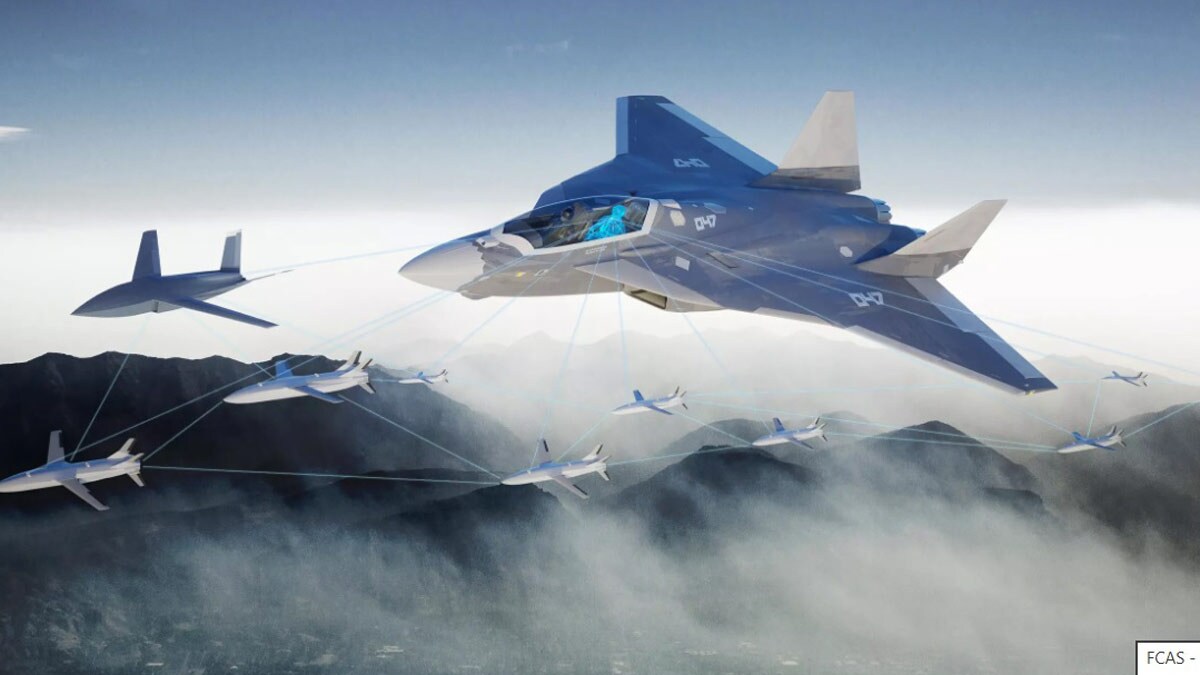
Even as the Indian Air Force is attempting to strengthen its fighter jet squadrons with the indigenous fifth-generation Advanced Medium Combat Aircraft (AMCA) and the Rafale deal with France, the defence ministry is also looking to go beyond fifth-generation jets, and move on to the next generation. This is especially important as stealth, AI, and unmanned systems are redefining the battlefield, as evidenced by conflicts across the world, including India’s May military stand-off with Pakistan.
Sixth-generation fighters go beyond current fifth-gen stealth aircraft like the American F-35 Lightning II or the Russian Su-57, with enhanced capabilities, moving to more of a system-of-systems approach, with features like AI-assisted or AI-controlled combat, manned-unmanned teaming of jets and drones, advanced stealth, hypersonic weapon capabilities, and even optional manning, making them highly suitable for a constantly evolving and increasingly unmanned aerial warfare environment.
India, which is already facing a critical shortage of squadrons, cannot afford to lag behind in the race for next-generation fighters at a time when China has already been making leaps in sixth-generation fighter development, with the testing of at least two tailless, next-generation prototypes.
Now, reports have emerged that the defence ministry has informed the standing committee on defence that it is looking at joining one of the two European consortia—the Global Combat Air Programme (GCAP) of the UK, Italy, and Japan, and the Future Combat Air System (FCAS) of France and Germany—so as to not fall behind in the race for a next-generation fighter jet.
In a report tabled in Parliament, the cabinet committee said it has been informed that two consortia are working on sixth-generation aircraft. "One is a consortium of the UK, Italy, and Japan, and the other is a consortium of France and Germany, and both are developing aircraft. The Committee has also been informed that the Air Force will try to join forces with one of the consortia and begin considering a sixth-generation fighter right away, with a view to ensure that they do not lag behind in achieving the target for advanced aircraft."
The committee said the fifth-generation AMCA has completed its design phase, and discussions regarding its development are currently in progress. "The Committee understands that, in view of the technical advancements in fighter aircraft globally and to meet the present security scenario, technical upgradation of aircraft is required on a top priority basis for enhancement of their combat capability."
It further said, "The Committee recommends the Ministry to chalk out a trajectory in this regard and step up the planning process for development and acquisition of sixth-generation (6G) aircraft, which would eventually enhance India's air domain capabilities in today's highly air-centric modern warfare."
Earlier, media reports had said India had expressed a desire to join the FCAS programme, which has been described as a system-of-systems built around a core Next Generation Weapon System (NGWS). It involves new-generation, highly advanced fighters working in tandem with uncrewed remote carriers, all connected to other systems in space, in the air, on the ground, at sea, and in cyberspace via a data cloud known as the ‘Combat Cloud’.
