



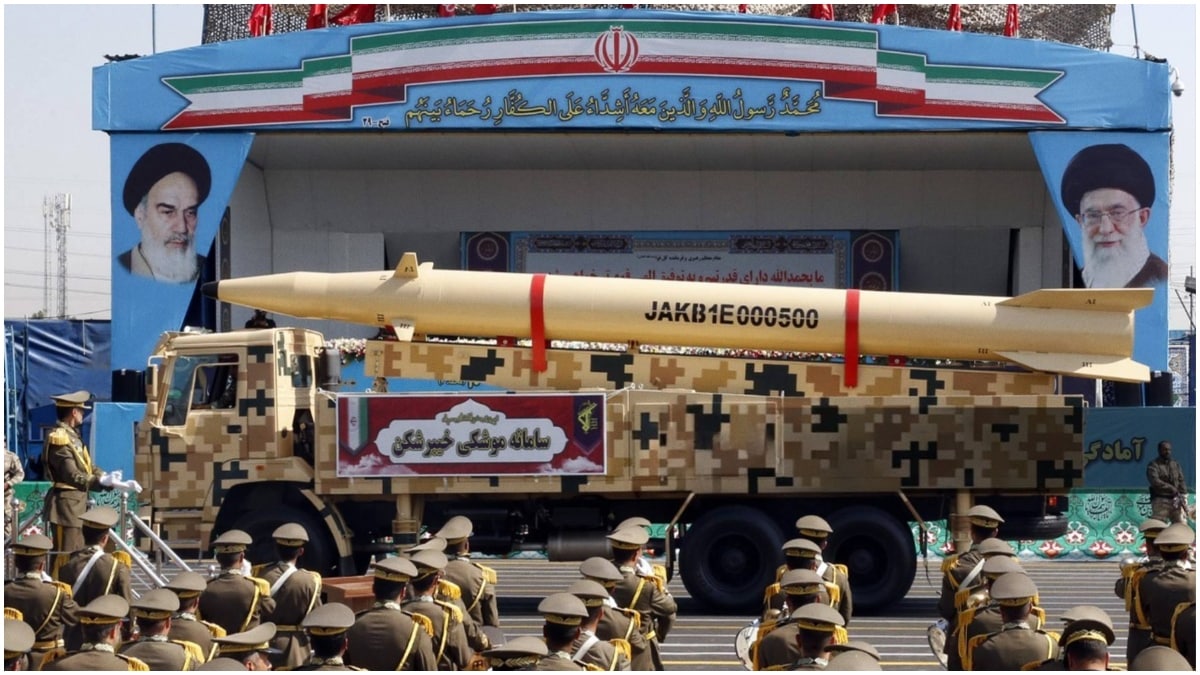
During last year's 'Twelve-Day War', Iran used its homegrown Kheibar Shekan ballistic missiles to target Israel's Ben Gurion Airport and military command centres, among other targets. According to reports, it was the first time that Tehran had used this secret weapon, which is said to be the most advanced in its arsenal, against its foes.
The Kheibar Shekan (sometimes spelled Khyber Shakan) missile is once again in the news as Iran remains unrelenting against Israel and the United States in the ongoing conflict, launching a barrage of projectiles against targets across the Middle East. The Kheibar is said to have been used in some of these attacks already, causing a headache for the time-tested air defence systems of both Israel and the US. Earlier, IRGC engineers had reportedly claimed that Kheibars can be made launch-ready in under 15 minutes. Here is a closer look at the Islamic Republic's feared missile.
How lethal are Kheibar Shekan missiles?
A third-generation IRGC missile unveiled in 2022, its name is composed of two words: "Kheibar" refers to a Jewish fort near Medina which was conquered by Muhammad in 628 AD, while "Shekan" means "destroyer" or "breaker". Consequently, the weapon’s very name is intended as a warning to Israel.
The Kheibar Shekan is said to have a range of 1,450 kilometres—which effectively makes it a medium-range ballistic missile—and can reportedly be launched from even commercial vehicles. IRGC scientists designed it in such a manner that the Kheibar is tougher to monitor or intercept. They come with no ailerons (movable control surfaces typically located on the trailing edges of a missile's fins), which reportedly reduces the area of friction and increases its speed and accuracy.
"The first thing that stands out about this missile is the relatively larger dimensions of the warhead's movable wings. This increase in wing dimensions increases the manoeuvrability of the warhead after entering the atmosphere and allows for more complex and faster manoeuvres to effectively bypass the barrier of anti-missile defences in the atmosphere, which is the specific task of defence systems such as the Israeli regime's David's Sling and the United States' Patriot," the Persian Alalam portal had said.
These missiles are considerably smaller compared to most of their counterparts, which makes storing them in underground facilities easier.
