



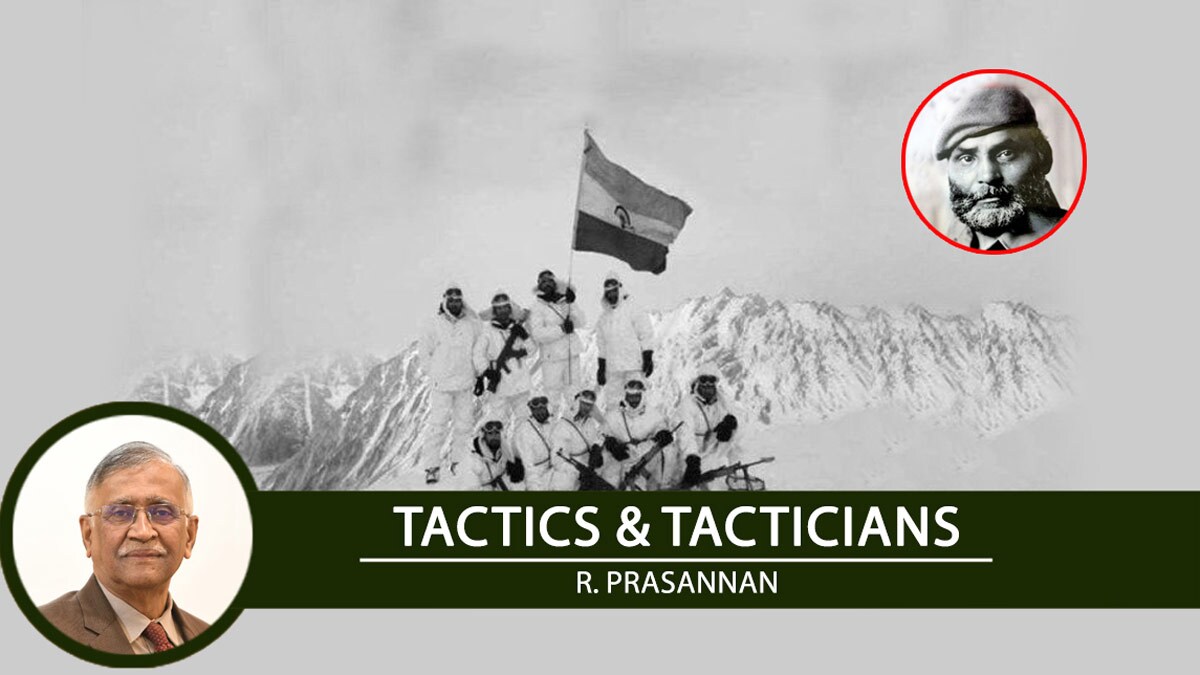
A man on a hilltop with a good dog and a machine gun can fend off an entire battalion of enemies - so goes a military maxim. You will need eight to 20 times the manpower or firepower to dislodge an enemy from a mountaintop.
The tactical significance of mountains and hills has been recognised since the time of the Chinese military strategist Sun Tzu, who lived 2500 years ago. There are many advantages to being on the high ground. No matter which direction the enemy comes from, they can be spotted from a distance. Since the paths to mountaintops are narrow, the enemy cannot advance in large groups, but in single file or double file. The man on top can take them down one by one by shooting, firing arrows, throwing stones, or even pouring boiling oil. On the contrary, the enemy coming up the hill suffers from a disadvantage. It is difficult to accurately hit a target when shooting arrows or throwing stones from below.
This is why the Pakistani army, despite numerous attempts since 1984, has been unable to dislodge the Indian Army from Siachen. Our boys have been sitting atop the Saltoro mountains that are adjacent to the Siachen region since then.
But how did we get to the top? Behind that is the story of Bull Kumar.
Narendra Kumar joined the military academy in 1950, where he charged at a six inch-taller, tougher and senior rival at his first boxing match. The rival, later Army chief S.F. Rodrigues, won the match, but Narendra came to be called Bull Kumar.
Bull was a passionate mountaineer. Losing four toes to frostbite in 1961, he charged up peaks in dozens, becoming the first Indian to scale the Nandadevi (1964), and the Kanchenjunga from its northeast face (1976), which was tougher than the Everest. He beat the Chinese to Barahoti and got patted on the back by Jawaharlal Nehru, skied down the Trisul wearing polythene sheets as stockings, and scaled the Everest 20 times.
Bull was heading the mountain warfare school in Gulmarg in 1977 when an old German rafter-friend asked if he could help him raft down the Nubra river. The US-printed map of Northern Kashmir that the German unrolled made Bull's blood freeze. It showed Siachen, the largest alpine glacier on earth which lay between Pak-held Kashmir and China-held Aksai Chin, as part of Pak-held Kashmir. (The border of the Siachen region was not demarcated on the ground or on maps. India considered it to be its territory.)
Bull grabbed the map and took it to the Army's operations chief Lt.-Gen. M.L. Chibber. Chibber persuaded Army chief Gen. T.N. Raina to sanction a 'training trek' by Bull and team to the heart of Siachen. There, the team picked up tin cans, chocolate wrappers and cigarette packets left behind by Pak and Pak-licensed climbers. While there, the team was threatened by a Pak Sabrejet, which fired warning smoke shots.
After making one more Siachen recce during which he became the first Indian to climb the 24,350-foot Sia Kangri, Bull published an account of his explorations. That was to test the ice. The publication alerted the Pakistanis; they understood India was planning some ‘mischief’ on Siachen. Soon, Indian spies in London learnt of the Pakistan army having ordered thousands of pairs of special mountain boots.
The Siachen game was afoot, literally.
Surmising that the Pak army was planning to occupy the glacier so as to get a link between the Pak-held Karakoram Pass and China-held Aksai Chin, Prime Minister Indira Gandhi sanctioned Operation Meghdoot in 1984, by which a brigade climbed up the Saltoro peaks, before the Pakistani army could arrive with their snow boots and other gear.
The Pakistanis, who arrived leisurely, were literally stunned to see Indians sitting atop the mountains. Since that day, they have been trying to dislodge the Indian Army from these mountain peaks, but have not succeeded so far. Although they captured one post in 1987, the Indian Army was able to recapture it.
More deadly than enemy attacks are the blood-freezing cold and the thin atmosphere there. It can lead to a condition where the lungs constrict, causing blood to leak into the air sacs. Fingers can get so frostbitten that they can fall off. No soldier is stationed there for more than three months. One must salute the soldiers of 1984-85, who went up there without even adequate winter clothing.
In 2003, both armies declared a ceasefire. However, soldiers continue to live there today, battling nature. The only solace is that the Indian Army is still positioned higher than the Pakistani army.
