



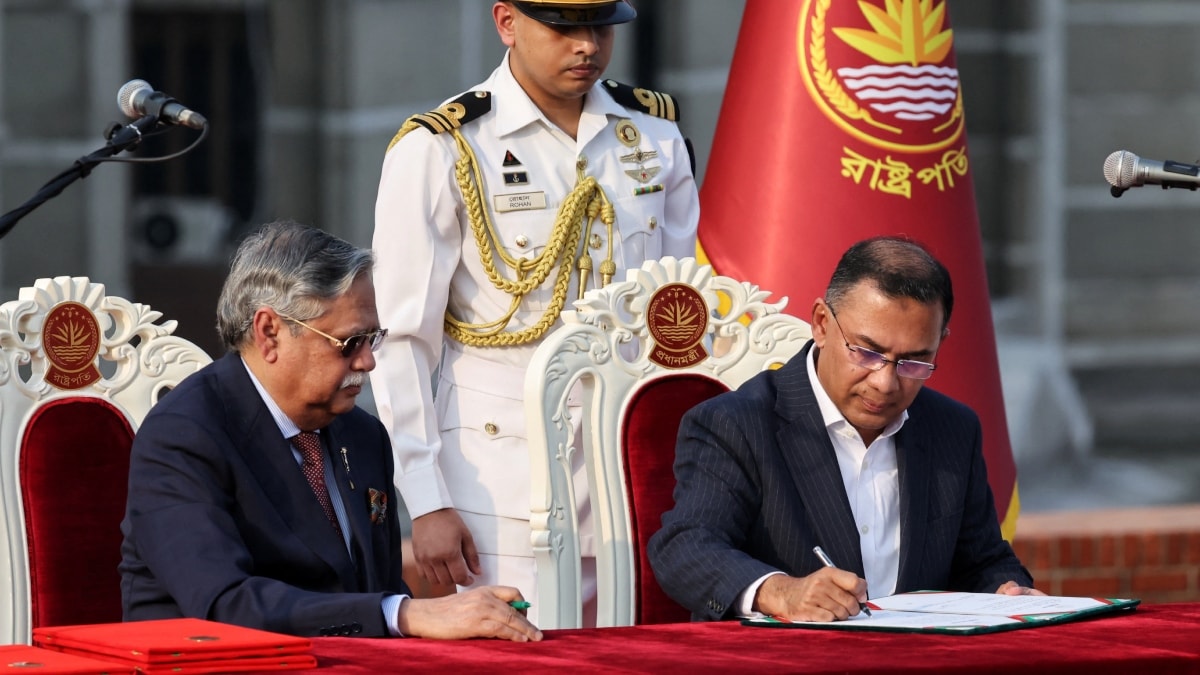
The political landscape of South Asia shifted on its axis on February 12, 2026. As the final tallies from Bangladesh’s general elections trickled in, confirming a landslide victory for the Bangladesh Nationalist Party (BNP) and its allies, a decade-long era of predictable—if increasingly brittle—bilateral stability came to an abrupt end. For New Delhi, the return of a BNP-led government, accompanied by a significant showing from the Jamaat-e-Islami, is not merely a change in administration across the border; it is a profound stress test for the ‘Neighbourhood First’ policy.
In the wake of Sheikh Hasina’s dramatic ouster in 2024 and the subsequent transitional period under Muhammad Yunus, India now faces a Bangladesh that is more assertive, more religiously conservative, and significantly more open to the strategic embrace of Beijing. The challenge for Indian diplomacy is no longer about preserving a ‘golden chapter’ with a friendly autocrat, but about forging a pragmatic, clear-eyed partnership with a revitalised democracy that views New Delhi with historical scepticism.
After all, Bangladesh is a crucial strategic partner for India, impacting its regional leadership goals through geographical connectivity, economic integration, and security cooperation. As India’s largest trading partner in South Asia, Bangladesh plays a key role in India’s Act East policy, facilitating trade in the North East and enhancing regional stability.
The ghost of 1971 and the weight of history
To understand the current stakes, one must look back at the foundational paradox of India-Bangladesh relations. India was the midwife of Bangladesh’s birth in 1971, a bond sealed in blood against the Pakistani military. However, the gratitude of the liberation era was never monolithic. While the Awami League, under the Mujibur Rahman lineage, championed secularism and a pro-India stance, the subsequent rise of military rulers like Ziaur Rahman—the founder of the BNP—introduced a brand of ‘Bangladeshi Nationalism’ that defined itself in opposition to Indian hegemony.
The ‘Hasina years’ (2009–2024) saw a remarkable reversal of this friction. The 2015 Land Boundary Agreement, which resolved decades-old enclave disputes, was hailed as a masterstroke of diplomacy. Under Hasina, Bangladesh became India’s largest trade partner in South Asia, and more importantly, a reliable security partner that dismantled insurgent camps targeting India’s Northeast. But this stability came at a cost: a growing perception in Dhaka that India was the primary patron of an increasingly authoritarian regime. When the student-led uprising of 2024 finally broke the dam, the anti-incumbency sentiment inevitably took on an anti-India hue.
The "Gen Z" mandate: Democracy over dogma
A critical factor in the 2026 election was the arrival of the "Gen Z" voter as a kingmaker. The 2024 uprising was not just a protest against Hasina; it was a rejection of the old political duopoly's corrupt tendencies. While the student-led National Citizen Party (NCP) struggled to translate street power into seats, their influence forced the BNP to modernise its rhetoric.
Tarique Rahman’s campaign focused on "democratic repair," appealing to a generation that views 1971 through the lens of human rights rather than blind party loyalty. For India, this means the old ‘pro-India vs anti-India’ binary is dead. Younger Bangladeshis want a relationship based on mutual respect and economic utility, not historical debt. If India continues to frame its ties solely through the lens of the Liberation War, it risks alienating a demographic that prioritizes digital jobs and visa-free travel over half-century-old war stories.
The strategic imperative: Beyond the ‘Chicken’s Neck’
For India, Bangladesh is not just a neighbour; it is a geographic necessity. The 4,096 km border is the longest India shares with any country, and it wraps around the ‘Chicken’s Neck’—the narrow Siliguri Corridor that connects mainland India to its seven northeastern states. A hostile or unstable Bangladesh could turn this corridor into a strategic chokehold.
Under the new BNP mandate, the security cooperation that India took for granted—the handover of ULFA militants and the suppression of anti-India terror cells—is no longer guaranteed. The BNP’s relationship with Jamaat-e-Islami, a group with deep-seated ideological friction with New Delhi, raises the spectre of a return to the early 2000s, when Indian insurgents found safe haven in the Chittagong Hill Tracts.
Troubled waters: The diplomacy of flow
Beyond security, the most visceral point of friction is water. The Ganges Water Sharing Treaty is set to expire in December 2026. Negotiating its renewal with a BNP government that has promised to "fight for every drop" will be gruelling. The BNP has already signalled that any renewal must be tied to progress on the Teesta River agreement, which has been stalled for over a decade due to domestic opposition in West Bengal.
India must recognize that for a lower-riparian state like Bangladesh, water is sovereignty. Failure to reach an appropriate agreement on the Ganges and Teesta will provide an easy target for nationalist rhetoric, potentially pushing Dhaka further into the arms of Beijing, which has already offered to fund a multi-billion dollar ‘Teesta River Comprehensive Management and Restoration Project.’
The dragon in the delta: The China factor
Perhaps the most pressing concern for New Delhi is the ‘Dragon in the Delta.’ During the vacuum left by Hasina’s departure, China moved with predatory precision. Beijing’s Belt and Road Initiative (BRI) has already funnelled billions into Bangladeshi ports and power plants, but the recent defence pact for a drone factory near the Indian border signals a shift from purely economic to overtly strategic interests.
The BNP has historically looked toward Beijing as a counterbalance to what it perceives as Indian overreach. With Tarique Rahman poised to take the helm, China is likely to offer a ‘sovereignty-first’ partnership: massive infrastructure loans with fewer of the democratic or human rights conditions often signalled by the West.
Regionalism reimagined: BIMSTEC vs. SAARC
The BNP’s return also reshuffles the deck for regional cooperation. Bangladesh currently holds the chairmanship of BIMSTEC (Bay of Bengal Initiative for Multi-Sectoral Technical and Economic Cooperation). India has long championed BIMSTEC as an alternative to the Pakistan-hamstrung SAARC.
However, the BNP may seek to revive SAARC to re-engage with Islamabad and dilute India's regional dominance. India must ensure that BIMSTEC remains the primary vehicle for integration by fast-tracking the ‘Bangkok Vision 2030.’ By supporting Bangladesh’s leadership in BIMSTEC, India can provide Dhaka with a prestigious platform that serves regional interests without pivoting back toward the stalemated SAARC framework.
The border paradox: Human rights as security
One of the most significant "silent irritants” in the relationship is the issue of border killings. For years, the death of Bangladeshi civilians at the hands of India’s Border Security Force (BSF) has been used by the BNP and Islamist groups to paint India as an aggressive, callous neighbour.
In this new era, India must realize that a "zero-fatality border policy” is not just a humanitarian necessity but a strategic one. Every incident at the fence provides fuel for anti-India protests in Dhaka. By implementing non-lethal border management and fostering joint patrolling with the Border Guard Bangladesh (BGB), India can strip its critics of their most potent emotional weapon. A ‘soft border’ for people and goods, combined with a ‘hard border for insurgents and smugglers, is the only sustainable way forward.
The Hasina dilemma: Justice vs. asylum
The most immediate diplomatic landmine is the physical presence of Sheikh Hasina on Indian soil. Sentenced to death in absentia in November 2025, her extradition is a rallying cry for the BNP and Jamaat base. For New Delhi, handing over a former ally who sought refuge would be a betrayal of its ‘asylum traditions’ and could signal to other regional leaders that India is weak and only a fair-weather friend.
The BNP government will likely use the extradition request as a litmus test for India’s respect for Bangladeshi sovereignty. India must find a "third way"—perhaps facilitating her relocation to a neutral third country—to remove this sovereign irritant from the bilateral equation before it triggers a formal diplomatic crisis. In the meanwhile, Sheikh Hasina must be dissuaded from using Indian territory as a base for her political activities.
The digital and cultural bridge: Soft Power 2.0
Finally, India must overhaul its soft power strategy. For too long, Indian influence has been seen through the prism of ‘Bollywood and Biryani.’ In a post-Hasina Bangladesh, India needs to engage with the vibrant, often critical, Bangladeshi civil society and its thriving tech sector.
By creating a ‘digital corridor’ that links the tech hubs of Bengaluru and Hyderabad with Dhaka’s emerging startups, India can offer value propositions that China cannot: shared language, shared culture, and shared democratic values. Student exchange programs, simplified medical visas, and collaborative research on climate change (a shared existential threat) can build a reservoir of goodwill that transcends whoever happens to be in power in the Prime Minister’s Office.
Conclusion: The path of pragmatism
The 2026 election results are a reminder that in geopolitics, there are no permanent friends, only permanent interests. India’s preference for the Awami League was a luxury of the past decade; its engagement with the BNP is the necessity of the coming one.
The victory of Tarique Rahman does not have to be seen as a zero-sum loss. If New Delhi acts with humility, strategic patience, and economic generosity, it can transform a historical adversary into a stable partner.
The ‘Chicken’s Neck’ is too narrow for India to allow a wall to be built between it and Dhaka. Instead, it must build a bridge—one sturdy enough to withstand the winds of political change and the rising tide of external influence. Bangladesh is at a crossroads; India must ensure that all roads still lead to a collaborative South Asia. The Dhaka pivot has begun; the challenge for New Delhi is to become a partner in this new journey, rather than be perceived as an adversary.
(Lt Gen Campose is the former Vice Chief of the Indian Army. He has authored the book ‘A National Strategy for India – the Way Forward’)
(The opinions expressed in this article are those of the author and do not purport to reflect the opinions or views of THE WEEK)
