



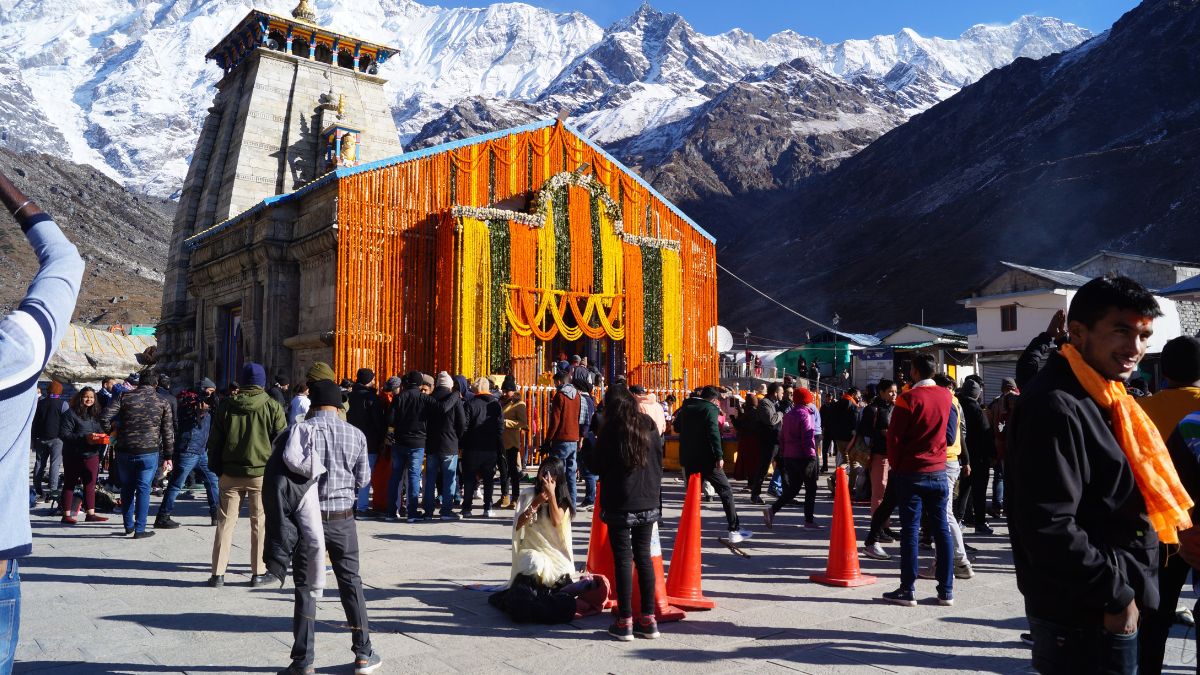
India has around 10 lakh temples. For most people, they are places of worship. For millions of others, they are where the day's income comes from.
A flower seller outside a temple in Tirupati, a prasad maker in Varanasi, a homestay owner in Ayodhya, a barber at the Tirumala tonsuring hall—these are the people the temple economy is built on.
And the scale of that economy is far larger than most people realise.
According to data from the National Sample Survey Office (NSSO), Hindus in India spend approximately Rs 4.74 lakh crore annually on religious pilgrimages.
A separate analysis drawing on the same NSSO figures puts the total value of India's temple economy at around Rs 3.02 lakh crore, equivalent to about 2.32 per cent of the GDP.
These figures come from NSSO survey data on religious spending and pilgrimage tourism, and remain the most cited baseline in academic research on the subject.
The employment picture attached to this economy is significant. Various sector-level estimates, including those referenced in research published by the International Journal for Multidisciplinary Research in 2024, suggest that religious tourism and temple-related activity together support around 7.6-8 crore livelihoods across India, primarily in hospitality, transport, flower farming, food services, and handicrafts.
These are the figures that reflect the range of employment that temple footfall generates in communities built around pilgrimage sites.
Field studies and temple administration records suggest that even a modest neighbourhood temple can sustain around 25 people in regular work—priests, cooks, security staff, cleaners, and others who depend on the temple for their daily income.
This is an estimate based on observational surveys—it is not a verified national statistic, but it gives a sense of how employment compounds across hundreds of thousands of small temples.
At the top end of the scale, the Tirumala Tirupati Devasthanams (TTD) offers the clearest picture of how a single temple drives an entire livelihood ecosystem.
According to the TTD's officially approved budget for 2025-26, the trust projects total revenue of Rs 5,258 crore.
Hundi donations are expected to reach Rs 1,729 crore. Prasad sales are estimated at Rs 600 crore. The Kalyanakatta wing—which manages tonsuring and auctions the hair offered by devotees to buyers in the United States, Japan, China, and Europe—is projected to bring in Rs 176.50 crore.
The TTD directly employs around 14,000 to 16,000 people and runs its own hospitals, educational institutions, bus services, and guest houses. The economic radius of that institution extends well beyond the hilltop.
Ayodhya shows what happens when a major temple opens in a town that had almost no economic base to speak of.
Before the Ram Temple's consecration in January 2024, the city saw roughly 1.7 lakh visitors annually, and local shopkeepers reported earning around Rs 400-500 per day.
Within six months of the temple opening, the city received more than 11 crore visitors, according to a study by the Indian Institute of Management, Lucknow, titled Economic Renaissance of Ayodhya.
The same study found that average daily earnings of small traders rose to around Rs 2,500.
Property rates went up five to ten times in parts of the city. More than 150 new hotels and homestays came up, and 6,000 new MSMEs were registered.
An estimated 1.2 lakh direct and indirect jobs are expected to be generated in the coming years. A homestay owner who used to rent a room for Rs 3,000 per month began charging Rs 3,000 per day.
Flower sellers, souvenir makers, auto drivers, and food vendors all reported income they had not seen before. A vendor selling pictures of Ram Lalla told researchers he earned over Rs 5 lakh in his first year. A puja items seller reported his daily income rising from Rs 300 to Rs 2,500.
These are individual accounts, but they point to a pattern that repeats across every major temple town in the country.
This is the economy the title refers to. Not vaults of gold or budget spreadsheets, but a prasad seller in Tirupati, a taxi driver in Ayodhya, a barber at Tirumala who earns his wage from the hair a devotee has just offered to a deity, and so on. For them, the temple is not a metaphor for economic activity—it is the economy itself.
The author is the founder of Temple Connect and the International Temples Convention & EXPO (ITCX).
