



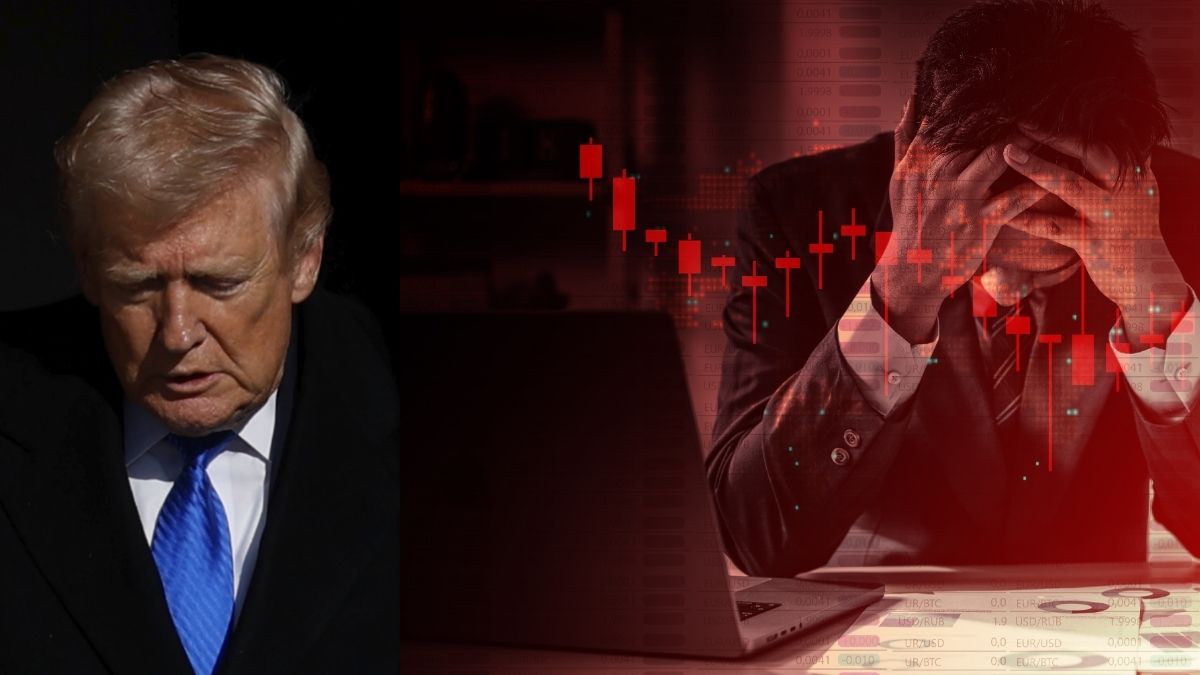
The recent turbulent journey of the Indian stock market seems like a testament to the fact that Indian investors are not only easily spooked but also never in the habit of learning from the past.
On Monday, when Donald Trump hinted at "blowing up" Kharg Island, Sensex slid. On Wednesday, Trump said Washington could wind down its military strikes on Iran within two to three weeks without requiring Tehran to first sign a deal, and the Sensex goes up. Now, on Thursday, Trump announced that the US plans to "send Iran back to Stone Age", and now we have a Sensex in free fall.
Even the Nasdaq has not been this seemingly shameless in aping Trump’s mood swings. In fact, the US benchmark gained 0.68 per cent in the past 5 days. The Sensex lost over 4 per cent. The BSE index might have lost more, but thanks to a market holiday on Tuesday, we did not have to witness one more day of trigger-happy, turbulent trading.
Yes, 80 per cent of India’s natural gas comes through the Strait of Hormuz. And around 60 per cent of our crude is from the Middle East. Our IT index is married to the US markets. And the globalisation of information technology services and their continued layoffs have done more harm than good to India since the pandemic. But are our investors falling to fear more than their US counterparts?
In March, the Indian volatility index (India VIX) more than doubled to around 27.9, its biggest monthly jump in six years. In the first half of March alone, India VIX surged 39–50 per cent.
Compare that with the US. The American VIX did jump to around 27.3 right after the Strait of Hormuz was closed, but it was only a 23 per cent jump. US indices have been volatile, but not in a full-blown correction the way Indian benchmarks were. This meant Indian markets were seeing more fluctuations.
The US markets are also treated as a relatively safe haven and even benefit in parts from higher energy prices. In short, easing war fears has calmed Wall Street faster than Dalal Street.
Why the Iran war bites India harder
First, oil. India imports around 85–88 per cent of its crude. The Iran war has pushed Brent up as much as 60 per cent in March, with prices briefly touching $115–120 a barrel. For India, that directly threatens inflation, the fiscal deficit, the current account and the rupee. Markets are repricing these macro risks.
Second, foreign money is leaving. As the conflict escalated, March saw record monthly foreign outflows from Indian equities, adding to pressure on the indices and the rupee. In global "risk-off" phases, investors tend to pull money from emerging markets like India first, while keeping more exposure to large, liquid developed markets such as the US. That makes Indian benchmarks more turbulent for the same global shock.
Third, positioning and valuations. Indian equities came into this crisis near record highs with rich valuations and very heavy domestic and retail participation. When a shock hits at stretched valuations, the fall is also sharper. This is due to a variety of reasons, like stop-losses triggering, margin calls hitting leveraged players, and small to mid-caps reacting violently.
And finally, India’s macro sensitivity is higher. A prolonged period of $100–120 oil became far more damaging for an oil-importing, developing economy than for the US, which is a major producer and exporter of energy. Moreover, the US has a reserve currency to cushion shocks.
In short, yes, Indian investors seem like they are falling for Trump’s words. But the deadly mix of these factors, paired with sharper market corrections, makes the market look more like a sine wave.
