



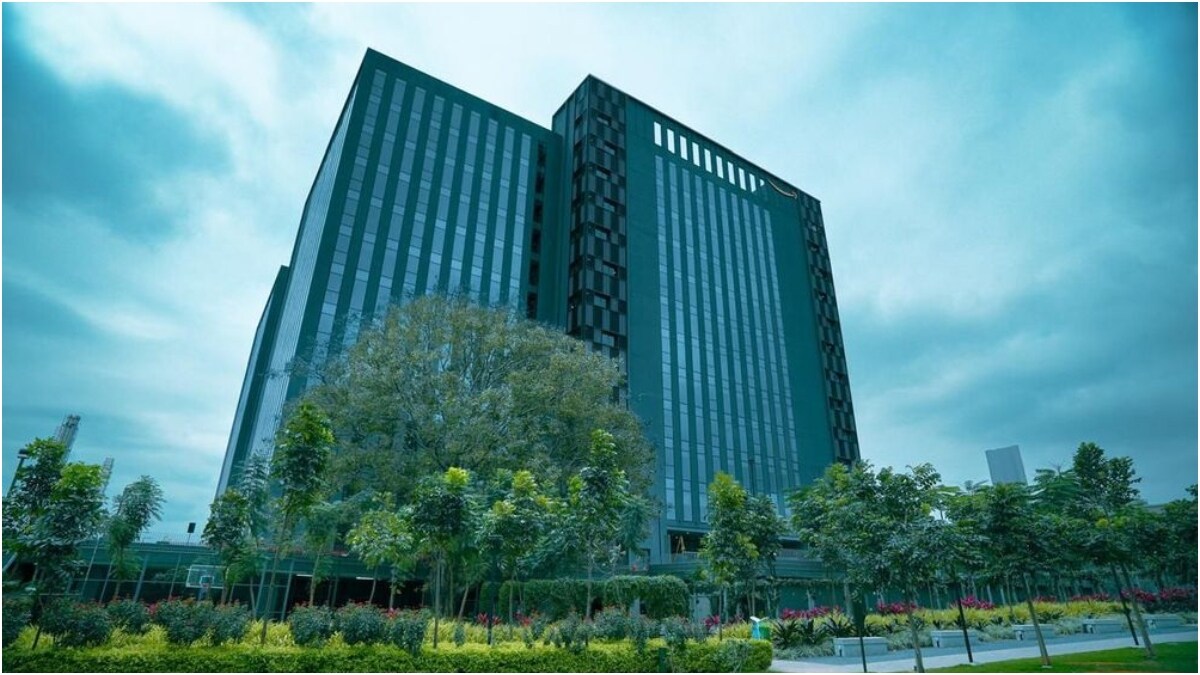
Amazon on Monday opened its second-largest office in Asia in Bengaluru. The campus is also Amazon's second-largest single-building corporate office globally, spanning 1.1 million square feet.
The 12-storey campus will support over 7,000 employees across e-commerce, operations, payments, technology, and seller services in India. The office is built on a five-acre site approximately 15 kilometres from Kempegowda International Airport in the IT city. The launch of this new campus is part of Amazon’s continued investments in India. The company has already invested over $40 billion in India and has committed to invest an additional $35 billion by 2030. The corporate building was officially inaugurated by M.B. Patil, Minister for Large & Medium Industries and Infrastructure Development, Government of Karnataka.
“We applaud Amazon’s commitment to invest $35 billion in India by 2030. This ambitious vision will empower millions of small businesses and support billions of jobs, and we are proud that Karnataka remains at the heart of it. Karnataka is the second-highest GST contributor in India. More importantly, we also drive India's Global Capability Centres (GCC) landscape, as there are 900-plus GCCs right here in Karnataka. We are also actively shaping our policies so that our new industrial policy is future-ready,” remarked Patil while inaugurating the campus.
David Zapolsky, SVP, Chief Global Affairs and Legal Officer at Amazon, observed that over the years the company had seen strong and sustained growth across all of its businesses here, including e-commerce, AWS, devices, payments, Prime Video, and other services.
“We know Indian customers are digitally savvy, mobile-first, and quick to embrace new technologies. The level of AI experimentation and awareness here in India that I have seen across startups and enterprises is really remarkable. That constant push from customers, sellers, enterprises, and developers raises our bar and asks us to innovate faster. Our commitment to India today is backed by significant investments. To date, we have invested $40 billion across all of our business units in the country, and we have recently committed to invest $35 billion more in the years ahead. The strength of engineering, product, science, and operations talent in India is also extraordinary. Teams based in India are not only building for India; they are building for customers around the world,” said Zapolsky.
He also said that India-based teams are critical to Amazon’s global operations. “From core cloud infrastructure and machine learning systems to supply chain optimisation and customer experience tools, India-based teams power mission-critical services across North America, Europe, the Middle East, Latin America, and Asia-Pacific,” added Zapolsky.
He also felt that, increasingly, India is the source of innovation for Amazon that travels globally. A strong example is "Amazon Now", its quick-commerce option which is designed to meet the needs of customers in fast-paced urban centres. “What began as a solution tailored for India is quickly making its way across the Middle East, North America, Europe, and Latin America,” pointed out Zapolsky.
Amazon’s new campus in Bengaluru will also bring together adaptable workspaces and collaborative zones organised into self-sustaining neighbourhoods with meeting rooms, huddle spaces, breakout areas, and event spaces that can host more than 200 people. Employees will have access to dedicated recreation facilities, including basketball and pickleball courts, an amphitheatre, landscaped lawns, and outdoor community spaces. Cafeterias across two floors will serve a range of global cuisines.
The new campus represents the company’s effort to reduce carbon across its corporate office portfolio, aligned with Amazon’s goal of reaching net-zero carbon by 2040 under The Climate Pledge. The project also incorporates strategies such as responsible material sourcing, the reuse of office assets, and systems aimed at reducing embodied and operational carbon.
.
