



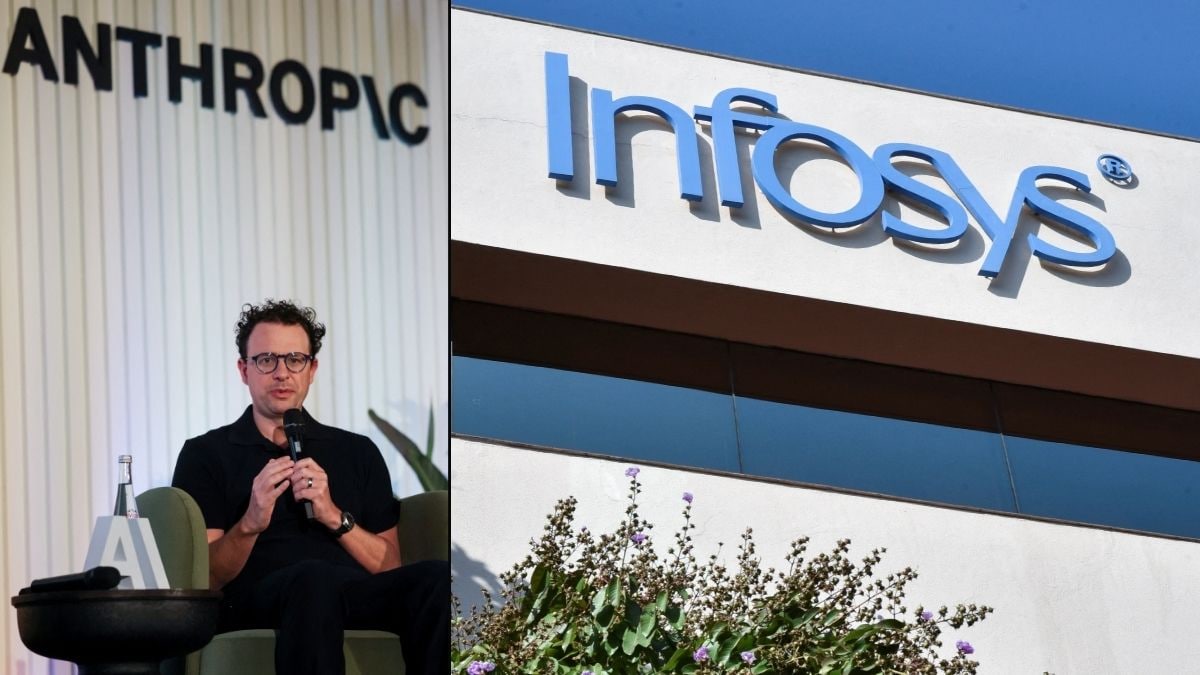
A day after Anthropic, the US-based AI giant behind the Claude LLM models, formally opened its first India office in Bengaluru, it took another significant step—partnering with Indian IT services megalith Infosys.
While the news of this deal took Infosys shares on a rally, the message from Claude-maker was clear—India is now central to its growth and product strategy.
This also signalled that the country is no longer the stage for simply using run-of-the-mill AI LLM models. Indian developers, enterprises and policymakers would now be at the forefront of how the AI ecosystem is shaping up, and how new technologies are being built and deployed.
India-focused roadmap
Anthropic CEO Dario Amodei, on Monday, said that India was already its second-largest market for Claude.ai, with nearly half of local usage involving computer and mathematical work such as building applications, modernising systems and shipping production software.
Run‑rate revenue from India doubled since the company announced its expansion in October 2025, prompting it to set up a dedicated Bengaluru office—its second in Asia after Tokyo—led by country MD Irina Ghose.
The company launched a structured push to improve Claude’s performance in Indian languages by curating better training data across 10 tongues, including Hindi, Bengali, Tamil, Telugu, Marathi and Urdu.
The company also said that it was working with organisations like Karya, Digital Green and Adalat AI to build public evaluations for Indic-language tasks in sectors such as agriculture and law, designed to guide future model improvements.
Infosys tie-up
On Tuesday morning, Infosys announced a strategic collaboration with Anthropic to take Claude and Claude Code into complex, regulated industries such as telecom, financial services, manufacturing and large-scale software development.
The partnership would start with a dedicated Anthropic Centre of Excellence in telecommunications and expand to other sectors, integrating Claude models into Infosys Topaz to automate workflows, modernise legacy systems and build “agentic” AI that can handle multi-step tasks like claims processing and compliance checks.
Infosys CEO Salil Parekh noted that the goal was to help enterprises become “more intelligent, resilient and responsible,” positioning AI as a driver of new operating models rather than just cost-cutting.
For the IT sector itself, this offers a way to move up the value chain—from staff-augmentation to co-building AI-first platforms—at a time when global clients are rethinking technology spending. But for the workforce, it might be a different story.
India’s AI advantage: scale, talent and public infrastructure
Recently, Anthropic CEO Dario Amodei described India’s “entrepreneurial energy and technical acumen” as unique, noting that the firm’s India business has nearly doubled in four months and that the country offers rare scale to run experiments with “hundreds of millions of people.”
Amodei cited rapid government adoption, including the Ministry of Statistics’ Model Context Protocol (MCP) server that lets AI systems query official economic data, as evidence that Indian institutions can move faster than peers elsewhere.
Anthropic’s official company statements also highlighted partnerships stretching from Air India and CRED to Razorpay, Enterpret and Emergent on the commercial side, and Pratham, Central Square Foundation, EkStep, Noora Health and Intelehealth in the social sector.
The writing on the wall is clear—India is not just a large AI market but a test bed for multilingual, safety-focused applications in education, health, finance and governance that could later be exported to other emerging economies. However, we need to address the elephant in the room: What does Anthropic integration replace? What is the human cost?
Anthropic’s entry into India and its collaboration with Infosys come with a complex human cost, especially for the country’s huge white‑collar IT workforce.
Claude Code and Cowork tools automate exactly the kind of routine coding, testing, documentation and back‑office work that has historically powered India’s outsourcing model. This obviously raises the risk of reduced demand for entry‑level engineers and mid‑level support roles over the next few years.
However, many experts stress that the impact is more likely to be job transformation than an overnight wipe‑out, with new demand emerging for higher‑value roles in AI deployment, governance, integration and ethics—roles that require reskilling and may not be easily accessible to all displaced workers.
The Centre’s challenge would be to ensure that partnerships such as Anthropic–Infosys create enough new, quality jobs and mass‑scale upskilling opportunities to offset the pressures on traditional IT (and even BPO) employment, particularly for young graduates and workers from smaller towns who have long seen these sectors as their main path to a better life.
