



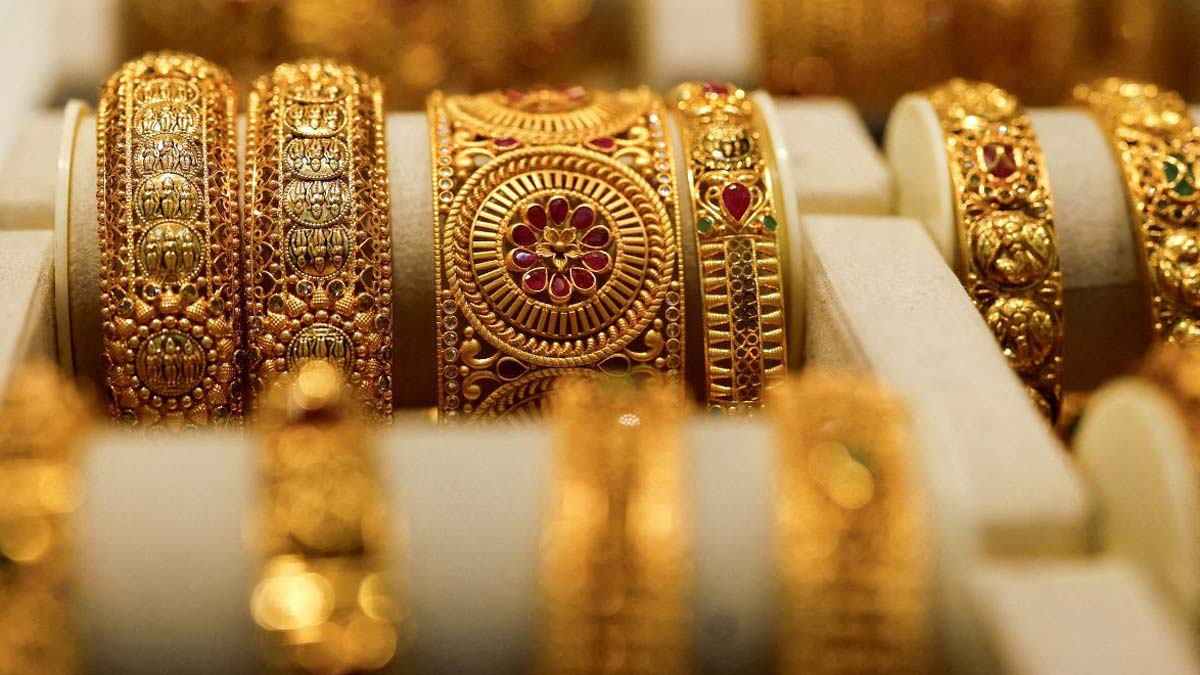
Gold is on a…er…’gold run’. The yellow metal registered record rates in India on Monday, and so has silver. Overall, gold prices have increased by 32 per cent.
And that’s just one half of all that glitters. On the strategic level, demand for gold is again on a high. For example, India’s Reserve Bank has been amassing a lot more gold bullion, as compared to US treasury bills.
As Trump’s tariff tirade wreaks havoc on global trade, with a long-term repercussion on the anvil, this safe haven metal, which last had its spot in the sun not too long ago when war broke out in Ukraine as well as Israel, is again back under the spotlight. The demand for gold has increased in India, too, as worries abound over the economy despite a better-than-expected 7.8 per cent growth rate in the April-June period. The reason? The debilitating 50 per cent tariff came into effect only last month, and its effect will start showing once Q2 growth is tabulated and revealed in November end. With analysts predicting Indian GDP’s fab run is in for a dampener, there is increased demand for assets like the precious metals.
In India, gold prices hit 1.05 lakh (for 10 grams of 24 karat) on Monday, with silver prices also at a record 1.17 for a kilogram. Meanwhile, in Dubai, too, gold prices hit an all-time high, with one gram of 24 karat currently priced at 418.75 dirhams.
In the global metals market, gold is set to overtake its all-time high of $3,500 — a record set back in April. On September 1, the yellow fellow was just 20 dollars shy of crossing the milestone. Interestingly, gold’s international performance has been even better than the hike in the Indian markets — while in India prices this year increased by 32 per cent, in the international market the increase has been much more solid, at 40 per cent.
“Gold’s glitter is back in the spotlight, not only as a classic safe haven but also as a strategic hedge,” said Chandrika Raghavendra, assistant professor (economics and international business) at Chennai’s Great Lakes Institute of Management. “Futures on the Multi-Commodity Exchange have exceeded ₹1 lakh per 10 grams, driven by rupee instability, a weaker dollar, and rising geopolitical tensions."
Of particular note is the fact that central banks around the world are looking at gold with renewed vigour, and the fact that it is coming at the start of what promises to be a newsy week is no accident. The US President seems to be in no mood to dial down his histrionics, and major economies of the world are looking at alternatives — forming new strategic alliances, sewing up trade deals and sending signals (like what Indian PM Modi did over the weekend by posing with the likes of Russia’s Putin and China’s Xi). The SCO Summit also assumes added significance in this light, while the US Federal Reserve’s decision on rate cuts (or not) is also majorly anticipated. To sum it up — gold as a fallback option.
And that includes India’s own central bank. “The Reserve Bank of India has been steadily increasing its gold reserves, which now account for nearly 12 per cent of its foreign exchange holdings,” pointed out out Chandrika, adding, “This trend reflects a global shift where central banks are shifting away from US Treasuries to gold, indicating a quest for stability amid global instability.”
She puts it in perspective. “For Indian households, gold remains a powerful symbol of financial security. For policymakers, it serves as a safeguard against inflation, currency fluctuations, and external shocks. The combination of household trust and institutional strategy ensures that during times of heightened uncertainty, gold’s appeal not only persists but grows stronger.”
