



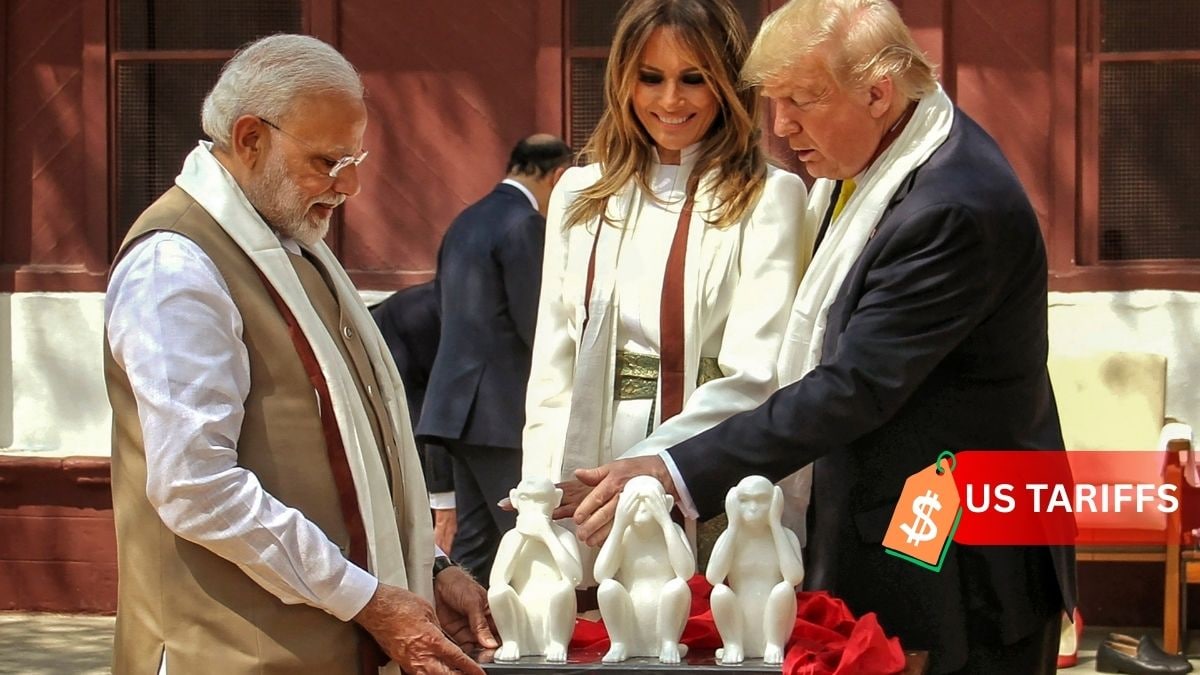
US President Donald Trump’s secondary tariffs on India came into effect on Wednesday, much to the ire of New Delhi. This move now brings the total tariffs on the Narendra Modi-led nation to a staggering 50 per cent.
It all began with Trump pushing the world’s fourth-largest economy to open up in agriculture and dairy markets to cheap US imports to India, which New Delhi shot down. Moreover, India did not heed the “advice” on pausing the import of Russian oil.
Now, let’s take a look at how it all came to be.
In February, Modi visited the US and agreed to begin work on a trade deal between the two nations to expand bilateral trade to $500 billion by 2030. The date to clinch the deal was roughly set for fall 2025.
Following this, Union Minister for Commerce and Industry Piyush Goyal met with US Commerce Secretary Howard Lutnick and Trade Representative Jamisen Greer in Washington in March.
Later in the month, a US delegation visited India for further talks, and New Delhi announced that the negotiations were progressing well.
Around the same time, the US Trade Representative’s annual report highlighted the high tariffs India slapped on US imports.
By April, Vice President J.D. Vance later reached India to further talks, with India announcing that a deal could be signed before the original July 9 deadline.
On April 22 2025, US ally Pakistan-backed terrorist group The Resistance Front (TRF) attacked Pahalgam in Jammu and Kashmir, India, killing 26 tourists and one local, and injuring 20 others.
India went on to expel Pakistani diplomats, called back its diplomats, suspended visas, closed borders, and suspended the Indus Waters Treaty. On May 7 2025, India launched Operation Sindoor with missile strikes on Pakistan’s base of terrorist operations.
By May 10, India decided to stop the conflict. However, later, Trump claimed credit in the US that he was the one who brokered peace between India and Pakistan.
Meanwhile, lead negotiator Rajesh Agrawal joined Goyal for more talks in the US in May. By June, US Commerce Secretary Howard Lutnick told the media that the India-US interim deal could be finalised soon. Trump backed this, announcing a “big” deal with India was “coming soon”.
ALSO READ | ‘Justice League against America’: Brazil to join defiant India in team Global South?
Meanwhile, exclusive media reports emerged that trade talks have stalled due to the US and India not agreeing on agriculture and dairy import duties.
By July, the Indian delegation returned to New Delhi without any major progress. Goyal told the media that India would not ink trade deals just to meet deadlines, and announced that national interest came first.
ALSO READ | 'Modi put his foot down': Even Fox News thinks Donald Trump tariffs on India was a geopolitical blunder
Later in the month, India sends another team to revive the deal.
Around the same time, Modi shot down Trump’s claims that he brokered peace between India and Pakistan by publicly rejecting the US President’s statements in the Parliament.
By July-end, Trump announced 25 per cent tariffs on Indian imports. He also warns of additional duties of 25 per cent if India continued the purchase of Russian oil. India called the move “double standards” and “unfair”.
ALSO READ | India’s silence on the Trump tariffs speaks volumes
The 25 per cent tariffs on India came into effect on August 7 2025. Modi and other leaders went public and stated that the Centre would not bow down to the US, stating that, despite the “heavy price”, India would not compromise on the interests of farmers.
ALSO READ | Classic American delusion? US Treasury Secretary Bessent calls India ‘recalcitrant’ in trade talks
Later, Modi announced his first ever visit to China in seven years. The US trade delegation visit to India, scheduled for the last week of August, was called off.
As it stands now, Indian imports to the US carry the highest “Trump tariffs” at 50 per cent. Trade and foreign affairs experts expect a severe short-term impact of tariffs on India, but are optimistic that Modi and Trump will come to the table to work out a better deal soon.
