



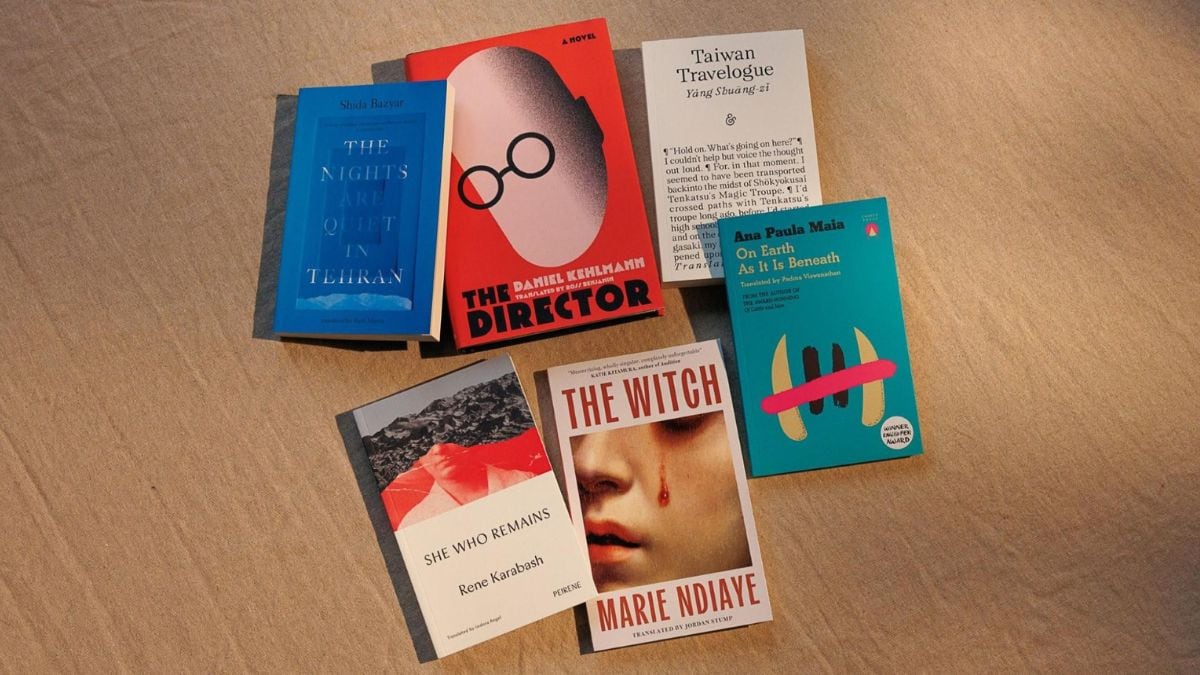
From Nazi Germany to post-revolutionary Iran and the Albanian Alps, the six books shortlisted for the International Booker Prize 2026 span turbulent histories and deeply personal rebellions. The writers and translators behind them are equally diverse, representing eight countries: Brazil, Bulgaria, Canada, France, Germany, Taiwan, the UK and the United States.
Women lead the shortlist, accounting for five of the six authors and four of the six translators.
The winner is set to be announced on Tuesday (May 19) at Tate Modern, London. One of the most equitable honours for novelists and translators alike, the £50,000 prize money will be divided equally between author and translator.
Natasha Brown is the Chair of this year’s judging panel, which also includes writers Troy Onyango and Nilanjana S Roy, translator Sophie Hughes, and Oxford Professor Marcus du Sautoy. “With narratives that capture moments from across the past century, these books reverberate with history,” said Brown about the shortlisted titles.
Two of them are debut books.
Shida Bazyar’s The Nights Are Quiet in Tehran follows an Iranian family’s experience of the 1979 Islamic Revolution in Iran, their exile, memory and hope. Translated from German into English by Ruth Martin, the novel spans four decades from 1979 to 2009. It opens in 1979 with father Behzad, a left-leaning activist, before moving to mother Nahid in Germany. It then shifts to Laleh, the first-born daughter and her family visit to Iran in 1999, and then the son Mo in 2009.
Rene Karabash’s She Who Remains is the other debut title in the shortlist. Set in the Albanian Alps in a strict patriarchal community, it follows a teenager who becomes a sworn virgin to escape an arranged marriage. She renouncing her womanhood to live as a man, making a case for what one makes of gender, identity and freedom. It’s translated by Izidora Angel from Bulgarian.
If these two are debut books, Marie NDiaye’s The Witch was published in French 30 years ago. Translated by Jordan Stump, it’s set in the 1990s France and follows a woman in an unhappy marriage who passes on her supernatural gift to her daughters. Showcasing a woman’s role – as a daughter, wife and mother – it’s a commentary on gendered expectations. Notably, NDiaye is the winner of Prix Goncourt, France’s most prestigious literary honour. She became the first Black woman to win it, in 2009.
This isn’t the first time the duo has made it to the list. They were earlier longlisted in 2016.
Another duo to have been nominated before is Daniel Kehlmann and Ross Benjamin, who made it to the shortlist in 2020. This year, the pairing is back with The Director. It follows the real-life filmmaker G.W. Pabst, who returns from Hollywood to his homeland in the Nazi-controlled Europe in the 1930s. Once an authority in Weimar cinema, he’s now forced to make Nazi propaganda. In a way, the novel’s exploration of art bending before power feels eerily contemporary.
Like The Director, Yang Shuang-zi’s Taiwan Travelogue, too, unfolds in the 1930s in Japan-ruled Taiwan. Translated by Lin King, it follows a fictional Japanese author’s culinary journey with a local translator. While premised on colonialism, it delves further into the friendship the two women forge, hinting at queer relation, while not stating it explicitly.
The book won National Book Award for Translated Literature in 2024.
Meanwhile, Ana Paula Maria’s On Earth As It Is Beneath, takes the readers to a penal colony in remote Brazil, which is built on land where enslaved people were tortured and murdered.
While there would be one winner, to be announced on Tuesday, it’s a win, yet again, to discover titles that span geographies, languages, themes and timelines.
