



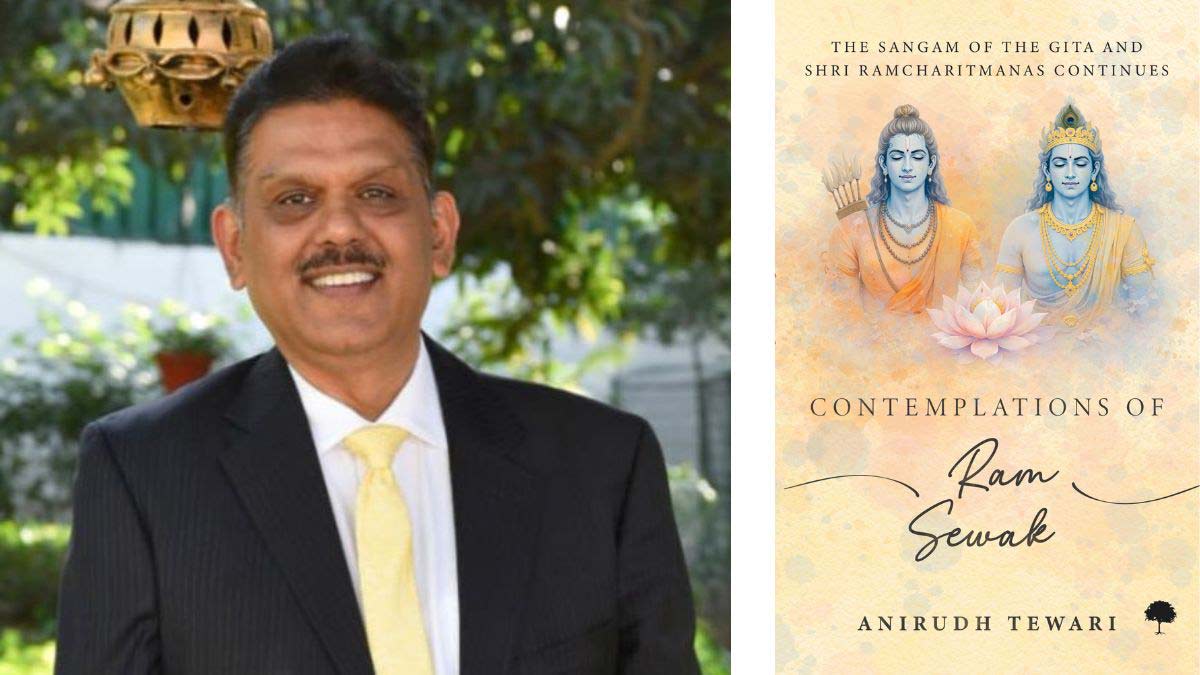
In Contemplations of Ram Sewak, senior IAS officer Anirudh Tewari extends a line of inquiry he began in his earlier work, Reflections of Ram Sewak. He explores the shared philosophical ground between the Bhagavad Gita and the Ramcharitmanas.
If the earlier book sought to map these parallels through structured commentary, the new volume adopts a more reflective mode, drawing on episodes from the Ramcharitmanas and placing them alongside corresponding ideas in the Gita. The book brings together 54 reflective essays with an emphasis on the synthesis of karma, bhakti, and gyan as interconnected approaches to navigating both personal and public life. In easy-to-understand essays, the book draws the reader to connect with the age-old wisdom which they may find relevant in the chaotic world.
Tewari’s long career in public administration informs this reading. While contexts change, he argues, the underlying ethical questions around duty, judgement, and responsibility remain constant. His engagement with the texts is less an academic exercise than an attempt to locate their relevance in contemporary life.
He speaks to THE WEEK about the origins of this project, the method behind his comparative approach, and what these texts might still offer to a modern reader.
Q: Your works are built on the idea that the Bhagavad Gita and the Ramcharitmanas share a common philosophical thread despite being separated by centuries. What first led you to see this continuity?
A: I was fortunate to be introduced to The Gita and Shri Ramcharitmanas at an early age by my grandfather. Reciting parts of these two spiritual texts became part of my daily routine. It was much later that I began to grasp their profundity. This prompted me to read not only the texts but also some commentaries by enlightened souls and scholars. It was during this time that, one day, I read verse (chaupai) 121.3-4 in the 1st canto (Balkanda) of Shri Ramcharitmanas, which echoes exactly what Lord Krishna says in Shlokas 4.7-8 of The Gita. Both these verses say that whenever virtue (dharma) declines, the Supreme incarnates to relieve the distress of the virtuous. That set me thinking that there may be a common philosophical thread connecting the two great texts, despite their composition being about 3,000 years apart. It is a testament to our scholars and saints who have preserved this knowledge across generations without distorting its core thought and philosophy.
Q: Many scholars have studied these texts independently. What gap did you identify that led you to bring them into a single framework?
A: I wouldn’t say I identified a gap; I would say my initial discovery made me more curious to find more commonalities and to take a deep dive. As I delved deeper, a treasure trove awaited. Perhaps in the two books I have managed to write, I have only been able to grasp a handful. There is an infinite mine of knowledge waiting. Personally, this journey has been very fulfilling, as I have developed a slightly better understanding of the nuances of karma yoga, gyan yoga, and bhakti yoga. While the concepts are the same in both these spiritual masterpieces, the difference lies in the language and the manner of composition. While The Gita is in Sanskrit in shlokas, Shri Ramcharitmanas is primarily composed in dohas and chaupais in the Awadhi dialect of Hindi. Reading them together is an altogether different experience: joyful, satisfying, and fulfilling!
Q: You spent decades in public administration. How did that experience shape your engagement with ideas of duty, ethics, and moral conflict in these texts?
A: My over three decades of public service have certainly exposed me to situations that present dilemmas in responses. What I have discovered while reading The Gita and Shri Ramcharitmanas is that although the challenges involving duty, ethics, and morality remain the same, the responses have evolved. Nonetheless, the answers in absolute terms certainly remain the same. Perspectives have changed over time. While some relative changes are necessary and understandable, what must be borne in mind is that the fundamentals have and will remain the same.
Q: Contemplations of Ram Sewak builds on your earlier work but adopts a more reflective tone. What prompted this shift from explanation to contemplation?
A: I don’t believe it was intentional or by design; it simply happened. It is probably a part of the evolutionary process, both as a writer and as someone undertaking this journey. I am perhaps the least qualified to be instructive in this field; this is just an endeavour to nudge readers to take this fulfilling journey and discover the joy that lies ahead. Both books are just an effort to help people find their inner clarity and equanimity. It’s everyone’s personal journey and discovery. As Gautama Buddha said, “Be a light unto yourself.” So, my humble suggestion is to pause, contemplate, and progress.
Q: You place shlokas from the Gita alongside chaupais and dohas from the Ramcharitmanas. What was your method in identifying meaningful parallels between the two?
A: In both these books, the same format is followed. What I have done is to primarily select an episode from Shri Ramcharitmanas that contains profound philosophical insights. As I explore the hidden gems of spirituality embedded in the chaupais and dohas, I searched for shlokas from The Gita that reflect or enhance the same philosophical concepts, or clarify what the chaupais and dohas convey. In the first book, Reflections of Ram Sewak, I present a conversation between Shri Ram and Sabari, in which Shri Ram imparts the essence of Bhakti through Navadha Bhakti. This is reflected in Chapter 12 of The Gita, where Shri Krishna describes Bhakti Yoga. In the second book, Contemplations of Ram Sewak, I discuss the Lakshman Gita, a conversation between Lakshmana and the tribal King Nishadraj. This is Lakshman’s discourse on Karma Yoga, which Shri Krishna articulates so well in The Gita.
Q: Do Krishna and Rama represent distinct models of leadership and moral authority? What can contemporary public life learn from them?
A: Well, both of these avatars appeared in different yugas or epochs, which also reflect the development of society. For example, in Satyuga, the conflict was between the Suras and Asuras, who inhabited different lokas or realms. During Shri Ram’s avatar in Treta Yuga, the fight was between two kingdoms (Ayodhya and Lanka). At the time of Shri Krishna's avatar in Dwapara Yuga, the conflict was within the same family (the Kauravas and the Pandavas were cousins), and perhaps today, the conflict exists within each individual. So, yes, given the times and circumstances, Shri Rama and Shri Krishna offered different models of leadership and moral authority. Shri Rama was the Maryada Purushottam – the ideal one. The ethical, principled, disciplined disciple, son, prince, husband, and king. For him, dharma, truth, and duty had to be followed, even at great personal cost and inconvenience. His leadership and governance remain the gold standard. On the other hand, Shri Krishna was a coach and a guide. His dharma was adaptable to complex circumstances. His methods intertwined tactical flexibility with ethical and adaptive governance. His discourse to Arjuna, enshrined in The Gita, contains, in essence, the entire philosophy of Vedanta and perhaps resolves every dilemma a human can face in his lifetime. What might be most helpful for effective and ethical governance is Shri Rama’s moral compass and Shri Krishna’s adaptive qualities and wisdom.
Q: Your work emphasises the convergence of karma, bhakti, and gyan. Why is this integration important, and how does it apply to modern life?
A: Let me give you an example. Sometimes, to reach your destination, you use different modes of travel. Suppose you live in Chandigarh and have to attend a meeting in London. You could drive to Delhi Airport, or use your car to reach Chandigarh Airport, then catch a flight to Delhi; or drive to the railway station and take a train to Delhi; and then fly to London; and finally drive to your meeting place. So, you reach your destination using a combination of transport methods. Similarly, in your spiritual journey, you could follow a blend of all three — Karma Yoga, Bhakti Yoga, and Gyan Yoga. For a householder, it might be more convenient to follow the paths of Karma Yoga and Bhakti Yoga. On the other hand, perhaps for a sanyasi, a mix of Bhakti Yoga and Gyan Yoga could be more effective. As I mentioned, everyone’s journey and discovery are personal. Whatever suits you, use that.
Q: Do you believe India’s political and administrative culture would benefit from a deeper engagement with these philosophical traditions?
A: Our philosophical traditions have been the moral compass of our society for centuries, and they also guided our constitution-makers as they beautifully interwove them into the philosophy of our constitution and nation. While we each have personal principles that guide us daily, the governance structure must align with the philosophy of our nation as articulated in the Constitution. Blending it with the philosophy of The Gita and Shri Ramcharitmanas will only enrich and strengthen the ethical framework of the responses of the governance structures, making them more welfare-oriented, fair, just, and equitable.
Q: After exploring this confluence across two books, what is the one idea you would want a modern reader to take away, and what questions remain unresolved for you?
A: There are a billion unresolved questions, and there is just one. The same that has foxed millions before me and shall continue to puzzle millions after me. While I would leave each reader to distill their own takeaway, for me, the thought that resonates is ‘faith’. Have faith in yourself and in HIM. When I say ‘have faith in yourself’, I am following the path of karma yoga. Doing all my duties, whether at work or at home, sincerely, diligently, with complete integrity, and to the best of my abilities, without worrying about the outcome of that performance, is, in my view, having faith in myself. Having faith in HIM, HIS grace, and constantly remembering that you are merely an instrument (Nimitta Matra) assigned to fulfill a particular role in this journey of yours is Bhakti Yoga for me. Of course, it’s easier said than done. Being in constant remembrance of these is almost impossible because the power of the ego, the thoughts of ‘I, Me, Mine’ and ‘You and Yours’ are too strong and overpowering. Even before you realise them, they have swept you away. Nonetheless, the effort should not be abandoned. Slowly and steadily, we’ll make it!
