



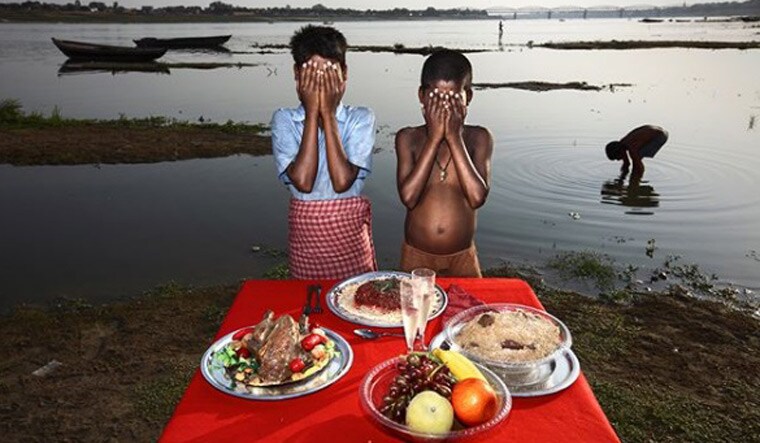
Children from poor regions of Uttar Pradesh and Madhya Pradesh. They stand with their hands covering their eyes, thinking of the foods they dreamed of eating. In front of them is a table laden with food—fruits, and even roasted chicken. Ironic the image is, and what thrusts the irony into your face is the fact that food on the table is fake. This insensitive 'creative freedom' of Italian photographer Alessio Mamo in Dreaming Food—a photo series on hunger in India—invited a flood of criticism earlier this week. The backlash prompted Mamo to put out a statement on Tuesday in which he justified his intentions and apologised to 'anyone who felt offended and hurt by the photos'. “I am a human being, I can make mistakes,” he wrote.
The photos were initially shared on the Instagram account of the World Press Photo Foundation. Captioning the series, Mamo had written: “These photographs are from Uttar Pradesh and Madhya Pradesh two of the poorest states of India. From the series "Dreaming Food", a conceptual project about hunger issue in India.” Things, however, did not pan out the way Mamo had probably anticipated. What followed was a massive backlash on social media with users including photojournalists questioning Mamo's ethics and bad taste. Calling the series 'poverty pornography', people lashed out at Mamo for exploiting poverty.

“What kind of warped mind it must be to put fake food in front of hungry people? And this was exhibited in @visapourlimage in 2012 and no one batted an eyelid....Poor black & brown bodies are a quick recipe for awards & recognition,” a user commented.
“When we take photos of the people, the core idea always remains to maintain and uphold the dignity of the people and the community we are photographing. These series of photographs exploits the sufferings of these people and are inappropriate on every ethical and moral scale,” another user commented.
Mamo, who had won a World Press Photo award for his portrait of a missile explosion victim in Iraq, was handling the foundation's account for a week. Following outrage against the foundation, he clarified that this was an independent project and was not commissioned by the foundation. In an official statement, the World Press Photo Foundation said that they do not limit photographer’s choices beyond the guidelines provided. “We keep our guidelines for Instagram takeovers under constant review to learn from the debates about pictures and projects the photographers share.”
In his statement, Mamo explains the idea was to get people in the West thinking about food wastage.
“The only goal of the concept was to let western people think, in a provocative way, about the waste of food. Maybe it did not work at all, maybe I did it in the wrong way, but I worked honestly and respectfully with all the people involved. I only had the intention to let people think about this issue.
I’m a human being and I can make mistakes. I want to offer my deepest apologies to anyone who felt offended and hurt by this photos, and to the people I photographed. It was not my intention at all to discredit them. I’m in love with India and with the people. I’m always open to be criticised in my work, but I have never in my life felt hate like the comments directed at me in recent days,” he wrote.
