



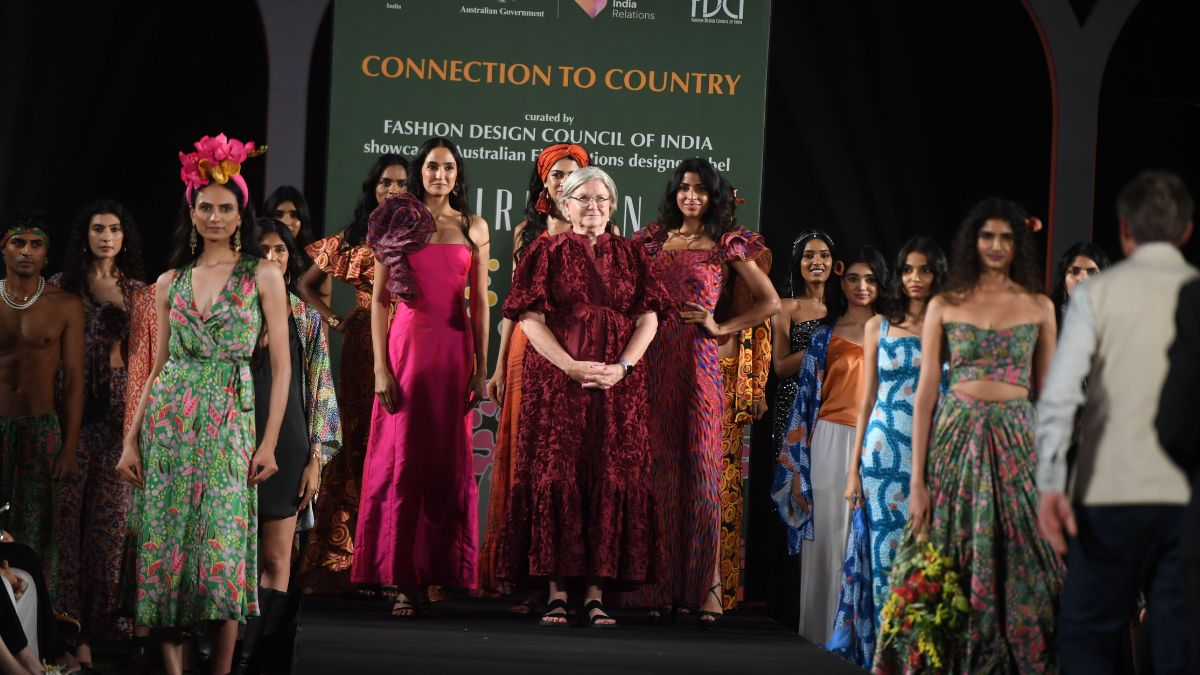
It was a full house at the Australian High Commission in New Delhi on Tuesday, where guests gathered for a special evening marking the India debut of Kirrikin – an Indigenous Australian luxury fashion label designed in Australia and crafted in India. A partnership between the Australian High Commission, the Centre for Australia-India Relations, and the Fashion Design Council of India (FDCI), the event celebrated the cross-cultural exchange, as it brought the story of the First Nations Australians (a term used to describe Australia’s Indigenous people) through fashion, to India.
The evening opened with a vibrant cultural performance of dance and music, setting the tone for a showcase that reflected the deep connection First Nations Australians share with the land, water, and nature – echoed in the collection’s palette of earthy greens, oceanic blues, and sunlit oranges. The brand, founded by social entrepreneur and Wonnarua woman Amanda Healy, transforms hand-painted First Nations artworks into striking luxury resortwear and accessories.
Notably, the term ‘Kirrikin’, which means ‘Sunday’s best clothes’, holds special meaning for the Wonnarua people. “The term traces back to the original language recorded by missionaries in Australia during the 1820s and has become a symbol of the label’s commitment to revitalising the language of the Wonnarua people,” the Australian High Commission noted in a release.
A shared history
Speaking on the India debut and the country as a fashion market, Healy told The WEEK, “Our commonality in love of colour, pattern and design makes us natural partners. We also notice the love of soft fabrics here. Most of all, we have a common heritage in terms of colonial impact. Our history mirrors yours.”
The brand manufactures almost everything in India. “We do occasionally do a small run in Australia, but generally everything is made here. Even if we make in Australia, we use fabrics from here,” says the founder-director. “I chose India as my major supplier because of the sheer fabulousness of your fabrics.”
The brand appears firm in building a strong international presence, having showcased its collections across several countries. “We receive tremendous support from Europe, perhaps because there’s a deeper recognition there of the lasting impact of colonisation,” she says.
And it’s only fitting, given the growing conversations around sustainability in fashion – an industry often criticised for its pollution and waste. Indigenous communities worldwide, however, have long showcased how to live in balance with nature. “We are still very unique on this planet and understand how to live in harmony with it,” Healy highlights.
