– Successfully replaces old degenerated TAVI valve of 65-year-old patient from Uzbekistan
· Patient had a TAVI procedure in 2017 but three months ago developed severe dyspnea as the valve had degenerated
· Cardiologist Dr Amit Chaurasia and team performed degenerative CoreValve replacement surgery, a TAVI in TAVI technique, a treatment of a degenerative TAVI
30th November, New Delhi: Cardiologists at Artemis Hospital Gurugram performed degenerative CoreValve replacement surgery. Cardiologist Dr Amit Chaurasia and his team of doctors successfully replaced a degenerated Transcatheter Aortic Valve implantation (TAVI) of a 65-year-old patient from Uzbekistan with a new TAVI (a Valve in valve technique), a highly complicated and delicate procedure.
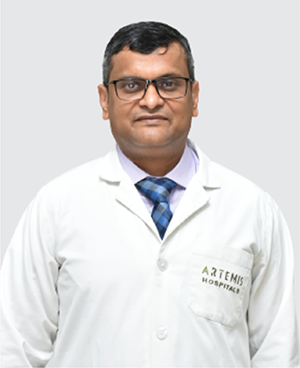
Dr. Amit Kumar Chaurasia is the Chief of Cath Lab & TAVI (Unit I) and he specializes in Cardiology, Interventional Cardiology, TAVI/TAVR and Structural Heart Diseases, Artemis Hospital, Gurugram.
Dr. Chaurasia, said the patient from Uzbekistan arrived at the hospital with severe dyspnea which caused her difficulty in breathing, occasional heaviness of chest. In 2017 the patient had undergone Transcatheter aortic valve implantation (TAVI) and had two stents inserted for two of her blocked arteries. As only one type of TAVI valve was available in 2017 in India, a Medtronic CoreValve of 29 mm size was used for the patient.
When the patient came to Artemis, Dr Chaurasia performed an Echo Cardiogram on the patient and its results showed that the TAVI valve put in 2017 had not only stenosed but was also leaking (regurgitation).
Acting promptly, the team of doctors decided to do Computed Tomography (CT) and angiogram. The results of these were heartening as they showed that the stents that had been put in the patient were fine and in good condition. An elaborate CT was done to thoroughly study and analyse the chances of coronary closure during repeating of TAVI procedure.
After this as per protocol a Transesophageal Echocardiogram (TEE) was planned. TEE uses echocardiography to assess how well the heart is working. She was not able to tolerate TEE and the cardiologists were forced to abandon this procedure (Due to dip in saturation).
Taking another approach, it was decided to do a Cath study before replacing the current CoreValve. The Cath study confirmed the Echocardiogram results that the TAVI implanted in 2017 had severely degenerated and there was leak or aortic regurgitation and the gradient of the valve was more than 35 MMhg.
Elaborating on this method, Dr. Chaurasia said: "This is the first case of TAVI in post-TAVI patient with degenerated COREVALVE in India. We had to face severe challenges. There were chances of coronary occlusion due to the previous valve and there were problems of replacing the valve; and the patient lung condition did not allow for any surgical intervention, hence replacement of Valve via TAVI was the only option. Thus, it was decided that we will change the valve by going through the leg. After careful study and analysis Dr Chaurasia and his team replaced the existing TAVI valve with a new one.
Highlighting that this is the first time such a surgery was done Dr Chaurasia said “This surgery gives hope to patients whose TAVI valve degenerates, it can be replaced providing much required and desired relief for the patient.” He added “Changing the valve was imperative otherwise there would have been patient fatality, the valve replacement helps in extending the patient life by about 10 years and even after that if there is any problem, the valve can be changed again.”
Dr Chaurasia said the valve degeneration had taken place because the patient suffered from rheumatoid arthritis and was taking steroids for this disease. This caused calcification of the valve leading to its degeneration.
Incidentally, the same day, the doctors of Artemis also performed TAVI procedure for another patient who had sever aortic stenosis and was a cardiac arrest survivor.
============
About Dr. Amit Kumar Chaurasia:
Dr. Amit Kumar Chaurasia is the Chief of Cath Lab & TAVI (Unit I) and he specializes in Cardiology, Interventional Cardiology, TAVI/TAVR and Structural Heart Diseases, Artemis Hospital, Gurugram. He graduated from Jawaharlal Institute of Postgraduate Medical Education and Research, Pondicherry; and did his MD in Internal Medicine from New Delhi’s All India Institute of Medical Sciences; and DM (Cardiology) from Sree Chitra Tirunal Institute for Medical Sciences and Technology, Thiruvananthapuram. Subsequently, he did his Fellowship in Complex coronary and Structural Heart Disease from György Gottsegen National Cardiovascular Institute, Budapest, Hungary, where he worked for about three years.
A dedicated interventional cardiologist with vast experience in adult, paediatric, and peripheral interventions, he is nationally and internationally recognized for his work in the field of Transcatheter Aortic Valve Implantation/Replacement (TAVI/TAVR). He has to his credit one of the highest numbers of TAVI/TAVR procedures in India (more than 1000) and has also performed Transcatheter Pulmonary Valve Replacement (TPVR) in the smallest conduit in India.
About Artemis Hospital:
Artemis Hospital, established in 2007, spread across 9 acres, is a 700 plus bed; state-of-the-art multi-speciality hospital located in Gurgaon, India. Artemis Hospital is the first JCI and NABH accredited Hospital in Gurgaon.
Designed as one of the most advanced hospitals in India, Artemis provides a depth of expertise in the spectrum of advanced medical & surgical interventions, comprehensive mix of inpatient and outpatient services. Artemis has put modern technology in the hands of renowned doctors from across the country and abroad to set new standards in healthcare. The medical practices and procedures followed in the hospital are research oriented and benchmarked against the best in the world. Top-notch services, in a warm, open patient centric environment, clubbed with affordability, has made us one of the most revered hospitals in the country.