



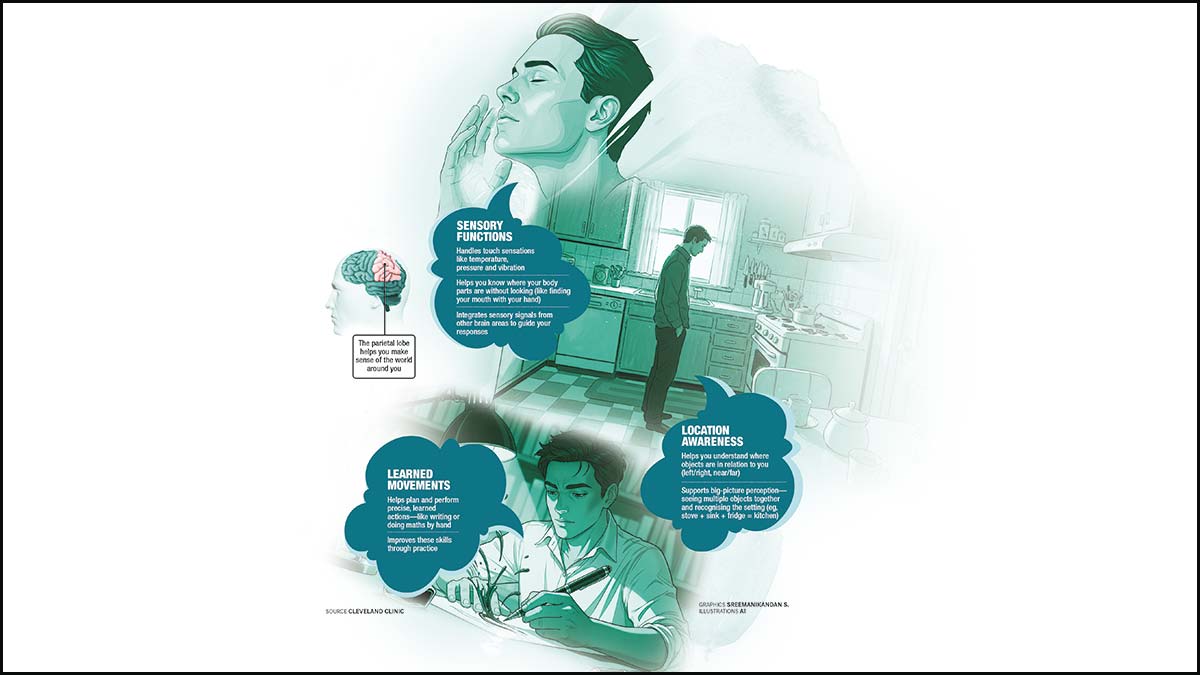
If the frontal lobe is where we decide what to do, the parietal lobe is where we understand where we are. It is the brain’s internal GPS, the quiet navigator that lets you put your hand exactly where your teacup is, find the edge of a staircase without staring at it, or scratch the correct side of your head when it itches. When it works well, we move through life gracefully. When it falters, life becomes slapstick comedy.
A few months ago, I saw a school teacher named Leena who walked into my clinic with a baffled expression and bandaged knee. Her husband followed behind her like a man who had witnessed something he could not unsee. “Doctor,” she announced, “I think something in my brain has gone on vacation.”
She had, quite literally, lost her sense of direction. She bumped into walls. She misjudged distances. She reached for her phone and grabbed the remote. At one point, she tried to place a glass of water on a table but set it gently on to thin air instead. It did not end well. Her husband added, “She walked into the fridge yesterday. Fully. Opened the door and walked straight in.” Leena glared at him. “It was white and rectangular and in the general direction of where I was going,” she retorted.
On examination, it was clear she had a deficit in spatial awareness. When I asked her to point to her left hand, she pointed to her right ear. When I asked her to place her finger on the tip of her nose, she almost poked her eye. She was cheerful about it and, in that way, uniquely Indian: she had already blamed her behaviour on stress, the weather, and her neighbour’s evil eye.
Her MRI revealed a small stroke in the right parietal lobe, the region responsible for constructing the map of our surroundings and the map of our own bodies. It is this area that tells you where your feet are in relation to the floor, where your torso ends and the sofa begins, and how far away your spouse’s elbow is during an argument.
In more severe injuries, the parietal lobe can produce something called Gerstmann syndrome, named after Josef Gerstmann—a Viennese neurologist who described it almost a century ago. Patients with this condition confuse right and left, struggle with calculations, mix up letters, and cannot recognise their own fingers. It is as if the brain suddenly forgets the body is attached to it. As one of my professors once said, the parietal lobe is the part of the brain that knows where all your furniture is, including the furniture you carry around.
Leena did not have the full syndrome, but she had a very entertaining partial version. During one test, I asked her to draw a simple clock. She placed all the numbers on one side, creating a timepiece that looked as if it had been emotionally traumatised by Salvador Dali. “This is abstract art,” she said proudly. “Do not judge.”
The parietal lobe is also deeply involved in proprioception, the silent sense that tells us where our limbs are without needing to look. When a surgeon operates on the brain, especially near this lobe, we navigate with extreme caution. A millimetre of insult can leave a person unable to find their own feet.
Fortunately, Leena’s stroke was small. With physiotherapy, occupational exercises, and a great deal of laughter, she began to regain her bearings. Six weeks later, she returned to the clinic. “Doctor,” she said triumphantly, “I have not walked into a single appliance this week.” Her husband nodded, relieved. “We are keeping count,” he whispered.
The parietal lobe reminds us that reality is not just what we see. It is what the brain constructs from millions of cues, distances, angles, and sensations. When the construction falters, life becomes tilted. When it recovers, everything snaps back into place. Before leaving, Leena told me, “I still mix up right and left sometimes.” I reassured her that so did half the people who drive in Mumbai.
The next time you effortlessly find your keys, locate your car, or sit successfully on a chair that is, in fact, actually placed behind you, pause for a moment and thank your parietal lobe. And if you walk straight into a fridge one day, do not panic. It may not be stupidity; it may just be geography.
The author is consultant neurosurgeon at Wockhardt Hospital, Mumbai.
mazdaturel@gmail.com @mazdaturel
