



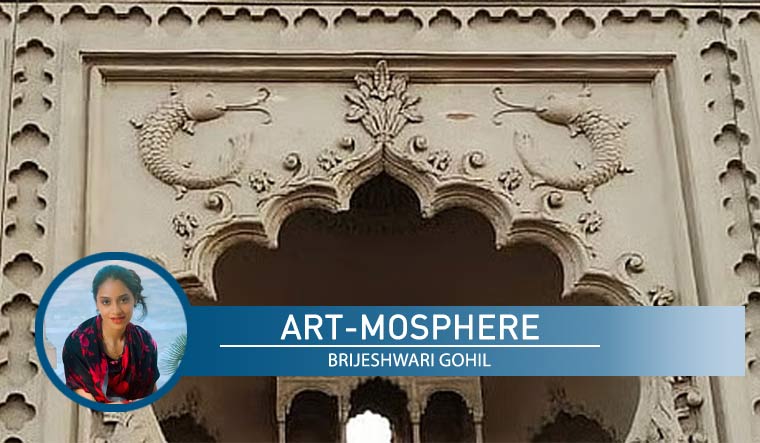
You arrive in Lucknow expecting kebabs, chikankari, and the languid grace of a city that perfected tehzeeb. What you don’t expect is to be watched by fish.
And yet, once you notice them, you can’t unsee them.
They crown gateways. They gleam from stucco medallions. They hover above arches at the Bara Imambara and the Rumi Darwaza. Twin fish, curved toward one another, suspended in stone as if still swimming. In a city built on etiquette and elegance, the fish is its quiet mascot, persistent, political, and surprisingly glamorous.
The emblem most associated with Lucknow is the Mahi Maratib, the “Fish of Dignity,” a Persian imperial insignia that signified royal favour and high rank. When the Nawabs of Awadh consolidated power in the eighteenth century, they adopted the fish into their courtly symbolism. It appeared on standards carried in procession, on coins, on architecture. Over time, it became inseparable from Awadh’s identity. Today, it even forms part of the official state emblem of Uttar Pradesh.
But here’s the twist: the fish in Lucknow isn’t just an imported Persian flourish. It swims in much deeper waters.
Long before the Nawabs, fish were already embedded in the Indian visual imagination. In Hindu mythology, Vishnu’s first avatar is Matsya, the fish who rescues humanity (and the Vedas) from a cosmic flood. Matsya is protector, guide, and saviour, navigating chaos with calm assurance. In temple sculpture and manuscript paintings, this half-fish, half-human form becomes a metaphor for divine intervention in turbulent times.
In Buddhist and Jain traditions, paired fish appear among the ashtamangala, the eight auspicious symbols. They represent abundance, fertility, and spiritual freedom, swimming freely, untouched by the net of worldly attachment. Sound familiar? Those twin fish above Lucknow’s gateways suddenly feel less like heraldry and more like inheritance.
And then there is geography. The Gangetic plains are river country. Fish are sustenance, livelihood, rhythm. In Mithila painting, fish signal prosperity and marital bliss. In Bengali alpana designs, they are painted at thresholds during weddings. They are everyday symbols, sacred, yes, but also domestic and celebratory. The fish belongs as much to courtyard walls as to palace façades.
What Lucknow did, and did exquisitely, was elevate this aquatic vocabulary into a statement of refined sovereignty. Under the Nawabs, the fish became chic. Stylised. Symmetrical. Almost logo-like in its clarity. It moved from river to regalia, from ecology to empire. And yet it never quite lost its earlier meanings.
That layering is quintessentially Indian. Symbols here rarely replace one another; they accumulate. The fish is a divine avatar, auspicious blessing, dynastic badge, all at once.
Fast-forward to modern Indian art, and the fish is still swimming.
Jamini Roy, in his rejection of colonial academic realism, turned to Bengali folk idioms and frequently painted fish in bold, flattened forms. His fish are rhythmic, decorative, unmistakably rooted in rural aesthetics, a quiet nationalist gesture rendered in tempera and line.
K.G. Subramanyan, ever playful and deeply invested in craft traditions, allowed fish to dart across his murals and glass paintings. For him, the motif was elastic, capable of irony, sensuality, and wit. It bridged “high” modernism and vernacular craft with effortless charm.
And then there is M.F. Husain. While horses gallop through popular memory, his canvases often ripple with aquatic forms. Fish intertwine with women, myths, and fractured landscapes. In Husain’s hands, the fish becomes elemental, sensual, restless, and slightly dangerous. It is not merely auspicious; it is alive.
Even contemporary artists have reclaimed the fish in ecological contexts. In installations addressing polluted rivers or vanishing aquatic life, the once-auspicious symbol becomes elegiac. The fish, long associated with abundance, now gestures toward fragility. It asks uncomfortable questions.
Which brings us back to Lucknow.
Standing beneath the vast vaulted halls of the Bara Imambara, the fish motifs feel almost theatrical suspended above you like stage props in a historical drama. But look closer and they are less ornamental than you first assumed. They are survivors. They have outlived dynasties, colonial administrators, and political transitions. They have slipped from royal insignia into civic identity without protest.
There is something deliciously modern about that adaptability. In an age obsessed with branding, the Nawabs may have understood visual identity better than most. Their emblem was memorable, symmetrical, and endlessly reproducible. It was photographed well before photography existed.
And yet its power lies not in design alone, but in depth. The fish in Lucknow carries the memory of floods and fertility, of Persian courts and Gangetic rivers, of temple walls and modern canvases. It is at once sacred and secular, local and cosmopolitan.
Perhaps that is why it feels so perfectly at home in Lucknow, a city that has always thrived on synthesis. Here, architecture borrows from Istanbul and Isfahan, cuisine from Central Asia and the Doab, language from Persian poetry and North Indian lyricism. The fish, too, is hybrid.
So next time you find yourself wandering through Lucknow’s monuments, look up. The fish are there, arched in stone, poised in perpetual motion.
They are not just decorative flourishes.
They are a reminder that in India, symbols don’t stand still. They swim, across centuries, across empires, across meanings, carrying history with them, luminous and alive.
