



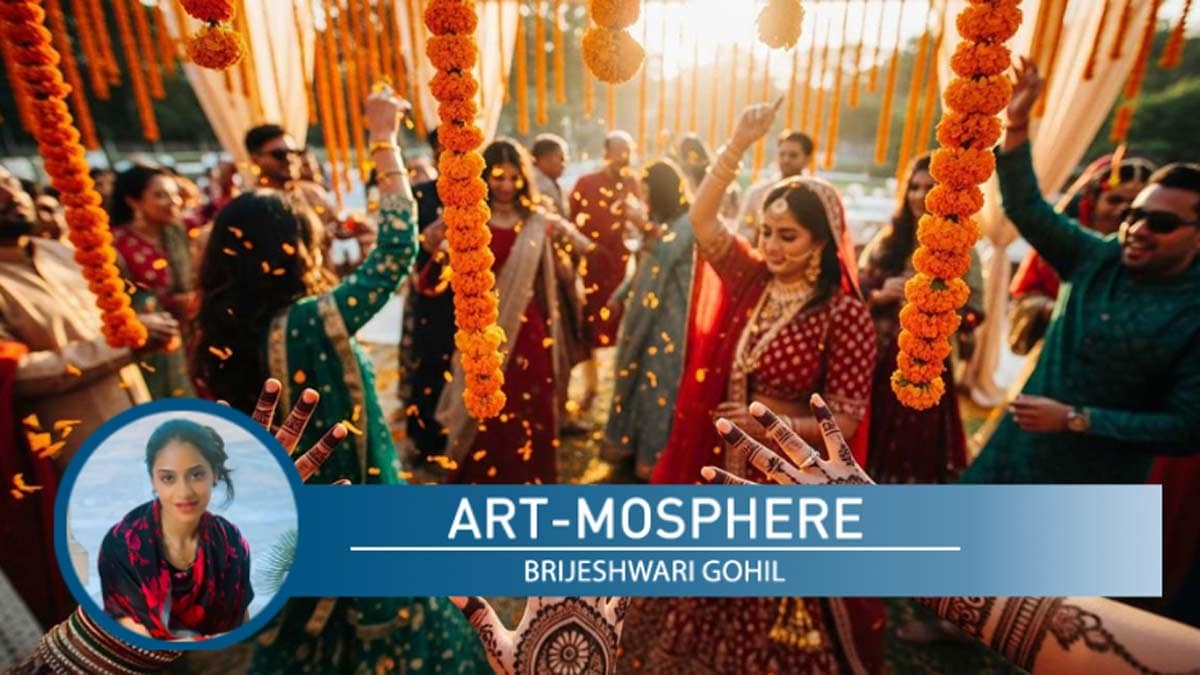
In India, the wedding season arrives like the monsoon—beautiful, excessive, and slightly terrifying.
The air changes in November (not referring to the Delhi AQI). The days grow cooler, the traffic grows worse, and the national economy perks up with the enthusiasm of a groom at the buffet. It is, once again, that five-month-long festival in which romance, ritual, and the Reserve Bank of India dance hand in hand. HR departments across the country resign themselves to approving leaves with the stoicism of saints.
Markets glint with brocade, marigolds multiply, and someone’s aunt, silent since 2017, re-emerges with urgent views on wedding arrangements and the bride’s weight. Across the nation, thousands of families prepare to re-enact what is essentially the same script: a multi-day operatic saga involving spreadsheets, sequins, and the occasional spiritual awakening. But before hashtags and helicopter entries, marriage was a matter of divine choreography.
In the carved panels of Khajuraho and the frescoed halls of Ajanta, gods and goddesses enacted the eternal wedding; Lord Shiv and Goddess Parvati, Lord Vishnu and Goddess Lakshmi, celestial unions that balanced heaven and earth. These images were not mere decoration; they were cosmic instruction manuals, reminding mortals that marriage was a sacred equilibrium, not a logistical nightmare involving a cornucopia of WhatsApp group chats.
Medieval miniature painters of Mewar, Kangra, and the Deccan carried that torch, recording royal weddings with exquisite precision. The baraat was a riot of elephants and parasols; the bride, a blush of vermilion and veils. These were not portraits but prayers, love rendered as geometry and grace. One imagines those artists, painstakingly grinding malachite and lamp black with mortar and pestle, would be astonished to see their spiritual successors today: wedding photographers armed with drones, gimbals, LED wands, and sponsorship deals. It’s still sacred work, just with Wi-Fi.
Then came the British, and with them, the great stiffening of posture.
The wedding portrait replaced the mural; myth gave way to sepia. Couples, once immortalised as divine archetypes, now posed beside Roman columns and velvet curtains, looking as if they’d just been told about the income tax system. Still, colonial photography taught an important Indian skill: how to stage oneself, how to look prosperous and how to hold one’s breath for 14 seconds.
If the Raj gave us restraint, Bollywood mercifully took it away.
From Mughal-e-Azam to Kabhi Khushi Kabhie Gham, cinema turned the wedding into a national art form. The sangeet, once a modest evening of folk songs, is now a full-scale musical choreographed to within an inch of its glittering life. Uncles twirl with misplaced confidence; cousins form dance troupes with military discipline; a distant relative performs a dramatic reading no one asked for; the best friend raises a toast everyone pretends to enjoy. Bollywood, bless it, gave the country permission to be fabulous again. The gods once descended to bless marriages; now, choreographers do. And unlike the gods, they bring props.
Today’s wedding is less a ceremony than a curated experience.
The mandap evokes a Mughal garden pavilion. The lehenga borrows from Basohli miniatures and weighs roughly as much as the British Raj. The décor references Shekhawati frescoes; the lighting can be seen from the International Space Station. Guests arrive in coordinated tones of ‘subtle gold’ (which is never actually subtle), and the bride’s entrance is timed to the precise emotional crescendo of a Bollywood tune. Somewhere, an event planner weeps quietly into a clipboard. It’s all very tasteful, like a Rajasthani miniature reimagined by Baz Luhrmann.
Still, one must admit: India does baroque better than anyone. Even chaos here is hand-embroidered.
The figures are impressive. The Indian wedding industry is now worth over ₹4.7 lakh crore, contributing generously to GDP, social mobility, and post-party regret. Every ceremony funds an army: florists, designers, caterers, makeup artists, décor engineers, drone pilots, pyrotechnics supervisors, and uncles with microphones. It’s a Keynesian dream; if demand ever falters, someone merely has to fall in love.
And every year, a new trend rises to prove that the subcontinent’s imagination is limitless.
At the recent Udaipur wedding, the one that lit up Instagram like a small galaxy, the festivities reached their apotheosis. Between floating florals, imported orchids, and a baraat that reportedly required traffic diversions large enough to be visible from Mars, guests were treated to the season’s newest essential: IV drips. Hydration lounges, once the domain of marathons and dubious wellness retreats, have now entered the wedding economy. Guests in couture silently reclined on daybeds, hooked to vitamin drips like glamorous hospital patients, recovering from the previous night’s revelry so they could survive the next. It was India at its most inventive: a civilisation capable of transforming medical equipment into a luxury amenity.
If all this was not enough, the entertainment lineup certainly will take your breath away. For the modern Indian wedding, music is no longer left to the enthusiastic DJ uncle with a pen drive labelled Shaadi Hits 2002. Instead, the stage resembles a small Coachella concert. Bollywood celebrities glide in for ‘surprise’ performances that are surprising only in their astronomical appearance fee. Punjabi pop stars arrive with entourages that rival state processions; Sufi troupes, indie darlings, and chart-toppers take turns ensuring no one, not even the most stoic attendee, can escape a mandatory shimmy. A single wedding can now host a musical roster with more star power than an awards night, proving once again that in India, romance is a full-fledged production part of the entertainment industry.
Critics may call it conspicuous consumption. The rest of us call it cultural continuity. After all, a civilisation that once carved passion into temple stone was hardly going to settle for a simple registry office.
Abroad, the diaspora continues the tradition with imperial flair, baraats halting traffic, sangeets performed like aerobics, and priests conducting havans via Zoom. Somewhere, one suspects, the gods themselves are scrolling, benevolently, one hopes, if not slightly amused. And yet, amid the lasers and the lehengas, there remains a moment of pure sincerity. When the noise fades and the couple circles the flame, the centuries collapse. For a brief, trembling instant, we are back in the frescoes of Ajanta, the colours of Kangra, the hush of belief.
The wedding, for all its absurdities, still remembers what it is: the art of making love visible. So, as India once again dons its sequined finery and vows eternal affection before 600 witnesses and a drone, perhaps it’s best not to scoff.
Yes, it’s overdone. Yes, it’s exhausting. But it is also magnificent, a performance art of emotion and economy. Where else can you find a single event that sustains cottage industries, revives ancient crafts, funds three generations of photographers, and keeps uncles in business as backup dancers?
Love may not always last forever. But the season, dear reader, always will.
