



The story of the chair in India is, in many ways, the story of India itself: a dialogue between posture and power, humility and hierarchy, local craft and foreign form. From royal courts to colonial clubs, and from temple floors to modern studios, the evolution of the Indian chair reveals how a culture that once sat close to the earth eventually learned to sit upon it and make it its own.
For centuries, India was a land of the floor-seated. The low stance on carpets, mats, or woven charpoys was not just comfort but culture. Posture conveyed meaning: to sit cross-legged was to embody humility, equality, and meditative composure. The asana itself was an act of philosophy. Elevated furniture, when it appeared, belonged to the divine or the royal: thrones (singhasans) carved of sandalwood or ivory, used in temples and darbars to lift the sacred and the sovereign above the mortal plane.
It was only with contact and conquest through trade, diplomacy, and ultimately colonization that the European concept of the chair began to find a foothold. What began as an imported object soon became an instrument of cultural translation.
By the 18th and 19th centuries, the British presence had transformed not just politics but also posture. The act of sitting in a chair—upright, supported, hierarchical—mirrored the new social order. But Indian artisans, never content to imitate, transformed these foreign forms into expressions of their own imagination.
From Bombay’s blackwood workshops to the ivory-inlaid studios of Vizagapatam, Indian craftsmen began producing furniture that looked European in silhouette but was Indian in soul. Ebony and rosewood replaced oak and mahogany; lotus buds curled where acanthus leaves once grew. The result was furniture that whispered of two worlds: the Raj’s propriety meeting India’s poetry.
Nowhere does this union of worlds and the poignancy behind it appear more vividly than in the tale of Maharaja Duleep Singh, the last ruler of the Sikh Empire. Crowned a child-king, dethroned by the Empire, and later adopted into Queen Victoria’s glittering circle, Duleep Singh lived a life both privileged and displaced.
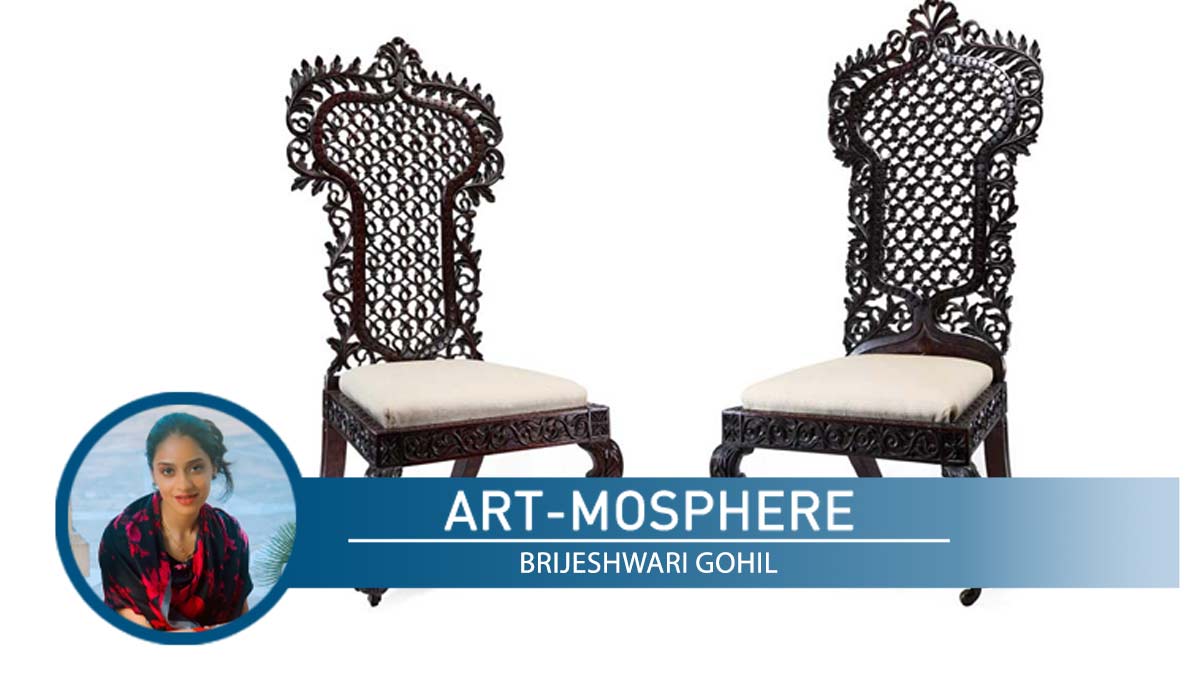
At his Suffolk estate, Elveden Hall, the exiled Maharaja attempted to recreate the India he had lost. He imported artisans, textiles, and furnishings that spoke of Lahore’s splendour and Bombay’s craftsmanship. Among them were two extraordinary Bombay blackwood chairs, part of the upcoming "Indian, Islamic, Himalayan and South-East Asian Art" auction taking place on November 26th at Olympia Auctions, London.
Both carved and pierced with exquisite precision, their tall, everted backs rising like royal diadems. The outer rails are a frieze of circular motifs crowned by stylized acanthus leaves, the front legs ending in elegant double scrolls—a dance of Rococo grace and Indian intricacy. Crafted in Bombay’s famed Meadow Street workshops, such pieces embodied the Bombay Blackwood style: furniture that followed Victorian fashion but pulsed with Indian vitality.
These very chairs once stood within the gilded rooms of Elveden, where Duleep Singh sought to blend the grandeur of Punjab with the gentility of England. To him, these were not merely seats; they were symbols. Each carving was a translation of self, each flourish a bridge between identities. When his fortunes faded and he left Elveden in 1886, the chairs remained quiet witnesses to a life suspended between empire and exile.
When the estate passed to the Earl of Iveagh in 1894, they became part of his collection and later featured in the Christie’s Elveden Hall sale of 1984. Now, resurfacing after more than forty years in private hands, they reappear as rare survivors of a vanished world, a tangible trace of India’s royal craftsmanship, filtered through Victorian eyes.
Their presence today offers more than historical curiosity; it carries a certain allure, an echo of romance. To acquire them is to inherit a story of a prince, a palace, and a paradox. Olympia Auctions' expert, Nicholas Shaw, comments: "It is a great privilege and responsibility to guide these chairs to a new home where their poignant history will be understood and celebrated. Though they have spent much of their life in Britain, it would seem fitting that the chairs might find a buyer in India and be restored to their original home, a feat that Maharajah Duleep Singh was unable to achieve for himself.”
These chairs are not merely carved wood but fragments of memory, proof that art endures even when empires fade. By the late 19th century, the Indian chair had become a vessel of adaptation. In urban households, the colonial easy chair—broad-armed, reclining, often made of cane and teak—became a fixture of verandas and salons. Yet even in their hybrid forms, they remained uniquely Indian: lighter, airier, woven for tropical air and human warmth.
Today, India’s designers return to the chair with renewed intention. From studio weavers in Ahmedabad reviving charpoy techniques to contemporary artisans in Jaipur merging brass with bamboo, the Indian chair continues to evolve, still negotiating between posture and power, tradition and reinvention.
In a sense, every chair in India still tells a story: of where we come from, how we sit, and what we choose to remember. Whether it is a throne of empire, a blackwood relic from Elveden, or a rattan seat on a Goan porch, each carries the same silent promise that form and feeling, craft and culture, are never truly separate.
