



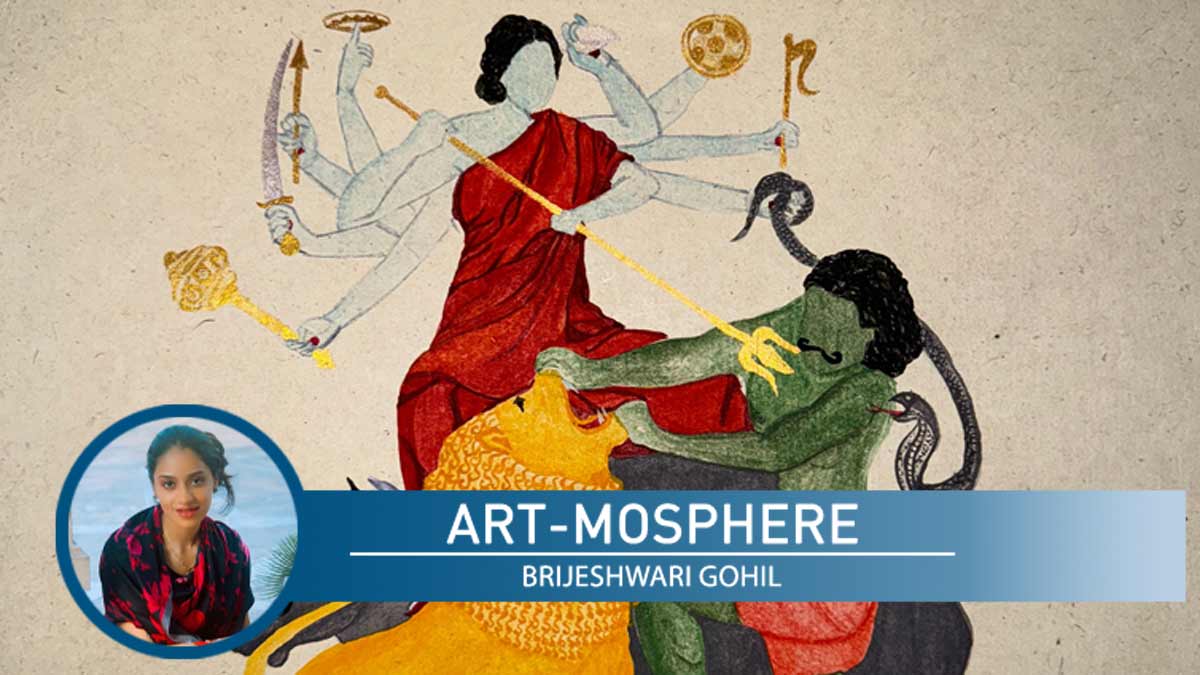
As monsoon bids adieu and the crisp air of autumn settles over the Indian subcontinent, the land bursts into a kaleidoscope of colour, rhythm, and devotion. Lamps are lit, drums are beaten, and a unique spiritual energy ripples across cities and villages alike. It’s Navratri, nine sacred nights dedicated to the Divine Feminine in her myriad forms. But Navratri is not just a festival, it is a multi-sensory experience where mythology meets movement, and where devotion becomes dance.
Rooted in Hindu mythology, Navratri celebrates the fierce battle between the goddess Durga and the shape-shifting demon Mahishasura. According to the legend, Durga fought him over nine nights and defeated him on the 10th day, Vijayadashami, also known as Dussehra. Her victory symbolises the triumph of good over evil, light over darkness, and spiritual awakening over ignorance.
Each night of Navratri is dedicated to a different incarnation of Durga, ranging from the tranquil Shailaputri, goddess of the mountains, to the fearsome Kalaratri, destroyer of evil. These varied forms reflect the many dimensions of feminine power, or Shakti: nurturing, protective, creative, and destructive.
Navratri is not only a time for worship, but also for reflection. Many devotees undertake fasting, engage in meditation, and participate in community rituals that mirror the transition of seasons, from the lush unpredictability of monsoon to the settled clarity of autumn.
At the heart of Navratri lies Garba, a circular folk dance originating in Gujarat. Traditionally performed around a lit clay lamp (Garbo) or an image of the goddess, Garba symbolises the eternal cycle of birth, death, and rebirth, with the flame representing the divine at the centre of all existence.
As dancers move in concentric circles, their steps begin slowly and build in intensity, mirroring the rise of spiritual energy over the nine nights. Women wear chaniya cholis in bright hues, adorned with mirror work and delicate embroidery, while men don kurtas with kediyu jackets. Together, they create a moving mandala of devotion.
The artistic resonance of Garba’s circular movement can be traced through Indian visual traditions. In temple architecture, the Natya Mandapas, dance halls attached to shrines, feature intricately carved apsaras (celestial dancers) in mid-spin, as seen in the temples of Chidambaram, Belur, and Madurai. These divine dancers echo the rhythm and symbolism of Garba in sculptural form.
Modern artists, too, have drawn inspiration from this folk heritage. In his prints and photographs, Jyoti Bhatt captures the intimacy and vibrancy of rural Garba traditions.
Complementing the circular grace of Garba is Dandiya Raas, often performed with decorated sticks in pairs. Each clack of the dandiya mimics the weapons used in battle, re-enacting the cosmic fight between Durga and Mahishasura. The choreography becomes a sacred duel, precise, rhythmic, and celebratory.
Like Garba, Dandiya Raas draws visual parallels with temple frescoes and murals. The Lepakshi temple in Andhra Pradesh features wall paintings that depict divine battles and dancers in motion, their limbs frozen in graceful yet dynamic stances that evoke the intensity of Dandiya.
Though rooted in Durga’s mythology, Navratri also brings to life Raas Leela, the ecstatic dance of Lord Krishna with the Gopis under the moonlit skies of Vrindavan. In these stories, Krishna multiplies himself so that each Gopi feels his complete presence. It’s a celebration of bhakti, devotion that transcends the material and touches the divine.
This theme has inspired some of the most iconic works of Indian art. In the 18th-century Pahari miniature paintings of Kangra, Krishna and the Gopis dance in luminous circles beneath silver moons and flowering trees. These intimate compositions capture the emotional and spiritual fervour of Raas, a love that is both sacred and transformative.
In temple architecture, Raas Leela is carved into the friezes of Khajuraho, Konark, and Modhera, where Krishna’s dance becomes a cosmic metaphor. Circular dance panels, often placed in sanctified spaces, reinforce the idea of divine rhythm governing the universe.
Today, Raas Leela continues to inspire Indian filmmakers, classical musicians, and choreographers, appearing in everything from Kathak performances, dance theatre to Sanjay Leela Bhansali’s Bollywood medleys.
Navratri also celebrates the Goddess not just as a warrior or mother, but as a cosmic dancer. In Indian iconography, she is often paired with Shiva, whose Tandava dance represents destruction, while hers, the Lasya, symbolises beauty, grace, and creation. Together, they embody the dual forces of the cosmos.
In the bronze sculptures of the Chola dynasty, the goddess is shown mid-step, adorned with flowing garments and expressive mudras (hand gestures). These figures are more than representations, they are embodiments of divine motion, captured in eternal rhythm. I have admired the work of artist Jayati Bose for some time now. While speaking with her on what Navratri means to her and her experiments of painting the Goddess, she eloquently states, ‘Navratri, for me, is less about ritual and more about remembering the many ways the feminine endures and transforms in our everyday lives. In my faceless goddess paintings, I try to step away from ornament and identity to reveal presence itself—power not as myth alone, but as something women carry, inhabit, and embody daily.’
What makes Navratri unique is its ability to remain deeply traditional while adapting to contemporary contexts. Today, Garba and Dandiya Raas are performed not only in village squares but also in city stadiums, college campuses, and even on international stages. The music blends folk with fusion, the attire blends ancestral textiles with modern aesthetics, and the dance becomes both a spiritual practice and a social celebration.
Social media has added another layer, turning Navratri into a digital spectacle. Viral dance challenges, fashion reels, and livestreamed aartis have brought the festival into the virtual realm, yet its essence remains unchanged.
In a world increasingly fragmented by noise and distraction, Navratri invites us to come back to centre. Whether through the fierce grace of Durga, the joyous Raas of Krishna, or the meditative rhythm of Garba, the festival offers a sacred space for connection, between the body and the soul, the community and the divine.
Art, in all its forms, dance, music, sculpture, and storytelling, becomes the language of devotion. And through this art, Navratri continues to remind us that divinity is not distant, but dancing all around us, waiting to be felt, seen, and celebrated.
