



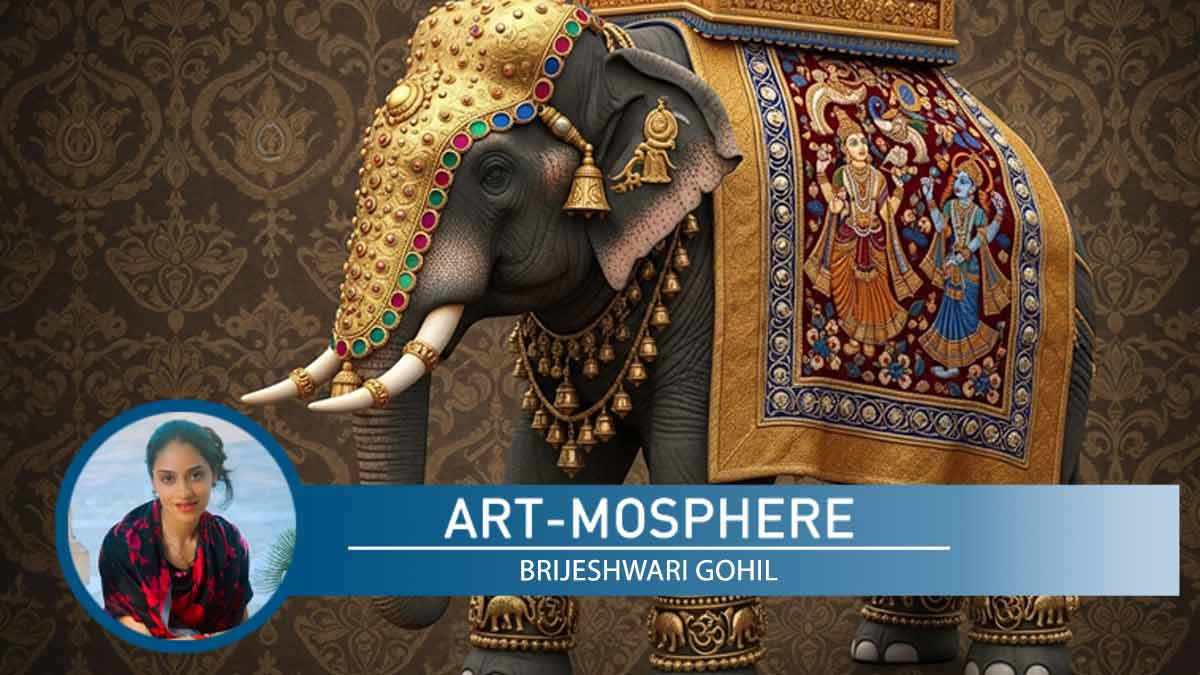
Elephant conservation in India is a complex and urgent issue, encompassing wildlife protection, legal frameworks, community involvement, and conflict resolution. Despite being deeply revered in Indian culture and religion, elephants face mounting threats from habitat loss, human-elephant conflict, poaching, and captivity-related exploitation.
A recent controversy has spotlighted this issue. The forced relocation of a 36-year-old elephant named Madhuri from a Jain temple in Maharashtra to the Vantara wildlife facility, owned by the Ambani family in Gujarat has sparked widespread debate online. While some argue that Madhuri was not receiving proper care at the temple, others accuse Vantara of unlawfully acquiring animals. The matter escalated as emotional local mass protests took over and spiralled, with the Supreme Court now ordering an official inquiry.
But beyond their ecological significance, elephants hold a deep, symbolic and spiritual value in Indian art and culture. They have served as enduring motifs for over 4,000 years, representing strength, wisdom, royalty, and spiritual devotion. Their artistic legacy spans ancient civilisations, religious iconography, royal courts, and folk traditions.
The earliest depictions of elephants in Indian art date back to the Indus Valley Civilization. Terracotta figurines and delicately engraved seals from Mohenjodaro and Harappa portray elephants among other animals, hinting at their revered status and symbolic importance.
During the Mauryan period, elephants became prominent symbols of imperial power. The Ashokan pillars, monuments of Buddhist dissemination, often featured elephant capitals or carvings, blending themes of royal authority with Buddhist virtues like patience and resilience. The white elephant, in particular, gained sacred status in Buddhism, symbolising the miraculous conception of the Buddha in Queen Maya’s dream, an image frequently depicted at sites like Sanchi and Bharhut.
By the Gupta era, considered a golden age of Indian art, the elephant’s role in sculpture and temple architecture was elevated even further. Elephants were portrayed with elegance and spiritual gravitas, often flanking deities, participating in divine processions, or embellishing temple gateways (toranas). Their presence signified divine power and cosmic balance. It was also during this era that Lord Ganesh, the elephant-headed deity, became a prominent figure, symbolising wisdom, prosperity, and the removal of obstacles. A motif that would flourish in later Hindu traditions.
In medieval Indian temples, especially in south India, elephants were sculpted at temple bases, symbolising foundational strength and spiritual stability. Temples like Khajuraho and Ellora feature elephants in battle scenes, ceremonial processions, and as protectors of sacred thresholds. Deccan and Tamil temple architecture introduced the Yali, a lion-elephant hybrid, blending mythic symbolism with artistic grandeur.
However, the Mughal era brought a shift in focus. Elephants became central figures in courtly art, featured prominently in miniature paintings of hunts, battles, processions, and royal ceremonies. Mughal artists captured elephants with anatomical precision and expressive detail, often naming them in inscriptions.
Rajput miniatures from Rajasthan also embraced the elephant as a symbol of royalty and divine power, portraying them adorned with rich textiles and jewels. From an ornate ‘pakhar’ on the forehead, to ‘bangris’ or bangles on the tusks, ‘jhumars’ on the ears and anklets on the legs. The elephant's tail too would be embellished with a jewellery piece called a ‘dumchi’. The City Palace Museum in Udaipur as well as Jodhpur have a display area devoted to ‘Howdahs’, the ceremonial seat upon which the ruler sat on the elephant. The ‘Jhool’ was an entire garment of velvet covered with gold and silver work upon which the howdah sat.
During the colonial period, elephants were depicted through both traditional and Western lenses. British and Indian artists often rendered them with a mix of documentation and exoticism, emphasising their role in Indian life and ceremonial spectacle.
In the 20th century, the elephant retained its cultural vitality through folk and tribal art forms such as Madhubani, Gond, Pattachitra, and Warli. These traditions use elephants as vibrant, stylised symbols of strength, fertility, and continuity, preserving their legacy in popular visual culture.
Today contemporary artists continue to reimagine the elephant’s role in Indian art. Bharti Kher’s, ‘The Skin Speaks a Language Not Its Own’ (2006), a life-sized elephant sculpture covered in thousands of bindis, powerfully explores themes of tradition, identity, and transformation. Similarly, Sudarshan Shetty’s ‘Path to Water’ (2013) features hand-carved reliefs of elephants in tranquil jungle scenes, accompanied by Sufi-inspired poetry that reflects on transition, ambiguity, and the spiritual journey.
The elephant remains one of the most versatile and powerful icons in Indian visual culture. Whether as a deity (Ganapati), a celestial mount (Airavat), a sacred dream (the Buddha’s conception), or a temple guardian, the elephant transcends mere artistic form. Its image continues to carry profound cultural, spiritual, and ecological significance, bridging ancient heritage with contemporary consciousness.
As the festival of Ganapati engulfs the country with celebrations, the subtle, spiritual philosophy of nurturing, loving, and eventually releasing… that this gentle pachyderm God teaches us ought not to be lost.
