



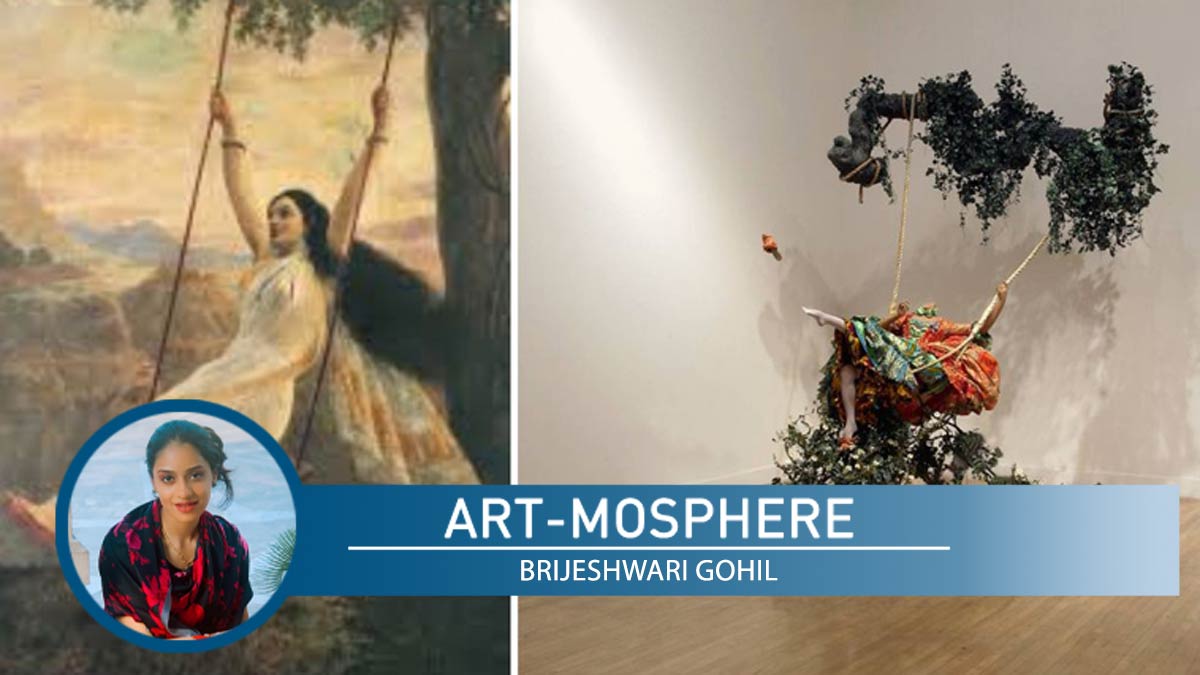
For most people a swing would perhaps be associated with children and play. The thought of a swing, immediately transporting one to a happy childhood memory of having fun in a park. A simple time now engulfed in nostalgia. However, in India, especially Gujarat, the swing holds relevance and importance as a quintessential household staple. Referred to as a ‘hichko’ or ‘jhula’, the craftsmanship, design and materiality differs regionally within Gujarat.
What started traditionally as just a simple plank of wood known as a ‘patlo’ was later embellished. Intricate metal work, ornate wooden carvings, a luxurious backrest were all additions to the original, good old plank of wood. Perhaps, the earliest depiction of the plank can be seen in miniature paintings. Radha and Krishna sharing a swing, gazing at each other in divine love and devotion or a lady on a swing embracing the monsoon. A popular subject in pahari miniature painting. The lady or nayika is standing atop the plank, the swing taking the support of a tree bearing fruit. Her hair let loose, she gazes afar, confidently swinging in delight. Could the swing be a metaphor for freedom and liberation? I do wonder and I would love to believe so.
Many years later, national treasure Raja Ravi Varma painted ‘Mohini on a Swing’. The painting depicts the female avatar of Lord Vishnu seated gracefully in a white saree with a glistening gold border. Radiating beauty and serenity, lost in deep thought as she swings. The work is a unique amalgamation of European techniques and Indian sensibilities. A style Ravi Varma continues to be celebrated and adored for.
Strangely, artists in the West too have explored various ways to feature the swing. For example, Jean-Honore Frangonard’s most popular work, ‘The Swing’. Painted in 1767, in the rococo style, well before Raja Ravi Varma, but similar in composition. Was Frangonard taking inspiration from the pahari miniature paintings or was Ravi Varma admiring Frangonard’s work?
While there is an element of sensuality and independence that exudes from the Indian artists, Fragonard’s work is hedonistic, imbued with erotic insinuations featuring one woman and two men. One man is seen controlling the swing behind the rosy cheeked woman sitting diligently on the swing. The other male figure is busy ogling at her legs. The atmosphere is one of mischief and fun in an enchanted forest. The artist beautifully plays with colour and light creating an alluring, rich colour palette.
In 2001, British Nigerian artist Yinka Shonibare, gave Fragonard’s work a fresh perspective. Well known for reinventing classic European paintings into three dimensional tableaux vivants with a twist, Shonibare in his work titled ‘The Swing (After Fragonard)’ uses life size fiberglass mannequins on a swing presenting them without heads. The work, which was purchased by Tate and gained prominence when it was nominated for the Turner Prize in 2004, is a playful reference to the beheading of the aristocracy during the French Revolution and the redistribution of power and land.
Artists continue to explore the swing in their art while designers are finding new ways to reinvent the swing. As family structures have changed, homes are modernised and space compromised, the swing too has evolved. While some homes feature a traditional, often painstakingly restored swing, others have a more contemporary, sleek, low maintenance modern approach. Either way it serves as a therapeutic, stress buster or a place to mull and think deeply.
The swing serves as a powerful reflection of life, representing both its ups and downs. A muse for the artist and a subtle reminder that change is the only constant.
