



WHEN IT COMES to modern warfare, there are specific requirements that a silicon-based chip may not be able to fulfill. In order to illustrate the requirements and the need for a specific class of chips, let’s take the functionalities of a drone on the modern battlefield. This drone will require four specific capabilities: persistence or the ability to hover and traverse the battlefield for a longer duration both spatially and temporally; precision for detection and identification; lethality for targeting; and connectivity for relaying data across networks, domains and formations.
Persistence requires high temperature tolerance (there are three sources of heat: chips themselves, workings of motor coil and propellers, and atmospheric friction). So, for longer duration and ranges, capacity to withstand heat has to be catered for. Silicon chips have a temperature tolerance of around 150 degrees Celsius, after which they enter ‘thermal runaway’—they become conductors, leading to short circuits.
Precision requires the ability to both detect and identify targets at longer ranges, which implies the need for higher frequency and hence a high electron velocity. However, higher frequencies have limited ranges. So greater power density is required to ensure that the signal reaches the intended target and is reflected back with adequate strength for the detection process to be completed.
For the lethality component, there are two ways of implementation: kinetic and non-kinetic. Addressing a target kinetically involves launching a projectile towards the target. Assuming that the drone is large and stable enough to launch a missile, the circuits within the missile can fry because of atmospheric friction, once a particular speed barrier has been crossed. This is more relevant for hypersonic missiles. For the non-kinetic solution, the drone’s emitter should be able to jam or work through rival jamming. In both scenarios, a higher power density is required, which is not possible with silicon-based chips.
Connectivity requires a real-time, sensor-to-shooter link with adequate bandwidth to include satellite and terrestrial data links, especially in millimetre wave spectrum—where most satellite communication and 5G/6G takes place. This again requires a different set of chips than silicon.
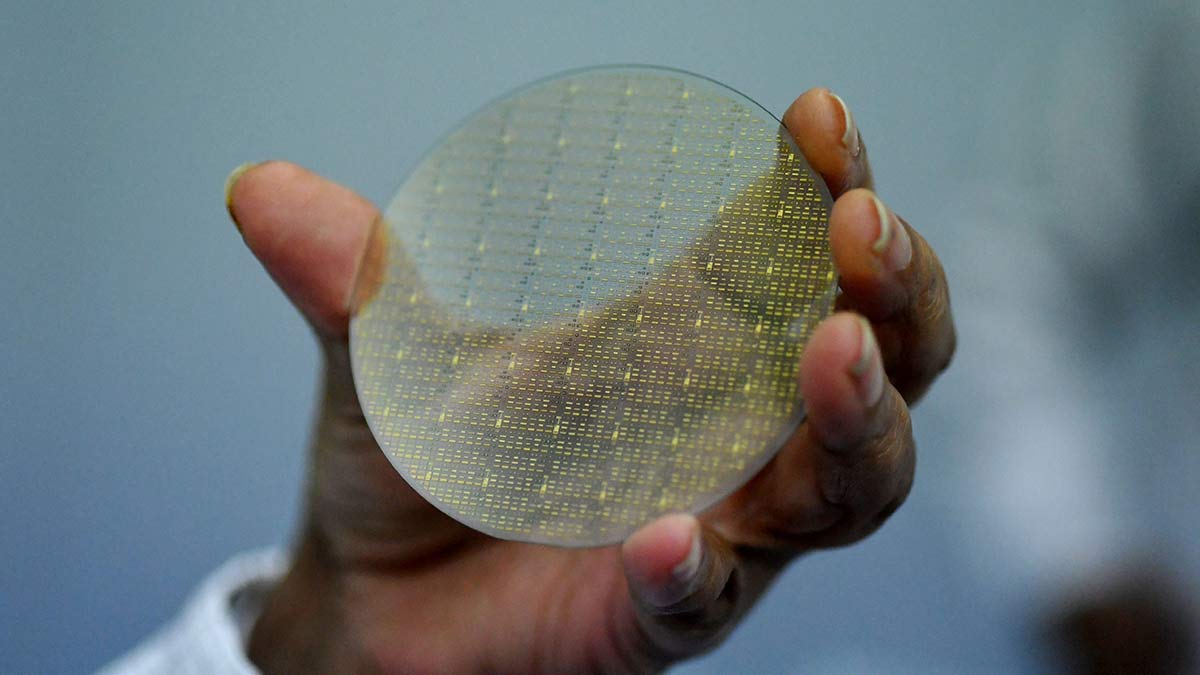
Compound semiconductors combine elements from different groups of the periodic table and specific qualities which are best suited for the rigours of modern warfare. Silicon carbide (SiC), gallium nitride (GaN), gallium arsenide and indium phosphide are examples of compound semiconductors. These chips can handle massive voltages and heat; have optimised SWaP (speed, weight and power) enabling miniaturisation and higher bandgap and greater electron velocity.
Going back to our drone, the use of compound chip-based components can enhance its performance on various parameters. Persistence can be enhanced using SiC-based switches in the drone’s engine controllers because of its high thermal conductivity, which means the drone will remain cool despite handling high voltages during its flight—adding significant hours to the mission.
In terms of precision, a GaN-based miniaturised active electronically scanned array (AESA) radar can detect smaller targets like drones from longer ranges and multiple targets at once because of the ability to switch beams almost instantly. This is made possible by the 30 per cent increase in the speed of electrons in the GaN chip.
A SiC-based chip in a missile fired by the drone can withstand up to 600 degrees Celsius—ensuring that the semiconductor retains its properties and pulls heat away from the chip’s core three times faster than silicon, meaning the missile retains its precision guidance at higher speeds.
For non-kinetic options, a GaN-based system provides a higher power density (five to 10 times more than silicon) enabling jamming. For counterjamming, these same chips can concentrate so much energy on a single frequency that they can work through the jamming.
Finally, connectivity requires real-time data links between platforms across domains—compound semiconductors are the most suited because of wide bandgaps.
Compound semiconductors are optimal for the Indian armed forces’ requirements in conducting multidomain operations—“coordinated, integrated, synchronised use of military and non-military capabilities across six domains, viz, land, sea, air, cyber, space and cognitive”. India’s incredible advancements in this field are strengthened by the fact that these chips require neither multibillion-dollar fabs nor high scale—enabling their fabrication even by startups. The supply chain for minerals and gases, however, will have to be made immune from geopolitical and natural shocks.
Lt Col Upadhyay is the author of a monograph—‘National Security Implications of Semiconductors’ (Manohar Parrikar Institute for Defence Studies and Analyses)—and the book Emerging Frontiers: Technology Absorption in the Indian Army.
