Interview/ Nara Lokesh, minister for information technology and human resources development, Andhra Pradesh
Q/ You campaigned for the National Democratic Alliance in Bihar. You also supported C.P. Radhakrishnan of the BJP as vice president candidate over the INDIA bloc’s nominee from Andhra Pradesh, former Supreme Court judge B. Sudershan Reddy.
Historically, the Telugu Desam Party has been a regional party but it has always had the nation’s interest at heart. Even when Chandrababu Naidu and [Atal Bihari] Vajpayee ji worked together, they always had the nation’s interest at heart. Policies were created for the nation where Andhra Pradesh had the first-mover advantage. We have been part of many national dispensations, and in every dispensation we have always contributed back to the nation. That is what makes the TDP different from other regional parties.
Q/ You have seen politics in your growing up years at home, and you were educated abroad. How are you stringing together your experiences today, and can you share some of your learnings?
I have had a very interesting childhood. I was born exactly a month after my grandfather N.T. Rama Rao became chief minister. I have seen the highs and lows of politics. The one thing I have learnt is that you should take your lows as you take your highs…. Only then can you become a practical politician. That has been my lesson. Being born in this family helps—it opens doors. But then, people decide whether you belong in that room or not. When I contested in 2019 from Mangalagiri constituency, which my party had not won in the last 40 years, I had the audacity to think I would win with ease. But I lost by 5,300 votes.
But it didn’t deter me. I worked hard and contested from the same constituency again, and won it with one of the highest majorities in Andhra’s history. My transition to politics happened exactly 13 years ago, but my padyatra [in 2023] is my MBA in politics. I believe that I have learned a lot more about my state, my motherland, because I walked. I understood the pain, suffering and challenges that people at the grassroots face.
Q/ You are bringing the first AI hub in India to Visakhapatnam. How do you see this bringing jobs and dividends? How did the idea come about?
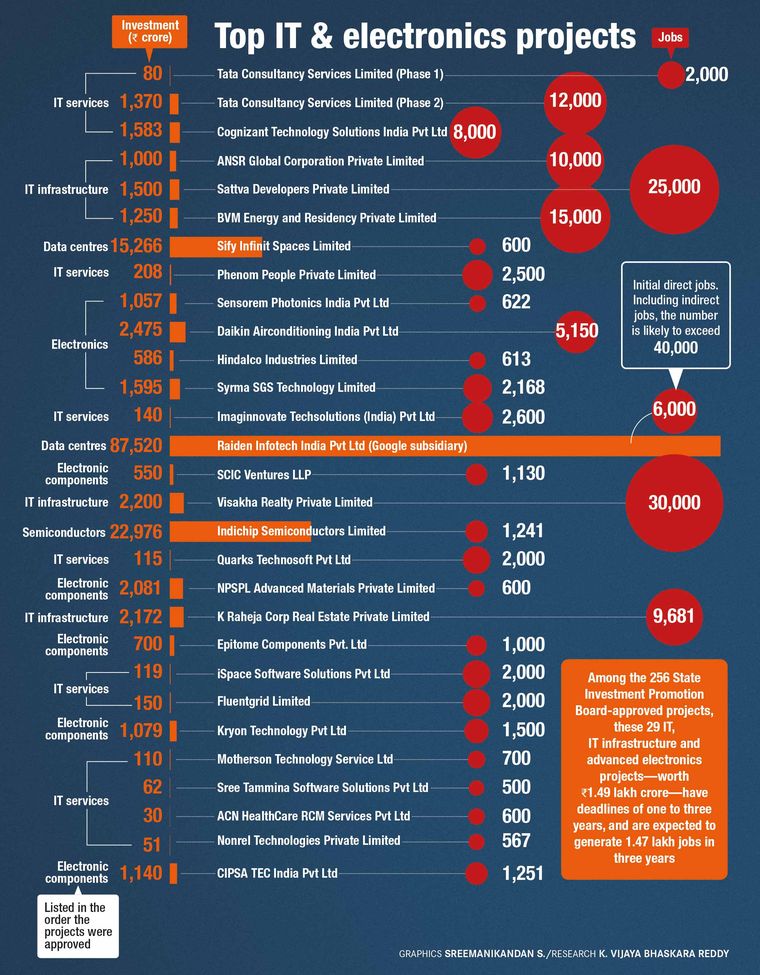
Our AI journey started way back in November-December 2018. We were the first state to actually have a policy around it. But then we lost power and the project was shelved for five years. But, as soon as the NDA government came to power, we immediately restarted our efforts, because we knew the power of data and AI. We believe Andhra Pradesh should play a strategically important role on the eastern coast as far as attracting investments in the data centre ecosystem is concerned. For me, what is exciting is to capture the entire value of that ecosystem: how do I create manufacturing jobs, train my citizens on using AI, and take AI to the grassroots? This includes agriculture, doubling household income, empowering women and even the skill census (aimed at understanding skills of individuals and skill sets needed by industries) that we are doing as a new project.
Q/ Another plan that created a lot of buzz was the 99-paisa lease model. Is it still on?
Absolutely. We call it the LIFT (Location for IT Framework and Technology) policy. It is aimed at attracting investments from Fortune 500 companies. We believe that Andhra Pradesh, [which has] graduates who can work anywhere in the world, should provide good opportunities here at home. That is the thought process with which we started.
Apart from the Speed of Doing Business, which is our USP, we are offering land at a substantive discount, which will create more economic value. We will attract investments, and through these investments, create substantively more economic value than selling land at government price. That is why I proposed in the cabinet that we should give land to TCS at 99 paise, which was accepted. It was suggested that I bring a policy. Cognizant was the first company to come in after that policy. We have noticed that IT jobs create amazing economic impact on the field. For every IT employee, there are close to four to five indirect jobs that get created and the ripple impact it has on the economy is massive. We have an aspiration to be a $2.4 trillion economy and IT will play a very important role.

Q/ While you focus on bringing big enterprises and global companies, are you also looking at the Indian startup industry?
We have two clear trajectories. One, we have the Ratan Tata Innovation Hub, which is our incubator and accelerator. This is not just about IT or IT-related startups; it is cross-sector, like food processing. We want to really incubate the ideas of our youngsters and focus on accelerating. That’s one vertical. The other vertical is MSMEs (micro, small and medium enterprises). In every constituency—we have 175 constituencies—we have an MSME park that is getting built by the state and land is given to the local entrepreneur.
Q/ You are also looking at boosting connectivity in the coastal region and laying undersea cables.
To have a cable-landing station is very important, especially on the eastern front. Chennai already has it, but we believe there is a need for a second one. We are working closely with the Union government. We are going to have double the capacity of what is coming to Mumbai right now. So we are going to get three cable-landing stations. We have already given right-of-way permissions, enabling us to attract investments in the AI-driven economy.
Q/ Talking about data centres, there are security and energy concerns. How do you plan to bring in green and sustainable solutions, and address waste management and climate concerns?
India is now investing in new infrastructure at a pace that the world has not seen. But like every developing economy, we have to keep investing more in our capital assets, and energy is one such asset. In Andhra Pradesh, we have solar, wind and pump storage projects; together, they can deliver round-the-clock green energy, which is very unique to the state. We want to create a green corridor where this power will be taken to different parts of the state; it is not only about green data centres, it is also about green steel, green automobiles, green electronics and green fertiliser. This is a competitive advantage for Andhra Pradesh that no other state can offer.
Next would be water. Thanks to the Polavaram project, we are securing water for the future, and the water that data centres use is minuscule compared with the amount of water that will come from Polavaram. As technology matures, AI data centres will also become more energy efficient.
Q/ The Centre is looking at a national data security policy. How closely are you working with the Central government, and are there any bottlenecks?
We have a double-engine, bullet-train government. Under the leadership of Prime Minister Narendra Modi and Chief Minister Chandrababu Naidu, we are working together to create products and solutions that we can give to the nation. As a state, we already have a data link—a core data authority that is responsible for housing and managing the data, ensuring that there is security and proper access. We are one of the first states to deliver a thousand citizen services on a single WhatsApp number.
Q/ How much time do you spend on WhatsApp coordinating these efforts? Has it percolated down to districts where real-time monitoring on ground is needed?
We have close to half a million active users at any given point of time, who are asking for different services. In my padyatra I had given my number quite liberally to karyakartas to give feedback to the party. I spend about three hours a day looking at all my messages and replying to them. I also have close to 30 WhatsApp groups with different companies, where things are at a very advanced stage and I monitor the projects on a weekly basis.
Q/ Your father, Chandrababu Naidu, is credited with the deregulation of the telecom sector and privatisation of airports. What is your dream, and what do you think you would be known for?
Chief job creator. At the end of the day, we are doing all this to create jobs. Speed of Doing Business is a tool to get investments, which will create jobs. A legacy that I would like to leave behind is that, during my time, several lakh core jobs were created.
Q/ A lot of land is needed for setting up data centres and AI hubs. Is there resistance to land acquisition?
We have adopted different models. It’s not always land acquisition as a model; land pooling is also an option. In Amaravati, the greenfield capital city, it is a land-pooling system involving 33,000 acres where farmers came together and gave the land to build a world-class capital city. They got a certain percentage of developed land back for themselves, which they can monetise at a certain point in time. Similar models have emerged. In Andhra Pradesh, we have not had major challenges as far as land acquisition is concerned.
Q/ The IT sector promises a lot of jobs, yet there seems to be some kind of a mismatch where youngsters are not really able to get into the industry. Is there a measurable target that you are looking at?
In the IT sector alone, I aspire to create half a million jobs by 2029. I am taking a two-pronged approach. First, I am working with the industry to revamp the entire curriculum, because I am also the education minister. Secondly, we are going to do a skill census. We are using conversational AI to help with resume building, preparing children on how to face interviews and rating how they are performing. We are going to use AI to improve their interview and technical skills.
Q/ There is concern about quality of studies in government schools.
When we came to power, only 3 per cent of the schools were ‘one class, one teacher’. Through a simple reform, we were able to take that number to 35-36 per cent. As public servants, twice a year, we go back to the schools and use parent-teacher meetings as a mechanism to do it. The chief minister himself attends, sits in a class, and takes feedback from students. We are just a tad below India’s average, which is not good for me—I want us to be number one. We are using AI to administer tests for students above sixth grade…. If India wants to be a developed nation, it’s very important to have moral education. For the first time in Andhra Pradesh, Saturday is a no-bag day and there is a class on moral education—moral responsibility, respecting women.… I am not saying I have a magic wand and can set everything right, but I believe that Andhra Pradesh can now set itself apart from the pack and deliver high-quality education in government schools.
Q/ You mentioned you were heavily influenced by your teachers. Can you recount any experience?
We were a very naughty bunch. I was particularly naughty and had to be disciplined more by my teachers who wanted to make an example out of me. That discipline helped me. During my board exams, I was weak in certain fundamentals, and I did bridge courses that really helped me leapfrog.
When I went to Carnegie Mellon University, I had a professor who was like my mentor. The year was 2000 and, in my generation, I was the first to go to the US. He helped me understand the credit system and the importance of homework. It really helped having mentors at different stages of my life, especially my teachers. It is that discipline, work ethic and culture that I carry as a minister today.
Q/ When we talk of Andhra Pradesh’s aerospace and defence policy, what steps have been taken towards actually becoming a defence hub?
We are looking at a vertical and horizontal integration. Verticals mean identifying the thousand companies that manufacture components that go into an engine. Horizontal is the curriculum, skill upgrade, testing and certification facilities you need, all in an ecosystem that we call a cluster. This clusterisation is very critical…. For example, 50 per cent of India’s air conditioners are manufactured in Andhra Pradesh. We are doing this clusterisation in aerospace and defence, glass, electronics, renewable energy and automotive space, and close to 22 clusters are getting created by this. This will set Andhra Pradesh apart from other states.
Q/ Against the backdrop of India-US trade tensions, do you see technology playing a part in bridging that gap?
I believe that crisis is an opportunity. India has always shone well when our backs were up against the wall. We should look at all our rules and regulations and bring about cutting-edge reforms that will enable manufacturing and enable GCCs (global capability centres) to come at a much bigger and faster rate.
Q/ How is the Polavaram project progressing?
It is on track. I think it will take us another two, or two and a half years.
Q/ What do you say to the opposition’s criticism of prices of agro-produce going down?
There is a challenge. But the government is proactively addressing it. We are giving free power and input subsidy, and we are giving support price in addition to backing government of India schemes. We are now focused on attracting more and more food processing companies. There will be highs and lows in commodity pricing. Only when we actually have crops that we can export to the world will we be successful. We have done well with cocoa, dairy, mango and dragon fruit, and Andhra is now number one in fruits in the country. We are identifying commodities. I believe and we will build on those. There will be shocks in the supply chain as it cannot be streamlined overnight, but the government is proactively working with the farmers and resolving those issues.
Q/ When the aquaculture industry faced a setback in the US, you moved to other markets like Australia. How has that experience been and how did you steer that market?
Crisis is an opportunity. We opened up doors. We have sent containers to Australia, Russia and even to Ukraine. We sort of diversified our market base. We looked at the cost structure of the farmers, and one of the initiatives is to reduce power tariff for the aqua farmer, because power is an important component. This approach has paid good dividends. That is why we are able to export our aqua produce to the rest of the world.
Q/ What has been your most trying moment and the lowest point so far?
When Naidu was arrested and was in jail for days—I think that was the worst part. He has always been clear that the family should not depend on politics for income and, in 1992, started this company called Heritage Foods. Our entire family income comes from that one company. He has always maintained that we should deliver a higher ethical framework in public life. Seeing him being arrested in a wrong case and sent to judicial remand for 53 days did really hurt us.
At one point, my wife also questioned whether we should continue in politics. We have always lived with so much pride and respect, and all of a sudden, for no fault of his, he is in jail. We all had tears in our eyes. It was the worst moment that we ever had, but people across the world—in 120-130 countries—came out in support of us. The entire Telugu community stands by Naidu, and they don’t believe in these allegations. That definitely helped me get through those tough days. And the mandate of the people in the last election, in 94 per cent of seats, made it clear that the people are with Naidu.
Q/ How do you see the Constitution (130th Amendment) Bill, which requires Central and state ministers to resign if they are jailed for more than 30 days for serious offences? Do you think it is prone to political misuse and needs revision?
Definitely, safeguards have to be in place. But at the same time, it’s very important that cases that have already been filed, [against] whoever it might be, need to be disposed by the courts within a year. There is a judgment by the Supreme Court that sets a deadline of one year for lower courts to complete the trial in cases involving MPs and MLAs. It is only when there is speedy delivery of justice in such cases that we will be living in a democracy where there is greater accountability.
Also Read
- How Nara Lokesh’s growth strategy is making Andhra Pradesh an investment hub
- Investing in Visakhapatnam? How tech is fuelling real estate gold rush
- From legacy to leadership: How Nara Lokesh is reshaping TDP's future
- Why Hinduja Group is betting on Nara Lokesh's ‘AP First’ vision
- Inside PAL system: The tech revolutionising Andhra Pradesh's govt schools
Q/ You are seen as a close apprentice of the prime minister, and you are the son of a visionary leader. How do you combine the strengths of both, and what would you say is common to the two?
I am the luckiest Indian because I have two great leaders to call upon as my mentors. Both of them have amazing life discipline. They work exceptionally hard, and they have India at heart. We have greater alignment, which is why I call it double-engine, bullet-train government, where both leaders are working together to create history at the state and national level.
Q/ You are the prominent face of the NDA in the south. How has been the NDA’s performance so far, and how can the alliance move forward?
I am a worker in the NDA ecosystem. It is our responsibility to work with the parties within the NDA and strengthen them. I look forward to working wherever NDA believes that I can be of help—even at the grassroots.
Q/ The chief minister of a neighbouring state opposes delimitation and mentions the need for larger families to ensure adequate parliamentary representation for the south. What would you say to that?
My view is that the current ratios should be maintained. It is important to protect the interests of all states and, at the end of the day, strong states make a strong nation. The nation grows only when the states grow.